1969 · NASA Jet Propulsion Laboratory, United States
The Mariner 7 spacecraft made its closest flyby of Mars, contributing significant data about the planet's surface and atmosphere and marking a pivotal moment in the exploration of Mars.
July 15, 1965
The Mariner 4 spacecraft, launched by NASA, successfully flew by Mars, sending back the first images of another planet taken from deep space.
Pasadena, United States | NASA
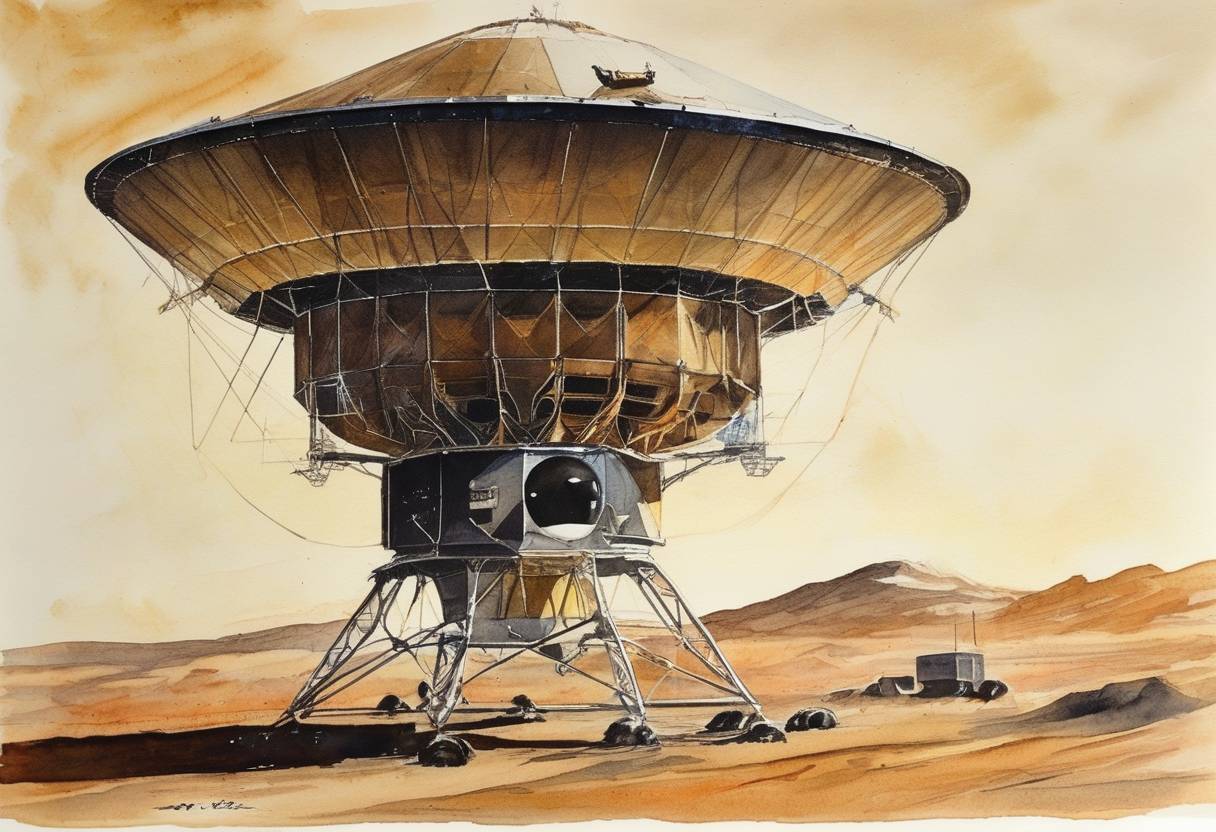
On July 15, 1965, NASA’s Mariner 4 spacecraft made history by successfully flying by Mars and transmitting the first-ever close-up images of another planet taken from space. This pivotal event in space exploration provided humanity with unprecedented insight into the Martian surface and marked a significant milestone in interplanetary exploration.
Mariner 4 was part of NASA’s Mariner program, which aimed to investigate Mars, Venus, and Mercury using unmanned spacecraft. Launched on November 28, 1964, Mariner 4’s mission objectives included capturing detailed images of Mars, studying its atmosphere, and analyzing the interplanetary space it traversed.
Approach and Encounter: On July 15, 1965, Mariner 4 approached within approximately 9,846 kilometers (6,118 miles) of Mars’ surface. During its closest approach, it captured 21 complete images over the span of 25 minutes.
Image Transmission: The images sent back to Earth provided the first detailed views of another planet, revealing surface features such as craters, which indicated a history of meteor impacts. This was a significant revelation as it challenged prior beliefs about Mars’ surface conditions.
Scientific Discoveries: Mariner 4’s instruments also measured the Martian atmosphere’s pressure and density, discovering it to be extremely thin and primarily composed of carbon dioxide. These findings helped redefine scientific understanding of the planet.
Mariner 4’s successful mission yielded a wealth of data that reshaped humanity’s perception of Mars. The spacecraft’s images and other data contributed to a growing body of scientific knowledge, sparking new interest in Mars exploration. This led to subsequent missions and studies that continue to the present day.
The success of Mariner 4 demonstrated the feasibility and importance of robotic exploration in the solar system, paving the way for future missions to Mars and beyond. These achievements highlighted the potential for scientific advancements achieved through space exploration, influencing both public interest and governmental investment in such endeavors.
Mariner 4 remained operational for some time after its flyby, continuing to provide important observations until its mission concluded in 1967. The legacy of its groundbreaking journey endures as a testament to human curiosity and the relentless pursuit of knowledge.
Source: nssdc.gsfc.nasa.gov