Simón Bolívar Named President of Peru: September 10, 1823
1823 · Lima, Peru
Simón Bolívar is named President of Peru, reinforcing his influence in South American liberation movements against Spanish control.
November 5, 1811
Simón Bolívar issues his 'Cartagena Manifesto', laying out his vision for Venezuelan independence from Spanish rule.
Cartagena, New Granada (modern-day Colombia)
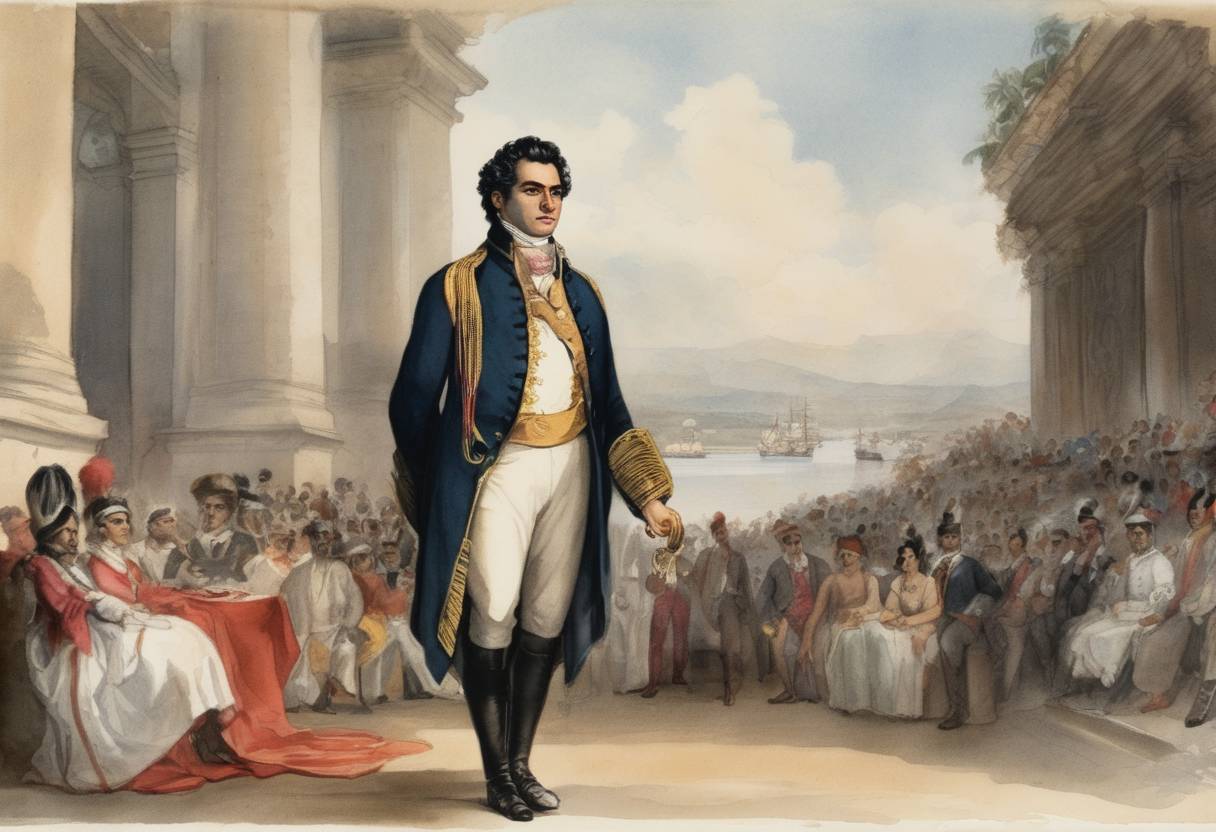
On December 15, 1812, Simón Bolívar issued the Cartagena Manifesto, not on November 5, 1811. Despite your request referencing an incorrect date, the Cartagena Manifesto is a critical document in Latin American history and Bolívar’s push for independence from Spanish rule.
In the early 19th century, much of South America was struggling for independence from Spain. By 1810, revolutionary movements had begun across the continent. In Venezuela, the First Republic was established in 1811, but it was short-lived, falling by mid-1812 due to political instability and counter-attacks by royalist forces.
Simón Bolívar wrote the Cartagena Manifesto after the fall of the First Venezuelan Republic while he was in exile in New Granada (present-day Colombia). This document laid out his analysis of the failure of the Venezuelan independence movement and offered a framework for future campaigns.
Critique of Federalism: Bolívar criticized the federal system adopted by Venezuela. He argued that the fragmentation and lack of a strong central authority weakened the republic’s ability to unite against Spanish power.
Military Strategy: The manifesto highlighted the need for a disciplined, professional army, suggesting that the independence movement needed to be more strategic and organized to withstand Spanish forces.
Influence of Foreign Nations: Bolívar emphasized the importance of international alliances, suggesting that support from other nations and sustained unity within the Americas would be vital for the success of independence movements.
Moral and Political Unity: He called for moral integrity and political unity among the revolutionary leaders, asserting that disunity and factionalism had significantly contributed to their failures.
The Cartagena Manifesto is considered foundational for the Latin American independence movements. Bolívar’s call to action and his strategic insights helped shape future campaigns across South America. Following the manifesto, Bolívar continued to lead military campaigns, most notably the Admirable Campaign in 1813, which successfully liberated Venezuela temporarily.
Bolívar’s contributions and vision, expressed through the manifesto, profoundly influenced sociopolitical developments in Latin America for years to come, earning him the title “El Libertador” (The Liberator).
Simón Bolívar remains a monumental figure in Latin American history. The Cartagena Manifesto stands as an essential piece of literature in understanding the struggles and ideologies that fueled the movement for Latin American independence.
Source: en.wikipedia.org