Execution of Atahualpa: The Last Inca Emperor
1533 · Cajamarca, Peru
Atahualpa, the last Inca Emperor, was executed by Spanish conquistadors under Francisco Pizarro's command, marking a significant event in the Spanish conquest of the Inca Empire.
November 12, 1532
Francisco Pizarro and his men arrived in the town of Cajamarca in the Inca Empire and prepared for their meeting with the Inca Emperor Atahualpa.
Cajamarca, Peru
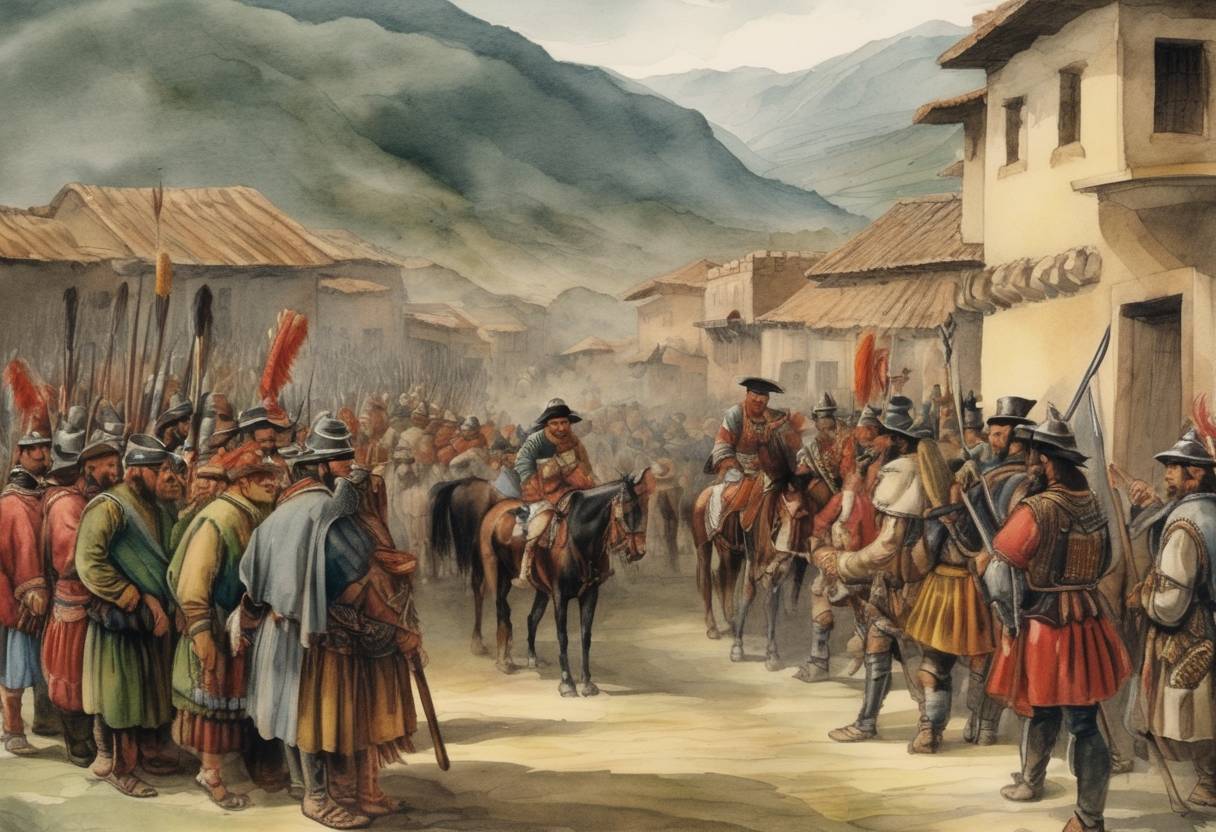
On November 12, 1532, Francisco Pizarro and his contingent of Spanish conquistadors reached the town of Cajamarca in the heart of the Inca Empire. This pivotal moment marked the commencement of the dramatic confrontation between Pizarro and the Inca Emperor Atahualpa, ultimately leading to the collapse of the vast and sophisticated empire.
Francisco Pizarro set out from Panama in an endeavor to explore and conquer the rich territories of South America, driven by the tales of wealth in the Inca Empire. After a challenging journey marked by difficult terrain and diseases, Pizarro and his men finally reached the Andes, where the Incan civilization was centered.
The Inca Empire at that time was the largest empire in pre-Columbian America, commanding a vast territory along the western region of South America. However, it was plagued by internal strife following a civil war between Atahualpa and his half-brother Huáscar, which weakened the empire significantly.
As Pizarro approached Cajamarca, he was aware of the potential for conflict with the mighty Incan forces. Despite being heavily outnumbered, Pizarro’s forces of around 160 men (consisting of foot soldiers, horsemen, and artillery) were equipped with advanced weaponry, including guns and steel swords, which gave them a strategic advantage.
Cajamarca was a strategic site for the Spanish as it lay within the Incan heartland. The city’s lofty altitude and surrounding mountains offered a commanding position. Approximately 80,000 Incan soldiers accompanied Atahualpa as he camped in the region, presenting a formidable presence.
Arriving in Cajamarca, Pizarro and his men set up quarters in the main square of the town. Pizarro planned a cunning and audacious strategy. His aim was to capture Atahualpa, neutralizing the Inca’s organizational structure and gaining leverage over their formidable army. Aware that direct confrontation with the large Incan forces could spell disaster, Pizarro devised a plot to entice Atahualpa into meeting within the controlled environment of the plaza.
The events following Pizarro’s arrival in Cajamarca precipitated the eventual fall of the Inca Empire. By capturing Atahualpa shortly after their meeting, Pizarro gained not only an incalculable amount of ransom wealth but also the decisive upper hand in negotiating power over the empire. This moment marks a turning point, where European colonial expansion began reshaping the New World.
The encounter at Cajamarca exemplifies the impact of military strategy and the devastating effects of European conquest on indigenous civilizations, leading to widespread social, cultural, and political transformations across the continent.
Source: en.wikipedia.org