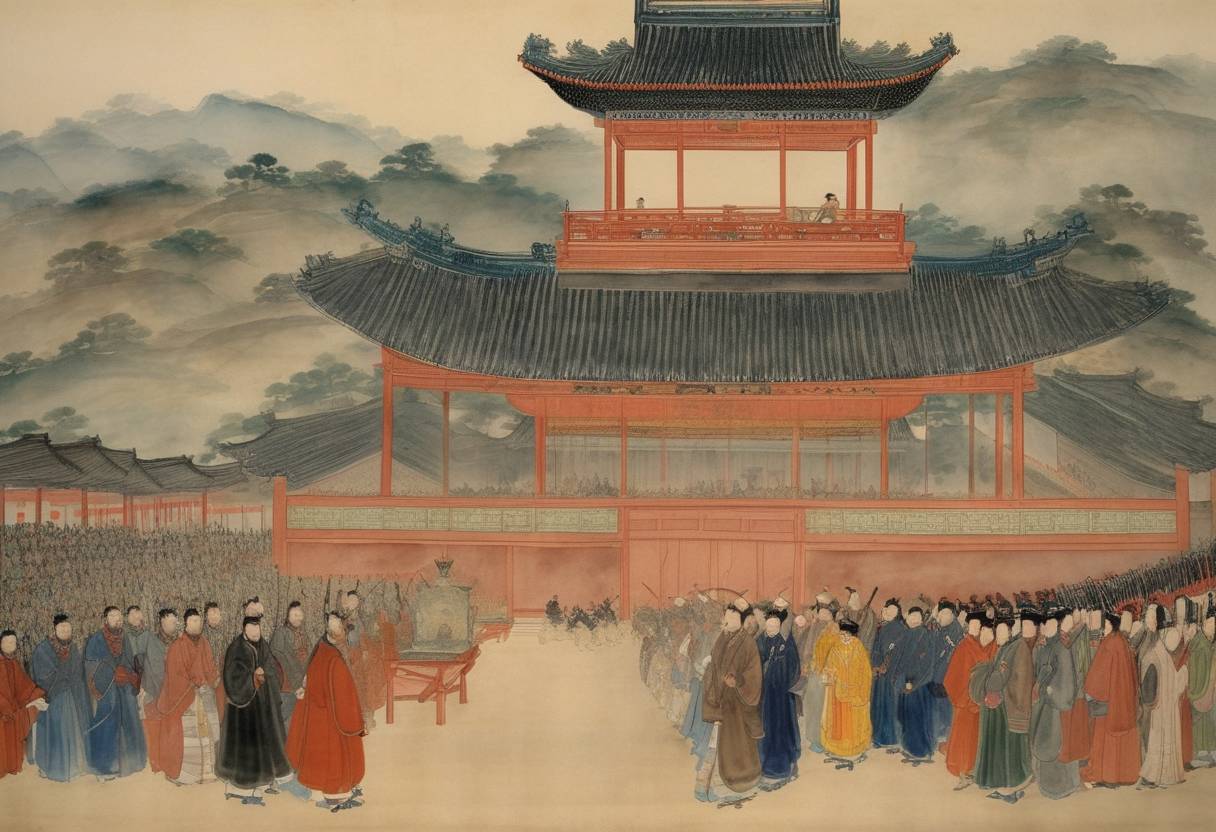
Emperor Jiajing Ascends to the Throne
On November 13, 1521, rather than 1523, Zhu Houcong became the 11th emperor of the Ming dynasty, known as the Jiajing Emperor. His ascension followed the death of his cousin, the Zhengde Emperor, who left no heir.
Context
- The Ming Dynasty: By 1521, the Ming dynasty was a well-established dynasty in Chinese history, characterized by its initial period of prosperity and expansion, but also beginning to show signs of administrative challenges and corruption.
- Predecessor: The Zhengde Emperor, who ruled from 1505 until his death in 1521, was known for his neglect of state affairs, indulging in personal pleasures and lavish constructions, leading to internal instability and a strained treasury.
- Dynastic Succession Concerns: The sudden death of Zhengde without an heir prompted a search for the next ruler, instigating political maneuvering within the imperial court.
Ascension to the Throne
- Jiajing Emperor: Born as Zhu Houcong, he was the son of Zhu Youyuan, the Prince of Xing, and was initially far removed from the line of succession. His elevation came about through the influence of prominent court officials who sought a ruler who could stabilize the empire following Zhengde’s self-indulgent reign.
- Political Strife: His rise was not without controversy. The shift in succession challenged the traditions concerning imperial lineage, causing significant court debates and factional conflicts.
- Transition of Power: The transition marked a turning point whereby Zhu Houcong was enthroned at the age of 14, taking the era name Jiajing, which means “Admirable Tranquility.”
Impact and Significance
- Reign: Jiajing’s reign (1521-1567) became one of the longest in the Ming dynasty, bringing about both efforts at reform and periods of stagnation.
- Religious Devotion and Isolation: Emphasizing Confucian and Daoist thoughts, he sometimes prioritized religious pursuits over governance, leading to periods of neglect and uprising.
- Centralization and Conflict: While his rule initially aimed at centralizing authority and reforming governance, it often resulted in alienating loyal officials, contributing to social unrest and weakening the state’s bureaucratic efficiency.
Legacy
- Long-term Consequences: The Jiajing Emperor’s reign had mixed outcomes, characterized by initial reforms but overshadowed by subsequent internal decay and uprisings, which contributed to further difficulties for the Ming dynasty in its later years.
- Cultural and Political Influence: Despite controversies, his era witnessed developments in arts and architecture, as well as an increased engagement with international trade, impacting China’s cultural and economic landscape.
The Jiajing Emperor’s ascension represented a critical juncture in Ming history, highlighting both the challenges of dynastic rule and the complex interplay of governance, succession, and cultural aspirations.