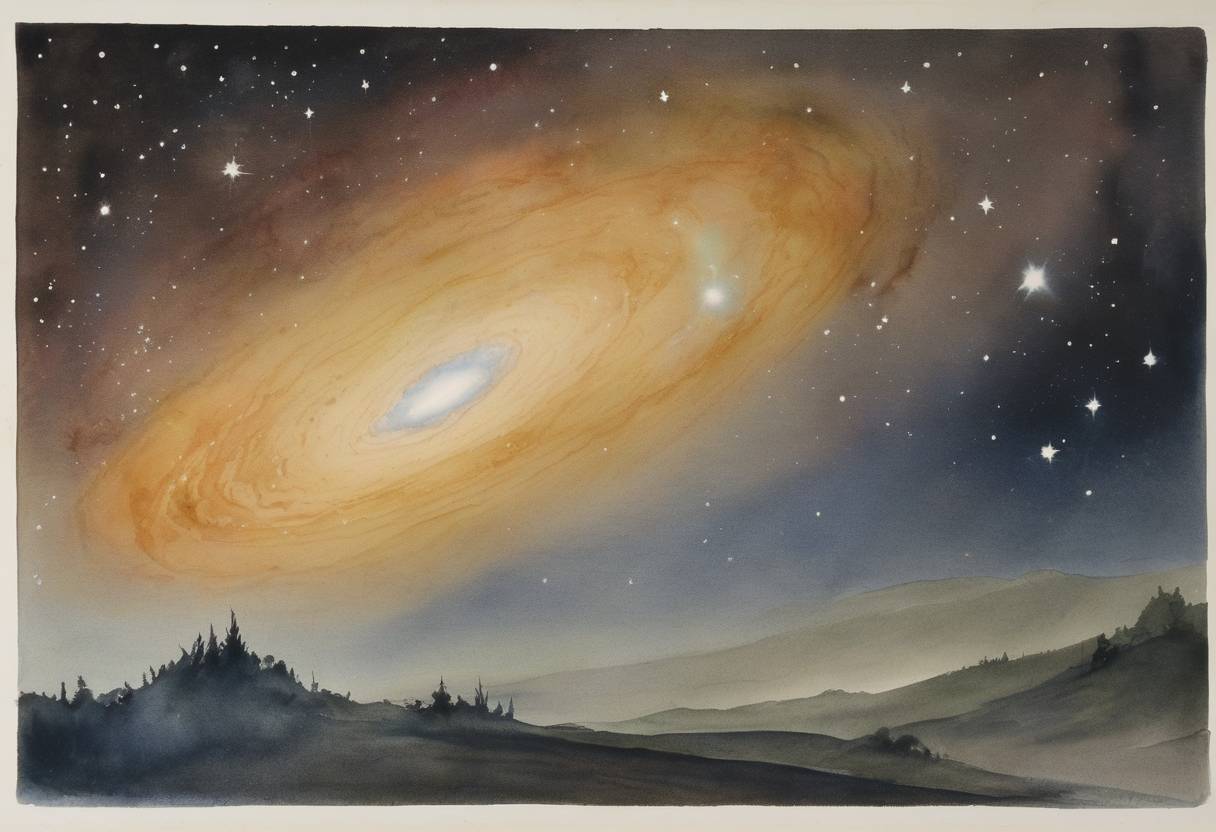
Edwin Hubble Confirms the Andromeda Nebula as a Separate Galaxy
On November 23, 1924, American astronomer Edwin Hubble presented groundbreaking evidence that would fundamentally change humanity’s understanding of the universe. At a meeting of the American Astronomical Society, Hubble shared his discovery that the Andromeda Nebula (now known as the Andromeda Galaxy) was not just a part of our Milky Way, but a separate galaxy altogether.
Background
Before Hubble’s landmark discovery, the prevailing scientific consensus was that the Milky Way constituted the entire universe. Objects like the Andromeda Nebula were thought to be clouds of gas within our galaxy.
Discovery
Hubble’s research was made possible through observations using the 100-inch Hooker Telescope at the Mount Wilson Observatory in California, at that time the world’s largest telescope. Utilizing the powerful optics of this telescope, Hubble was able to resolve individual stars within the Andromeda Nebula. Among these stars, he identified Cepheid variables—stars whose brightness varied at regular intervals.
Hubble noted the significance of these Cepheid variables because they served as reliable markers for measuring astronomical distances, based on Henrietta Swan Leavitt’s earlier work demonstrating a relationship between a Cepheid variable’s pulsation period and its intrinsic brightness. By calculating the distance to these Cepheid variables in the Andromeda Nebula, Hubble determined that it lay far beyond the boundaries of the Milky Way.
Impact
The finding that the Andromeda Nebula was, in fact, an entirely separate galaxy had profound implications. It expanded the size of the known universe overnight and introduced the notion that our Milky Way was just one of countless galaxies in a vast cosmos. This discovery served as a catalyst for further astronomical exploration and fostered a deeper scientific inquiry into the nature and structure of the universe.
Aftermath
Hubble’s revelation was part of a series of discoveries leading to the broader acceptance of an expanding universe theory, further elaborated by Hubble’s own law observed a few years later, which quantified the rate at which galaxies move away from each other. This laid critical groundwork for the development of the Big Bang theory.
Edwin Hubble’s publication of evidence on November 23, 1924, marks a pivotal point in astronomical history, one that reshaped how humanity perceives its place in the cosmos.