Nicholas II Becomes the Last Tsar of Russia
1894 · St. Petersburg, Russia
Nicholas II becomes the last Tsar of Russia after the death of his father, Alexander III.
January 9, 1905
Bloody Sunday took place when unarmed demonstrators were fired upon by soldiers of the Imperial Guard as they marched towards the Winter Palace in St. Petersburg to present a petition to Tsar Nicholas II.
St. Petersburg, Russia | Imperial Guard
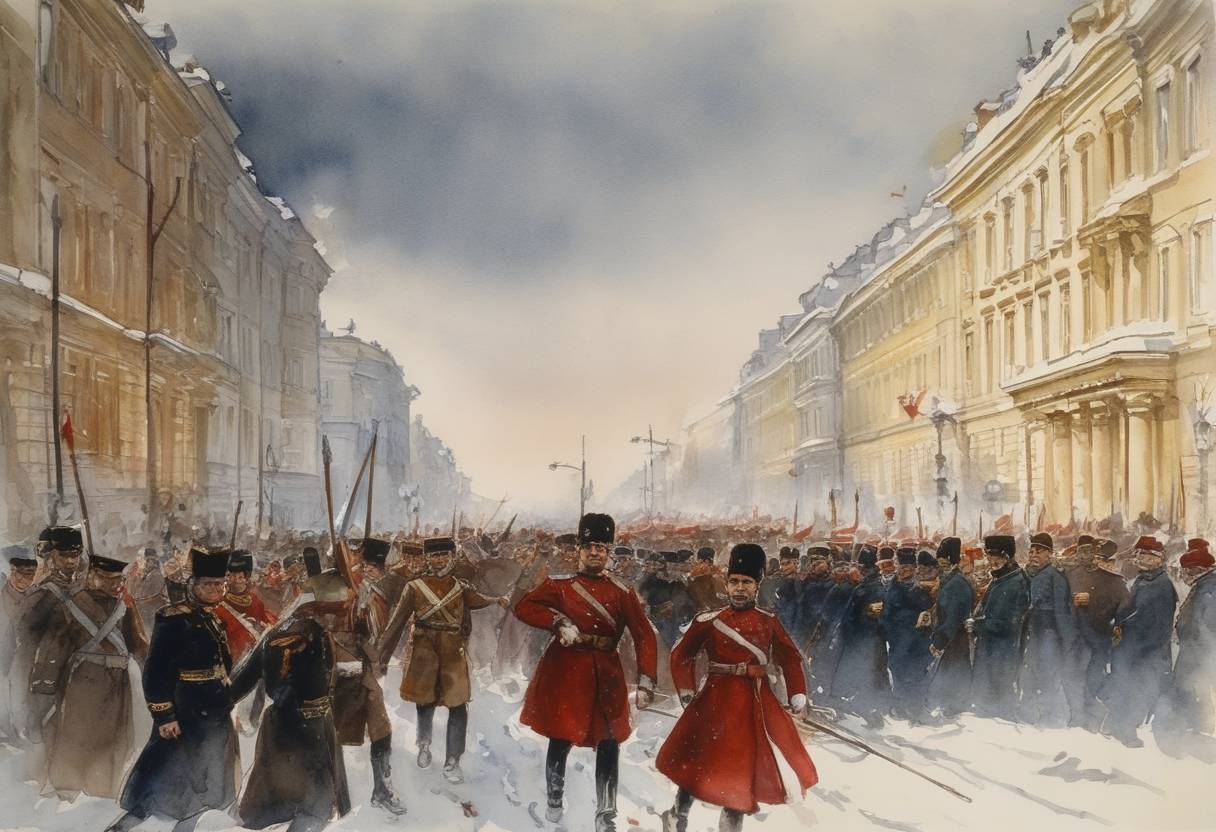
On January 9, 1905, an event known as “Bloody Sunday” occurred in St. Petersburg, Russia, marking a crucial turning point in Russian history. This day witnessed the killing of unarmed demonstrators by soldiers of the Imperial Guard as they marched to present a petition to Tsar Nicholas II. This violence would catalyze broader unrest in the Russian Empire and ignite the revolutionary fervor that characterized the early 20th century.
The early 1900s in Russia were a period of significant social unrest and economic hardship. The peasants and working class faced grave conditions, with poor wages, unbearable working hours, and inadequate living standards. Industrial workers, particularly in urban centers like St. Petersburg, were becoming increasingly dissatisfied with their plight.
In this environment of discontent, Father Georgy Gapon, an Orthodox priest, emerged as a prominent figure leading the workers. He heading the Assembly of Russian Factory and Mill Workers, which had ties with the government to provide a legal outlet for worker grievances, yet failed to address their chronic issues.
On January 9, under Father Gapon’s leadership, a large procession of workers set out to present a respectful petition to Tsar Nicholas II. The petition called for improved working conditions, fairer wages, reduction of working hours, and a call for political reforms, including an end to the Russo-Japanese War, civil liberties, and universal suffrage.
Thousands of demonstrators—men, women, and children—marched peacefully, carrying religious icons and portraits of the Tsar, exhibiting their loyalty despite their grievances.
As the demonstration advanced towards the Winter Palace, the mood was one of hope rather than rebellion. However, Tsar Nicholas II was not present at the Winter Palace, and the authorities, fearing unrest, decided to respond with military force.
The march met a devastating hindrance when soldiers of the Imperial Guard opened fire, reportedly without warning, on the procession. The exact number of casualties remains a subject of dispute, but estimates suggest that hundreds were killed or wounded.
Bloody Sunday fueled widespread outrage across the Russian Empire and undermined the image of the Tsar as a benevolent ruler, leading to a rapid decline in Nicholas II’s popularity. The massacre sparked waves of strikes, protests, and demonstrations, known collectively as the 1905 Revolution.
Although the immediate goals of the petition were not realized, the events of Bloody Sunday forced Tsar Nicholas II to implement reforms. This included the issuance of the October Manifesto, which promised the creation of a constitution and the establishment of the Duma, a legislative body, albeit with limited powers.
Bloody Sunday is remembered as a pivotal moment that exposed the vulnerabilities of the Tsarist regime and set the stage for the revolutionary movements that would ultimately culminate in the Russian Revolution of 1917.
Source: en.wikipedia.org