The Battle of Guadalcanal: A Strategic Victory for the Allies
1943 · Guadalcanal, Solomon Islands
The Battle of Guadalcanal ended with a strategic victory for the Allies, marking a turning point in the Pacific War during World War II.
January 24, 1942
The Battle of Makassar Strait occurs during World War II, involving a naval engagement between the Allies and Japan.
Makassar Strait, Indonesia | Allied Forces
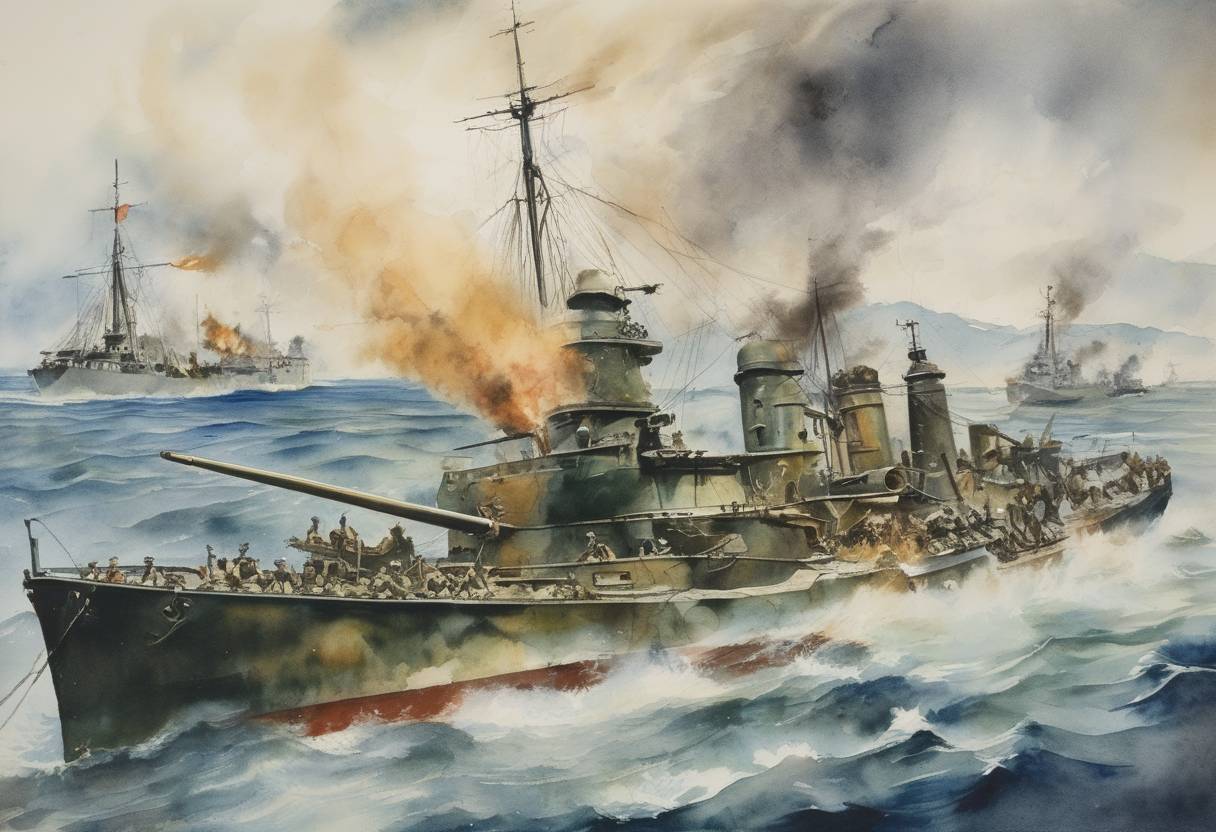
The Battle of Makassar Strait, also known as the Action of Makassar Strait, was a significant naval engagement during World War II. It occurred on January 24, 1942, in the waters off the coast of the Indonesian island of Sulawesi, then part of the Dutch East Indies. This battle was part of the larger campaign for control of the Dutch East Indies, a region critical due to its rich resources and strategic position.
The battle took place in the early stages of the Pacific War, with the Japanese forces advancing rapidly through Southeast Asia after their attack on Pearl Harbor in December 1941. The Japanese sought to seize the resource-rich territories, particularly for oil and rubber, vital for sustaining their war efforts.
The Allies, consisting primarily of forces from the United States, the United Kingdom, Australia, and the Netherlands, formed the American-British-Dutch-Australian Command (ABDA) to defend the region. The naval engagement at Makassar Strait was part of the ABDA’s efforts to slow down the Japanese advance through the archipelago.
On January 24, 1942, a force of Allied warships attempted to intercept a Japanese convoy escorted by a considerable number of warships, including destroyers and cruisers, transporting troops and supplies intended for the invasion of the Dutch East Indies.
The Allied task force, led by Rear Admiral William A. Glassford, consisted of several cruisers and destroyers. The Japanese convoy, protected by a fleet under Rear Admiral Raizō Tanaka, was advancing rapidly towards strategic locations within the Dutch East Indies.
The engagement primarily involved surface ships, with exchanges of gunfire and attempts to avoid torpedoes. The Japanese used their air superiority to attack the Allied forces with aircraft based on nearby islands, preventing effective counterattacks and causing significant operational difficulties for the Allies.
The Battle of Makassar Strait ended with the Allies being forced to withdraw due to overwhelming Japanese air attacks, which inflicted damage on several Allied ships. Notably, the heavy cruiser USS Marblehead and the light cruiser USS Boise were severely damaged, affecting their operational capabilities.
In the broader context of the Pacific War, the Japanese continued their advance, eventually overrunning the Dutch East Indies. This engagement demonstrated the challenges faced by the Allies in deploying naval and air forces effectively against superior Japanese forces in the region.
The battle underscored the importance of air power in naval engagements and highlighted the difficulties the Allies faced in coordinating multinational forces against a well-organized and resourceful adversary. Despite their setbacks, the experiences gained from engagements such as the Battle of Makassar Strait contributed to subsequent Allied strategic adjustments in the Pacific Theater.
The battle remains a poignant example of the early struggles of the Allies in the Pacific War, preceding more coordinated efforts that would eventually lead to turning points, such as the Battle of Midway later in 1942.
Source: en.wikipedia.org