George Westinghouse Patents Air Brake - March 5, 1872
1872 · Washington, D.C., United States
George Westinghouse patents an air brake for railroad trains, revolutionizing railway safety and efficiency.
June 1, 1869
Thomas Edison received his first patent for the electric vote recorder, marking the beginning of his prolific career as an inventor.
Washington, D.C., United States | United States Patent Office
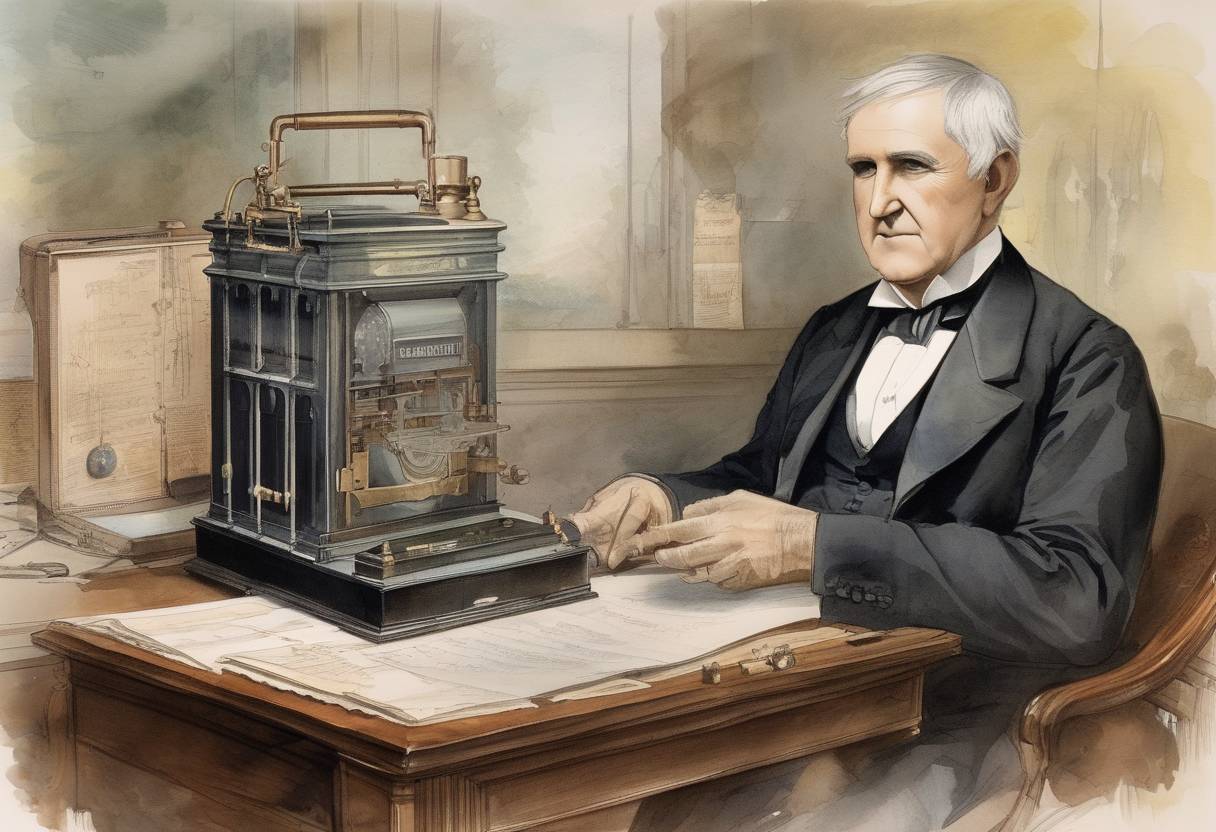
On June 1, 1869, Thomas Edison received his first patent for an invention that marked the beginning of his illustrious career as one of history’s most prolific inventors. This patent was for an electric vote recorder, a device designed to improve the efficiency and accuracy of the voting process in legislative bodies.
In the late 1860s, the process of voting in legislative assemblies was often slow and prone to errors, as it relied on manual counting and recording. Edison, who was just 22 years old at the time, sought to address these inefficiencies with his electric vote recorder. The device allowed legislators to cast their votes electronically, which would then be automatically tallied, thus speeding up the process and reducing the potential for human error.
Edison’s electric vote recorder was a relatively simple device by today’s standards. It consisted of a system of switches and a central recording mechanism. Each legislator had a switch at their desk, which they could use to cast a “yes” or “no” vote. These votes were then transmitted to a central device that recorded the results on a dial, providing an immediate and accurate count of the votes.
Despite the ingenuity of the electric vote recorder, it was not a commercial success. The legislative bodies of the time were resistant to change, and there was little demand for such a device. Lawmakers were accustomed to the traditional methods of voting and were wary of adopting new technology that might disrupt established procedures.
While the electric vote recorder did not achieve commercial success, it was significant for several reasons:
First Patent: It was Edison’s first patent, marking the official start of his career as an inventor. This experience taught him valuable lessons about the importance of market demand and the practical application of inventions.
Innovation Mindset: The invention demonstrated Edison’s innovative mindset and his ability to identify and attempt to solve real-world problems through technology.
Foundation for Future Success: Although the vote recorder itself did not succeed, it laid the groundwork for Edison’s future endeavors. He went on to secure over 1,000 patents in his lifetime, including those for the phonograph, the incandescent light bulb, and the motion picture camera.
In conclusion, while the electric vote recorder was not a commercial triumph, it was a pivotal moment in Edison’s career, showcasing his potential and setting the stage for his future contributions to technology and society.
Source: en.wikipedia.org