The June Days Uprising: June 23, 1848
1848 · Paris, France
The June Days Uprising began in Paris, where workers protested against the closure of National Workshops. This event was part of the broader struggles of the 1848 Revolutions in Europe.
April 28, 1969
Charles de Gaulle resigned as President of France following the defeat of a referendum on regional reform and Senate reform.
Paris, France | French government
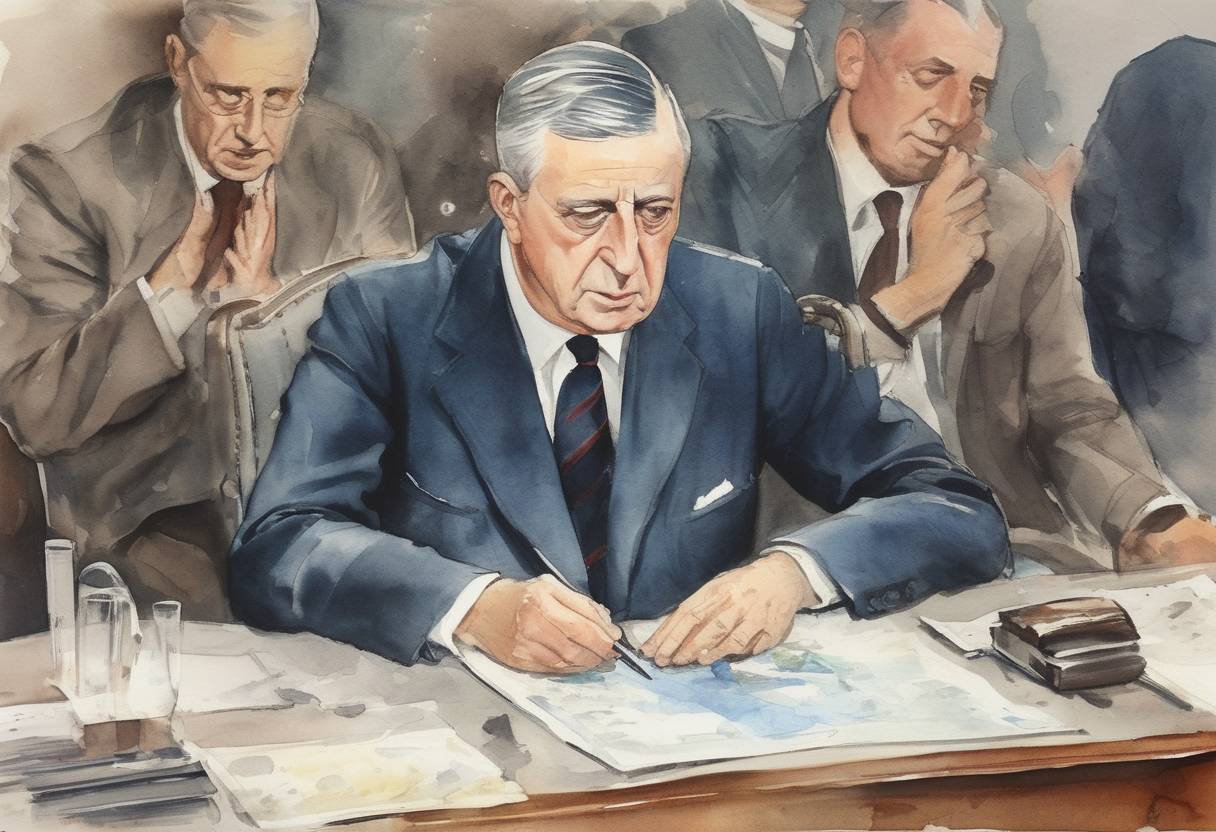
On April 28, 1969, Charles de Gaulle, the towering figure of French politics and a symbol of French resistance during World War II, resigned from his position as President of France. This decision came in the wake of a significant political defeat—a failed referendum on regional and Senate reform.
Charles de Gaulle had been a dominant force in French politics since the end of World War II. He founded the Fifth Republic in 1958, a new political system designed to bring stability to France after years of political turmoil. As President, de Gaulle wielded considerable power and sought to implement reforms that would further consolidate his vision of a strong, centralized state.
The referendum held on April 27, 1969, proposed two major reforms:
Regional Reform: This aimed to decentralize administrative powers, granting more autonomy to regional governments. De Gaulle believed this would modernize France’s administrative structure and improve efficiency.
Senate Reform: The proposal sought to transform the Senate into a consultative body, reducing its legislative power and altering its composition to include representatives from professional and regional bodies.
De Gaulle tied his political future to the success of this referendum, declaring that he would resign if the proposals were rejected.
The French public voted against the referendum, with approximately 52.4% opposing the reforms. This defeat was a significant blow to de Gaulle, who had always maintained that his leadership was contingent upon the support of the French people.
True to his word, de Gaulle resigned the day after the referendum, on April 28, 1969. His resignation marked the end of an era in French politics. De Gaulle retreated from public life and spent his remaining years at his home in Colombey-les-Deux-Églises, where he passed away in November 1970.
The immediate consequence of de Gaulle’s resignation was the election of Georges Pompidou as his successor. Pompidou, who had served as Prime Minister under de Gaulle, continued many of his policies but also sought to modernize France’s economy and society.
De Gaulle’s resignation underscored the challenges of implementing significant constitutional reforms in a democratic society. It also highlighted the limits of personal political power, even for a leader as influential as de Gaulle. His departure paved the way for a more pragmatic and less ideologically driven approach to governance in France.
De Gaulle’s legacy remains complex; he is remembered both for his role in liberating France during World War II and for his efforts to restore France’s status as a major world power. His resignation in 1969 marked a pivotal moment in French history, signaling a shift towards a new political era.
Source: en.wikipedia.org