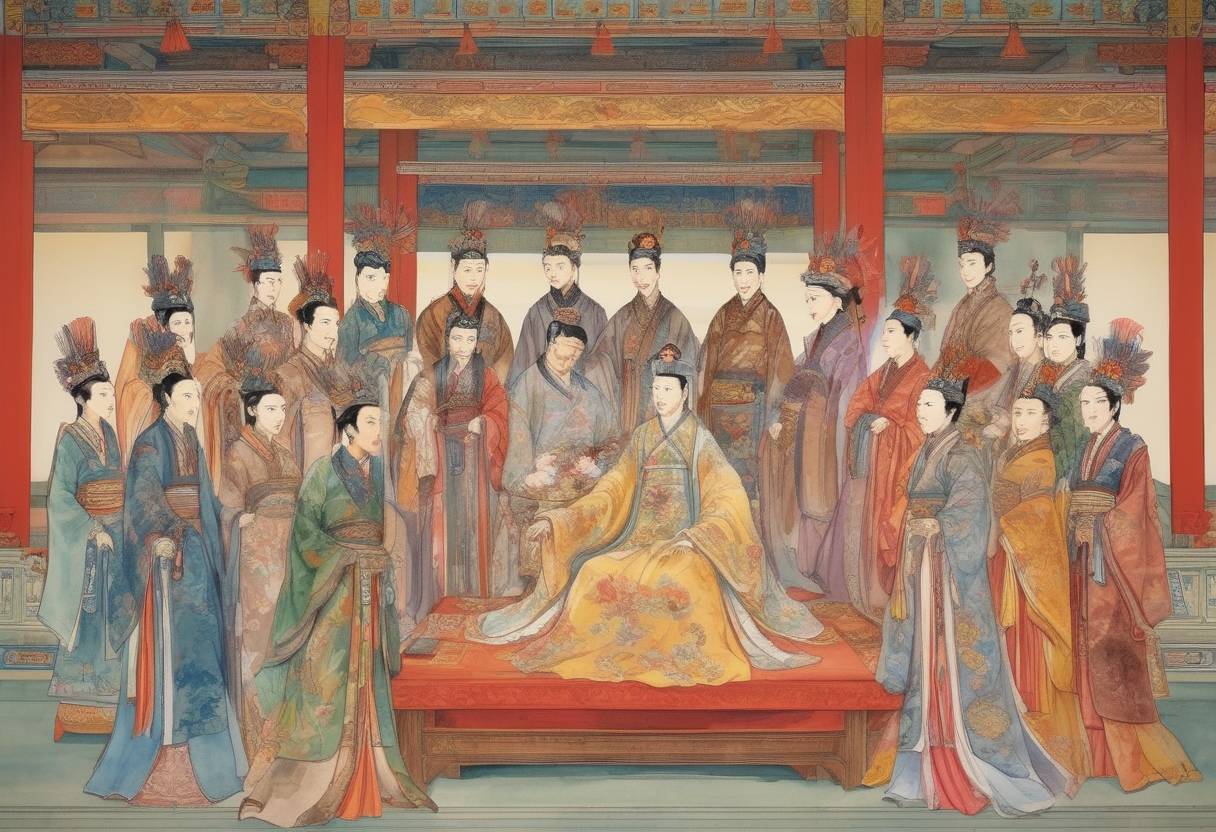
Empress Wu Zetian Abdicates the Throne
On February 22, 705, a significant event unfolded in Chinese history: Empress Wu Zetian, the only female emperor in Chinese history, abdicated the throne. This event marked the end of her reign and the restoration of the Tang Dynasty with her son, Emperor Zhongzong, ascending to the throne.
Background
Wu Zetian was born in 624 and rose to power through her intelligence, political acumen, and strategic marriages. Initially a concubine of Emperor Taizong, she later became the empress consort of his successor, Emperor Gaozong. After Gaozong’s death, Wu Zetian effectively controlled the empire as regent for her sons before declaring herself emperor in 690, establishing the Zhou Dynasty and becoming the first and only female emperor in Chinese history.
Wu Zetian’s Reign
During her reign, Wu Zetian implemented several reforms that strengthened the central government, promoted meritocracy by expanding the civil service examination system, and supported Buddhism, which gained prominence during her rule. Her reign was marked by both effective governance and ruthless measures to eliminate opposition, including the execution of rivals and suppression of dissent.
Abdication and Restoration of the Tang Dynasty
By 705, Wu Zetian was in her 80s and her health was declining. Her court was rife with intrigue, and her power was increasingly challenged by officials and members of the Tang royal family. A coup led by Zhang Jianzhi, a senior official, and other loyalists forced Wu Zetian to abdicate in favor of her son, Li Xian, who took the throne as Emperor Zhongzong.
The abdication of Wu Zetian on February 22, 705, marked the end of the Zhou Dynasty and the restoration of the Tang Dynasty. Emperor Zhongzong’s ascension was seen as a return to the traditional order, and it was welcomed by many who had been uneasy with Wu Zetian’s unprecedented rule.
Aftermath and Historical Significance
Wu Zetian’s abdication and the restoration of the Tang Dynasty had significant implications for Chinese history. Her reign, though controversial, demonstrated the potential for female leadership in a male-dominated society. Her policies, particularly those related to governance and the civil service, left a lasting impact on the Chinese imperial system.
Emperor Zhongzong’s reign, however, was short-lived and marked by internal strife. He was eventually deposed, and the Tang Dynasty continued to experience periods of instability until its eventual decline.
Wu Zetian remains a complex and fascinating figure in Chinese history, remembered both for her effective rule and the ruthless means by which she maintained power. Her abdication on February 22, 705, stands as a pivotal moment in the history of the Tang Dynasty and the broader narrative of imperial China.