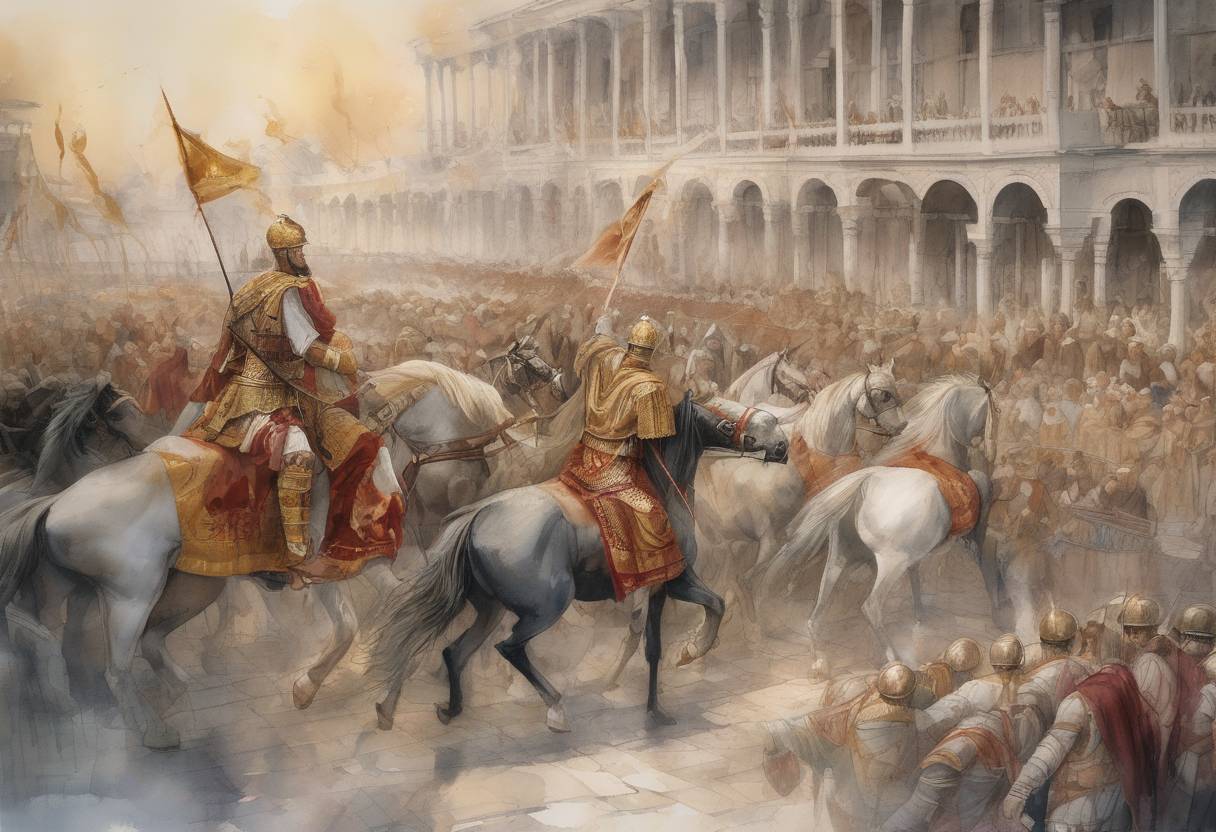
The Death of Theodosius II and the Rise of Marcian
On July 28, 450, the Eastern Roman Emperor Theodosius II died unexpectedly after a fall from his horse during a hunting expedition. His death marked a significant turning point in the history of the Eastern Roman Empire, leading to a succession crisis that ultimately resulted in the ascension of Marcian as the new emperor.
Background
Theodosius II, born in 401, became emperor at a young age following the death of his father, Arcadius, in 408. His reign, which lasted over four decades, was marked by significant events such as the construction of the Theodosian Walls of Constantinople and the issuance of the Theodosian Code, a compilation of laws that would influence European legal systems for centuries.
Despite these achievements, Theodosius II’s reign was often characterized by the influence of powerful court officials and his sister, Pulcheria, who played a crucial role in governance. Theodosius was known for his piety and scholarly interests, but his political acumen was often questioned.
The Succession Crisis
The sudden death of Theodosius II without a direct heir led to a power vacuum and a potential crisis of succession. Pulcheria, who had significant influence at court, quickly moved to stabilize the situation. She was a key figure in the transition of power, leveraging her political acumen and connections.
Pulcheria married Marcian, a respected military officer, to legitimize his claim to the throne. This marriage was strategic, as it provided Marcian with the necessary support and legitimacy to assume the role of emperor. Marcian’s rise to power was relatively smooth, thanks to Pulcheria’s decisive actions and the support of the military and the Senate.
Marcian’s Reign
Marcian’s reign, which lasted from 450 to 457, is often regarded as a period of stability and reform. He is noted for his efforts to strengthen the empire’s finances and military, as well as his role in the Council of Chalcedon in 451, which addressed key theological disputes within Christianity.
Marcian’s policies helped to stabilize the Eastern Roman Empire during a time of external threats and internal challenges. His reign is often seen as a precursor to the more prosperous period under Emperor Leo I.
Historical Significance
The transition from Theodosius II to Marcian highlights the complexities of succession in the Roman Empire, particularly in the absence of a direct heir. It underscores the importance of political alliances and the role of influential figures like Pulcheria in shaping the course of imperial history.
Marcian’s successful reign helped to maintain the stability of the Eastern Roman Empire during a tumultuous period, setting the stage for future developments in Byzantine history. His leadership during the Council of Chalcedon also had lasting impacts on the Christian Church, influencing doctrinal developments for centuries.
In summary, the death of Theodosius II and the subsequent rise of Marcian illustrate the intricate dynamics of power, succession, and governance in the late Roman Empire, with lasting implications for both the empire and the broader historical landscape.