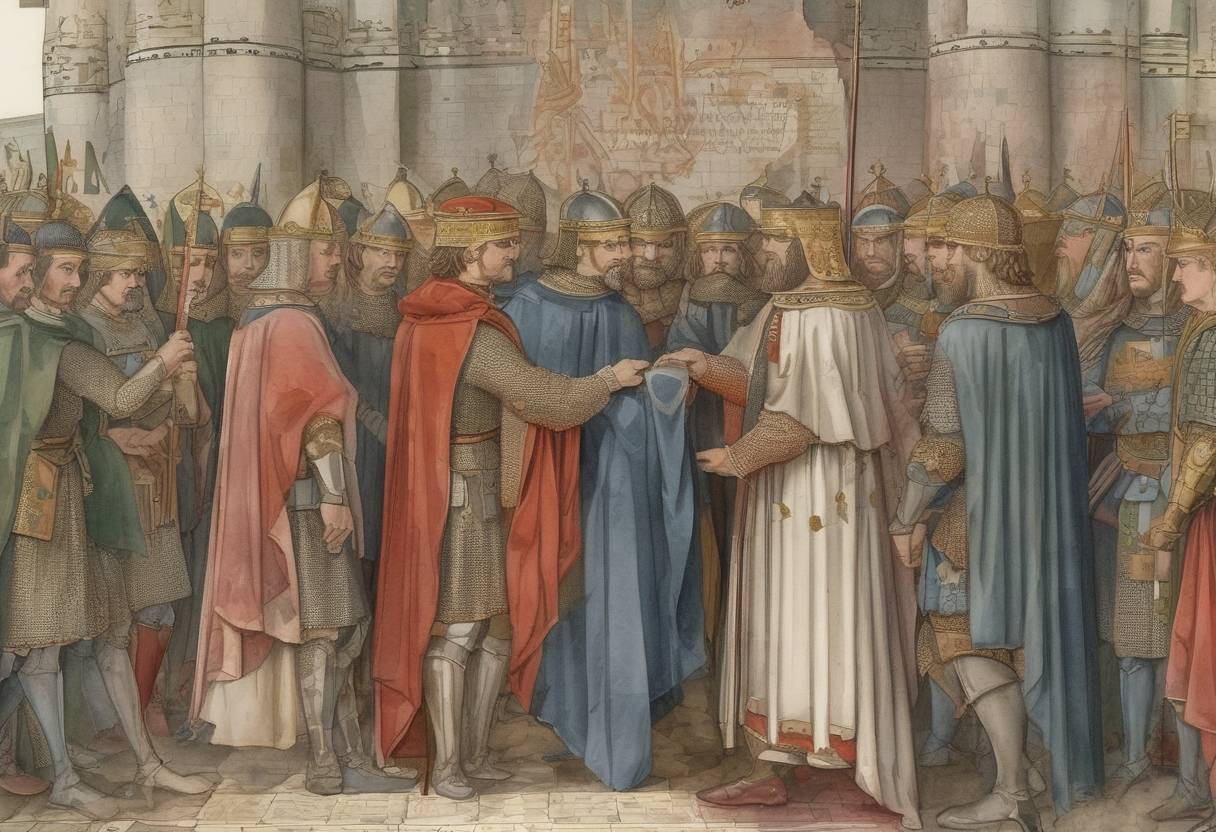
The Treaty of Meerssen, signed on June 21, 870, was a significant event in the history of the Carolingian Empire, marking a pivotal moment in the division of the empire among the descendants of Charlemagne. This treaty was an agreement between Louis the German and Charles the Bald, two grandsons of Charlemagne, and it played a crucial role in shaping the political landscape of medieval Europe.
Historical Context
Carolingian Empire: The Carolingian Empire, founded by Charlemagne, was a vast realm that encompassed much of Western and Central Europe. After Charlemagne’s death in 814, the empire faced internal strife and external pressures, leading to its fragmentation.
Treaty of Verdun (843): Prior to the Treaty of Meerssen, the Treaty of Verdun had divided the empire among Charlemagne’s grandsons: Lothair I, Louis the German, and Charles the Bald. This division created three distinct kingdoms: West Francia, East Francia, and Middle Francia.
Death of Lothair II (869): Lothair II, who ruled Middle Francia, died without legitimate heirs, leading to disputes over his territory. This set the stage for further negotiations and divisions among his uncles, Louis the German and Charles the Bald.
Key Provisions of the Treaty
Division of Lotharingia: The Treaty of Meerssen primarily addressed the division of Lotharingia, the region previously ruled by Lothair II. The treaty split this territory between Louis the German and Charles the Bald.
Territorial Adjustments: The treaty delineated specific regions and cities to each ruler, effectively redistributing power and influence in the region. This division was intended to maintain peace and stability by clearly defining the borders of each ruler’s domain.
Aftermath and Consequences
Temporary Peace: The Treaty of Meerssen temporarily resolved the disputes over Lotharingia and brought a period of relative peace between the two rulers. However, the division was not permanent, as future conflicts and treaties would continue to reshape the region.
Fragmentation of the Carolingian Empire: The treaty exemplified the ongoing fragmentation of the Carolingian Empire, a process that would eventually lead to the emergence of distinct European kingdoms. The divisions laid the groundwork for the development of modern European states.
Legacy: The Treaty of Meerssen is a testament to the complex political dynamics of the Carolingian period and the challenges of maintaining a unified empire in the face of internal and external pressures.
In summary, the Treaty of Meerssen was a crucial event in the history of the Carolingian Empire, reflecting the broader trends of division and decentralization that characterized the era. It highlights the intricate balance of power and the ongoing struggle for control among the descendants of Charlemagne.