Assassination of Abraham Lincoln
1865 · Washington, D.C., United States
U.S. President Abraham Lincoln was shot by John Wilkes Booth at Ford's Theatre in Washington, D.C. He died the following day, marking a pivotal moment in American history.
October 16, 1869
The Cardiff Giant is 'discovered' in Cardiff, New York, a ten-foot-tall purported 'petrified man' which was later confirmed to be a hoax.
Cardiff, United States | Newell's farm
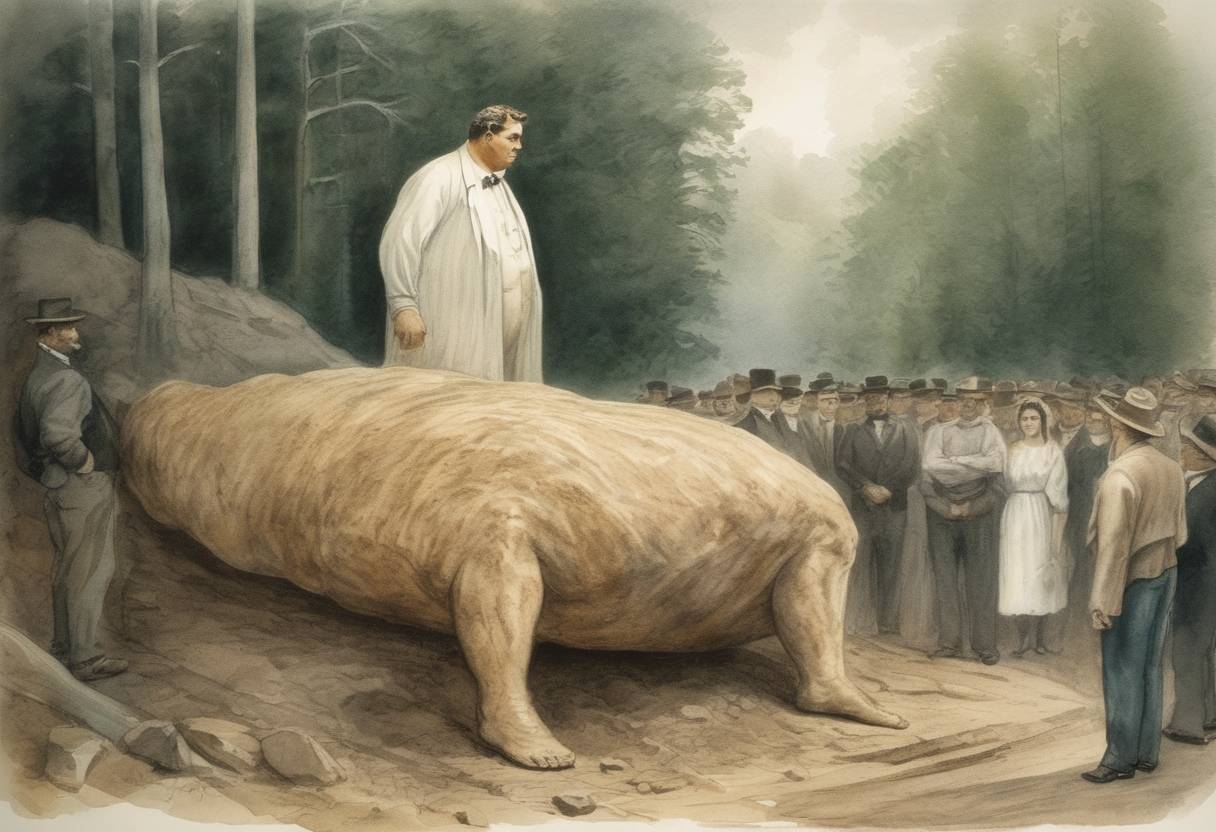
On October 16, 1869, workers digging a well in Cardiff, New York, unearthed what was claimed to be a ten-foot-tall petrified man. This figure, known as the Cardiff Giant, quickly became a sensation and drew significant public attention.
The Cardiff Giant was the creation of George Hull, a New York tobacconist. Hull, an atheist, devised the giant figure to mock religious literalists who interpreted the Bible’s mention of giants as factual history. Inspired by an argument with a Methodist minister and stories about giant fossilized figures, Hull decided to craft a stone giant secretly.
Hull commissioned a stonecutter in Chicago to carve the figure from a block of gypsum and arranged for it to be buried on his cousin William Newell’s farm in Cardiff, New York. A year later, Newell hired workers to dig a well, strategically leading them to ‘discover’ the giant.
The discovery generated tremendous intrigue, with many speculating it was evidence of ancient life on Earth. People flocked to see the Cardiff Giant, paying fifty cents to catch a glimpse. The New York press covered the event extensively, and both scientific and religious debates ensued about its authenticity.
Despite widespread public fascination, skepticism was rampant, especially among scientists and scholars. Early on, prominent paleontologist Othniel C. Marsh examined the giant and declared it a hoax, noting the construction marks indicative of a modern creation. Nevertheless, the public’s interest persisted.
In December 1869, Hull admitted to the hoax amid increasing scrutiny. The revelation came after P. T. Barnum, ever the showman, constructed his own replica of the giant when Hull refused to sell him the original. This act of one-upmanship and the mounting pressure from scientific assessments eventually prompted Hull to confess his ruse.
Though ultimately exposed, the Cardiff Giant remains one of the most famous hoaxes in American history, illustrating the period’s cultural fascination with prehistoric giants and the growing tension between science and religion. It also reflects the era’s burgeoning entertainment industry and the public’s appetite for sensational stories.
Today, the original Cardiff Giant is displayed at The Farmers’ Museum in Cooperstown, New York, serving as a testament to 19th-century gullibility and the enduring appeal of a well-planned practical joke.
Source: www.history.com