German Federal Election of September 22, 2013
2013 · Berlin, Germany
Angela Merkel's Christian Democratic Union (CDU) won the German federal election, securing her a third term as Chancellor of Germany.
November 22, 2005
Angela Merkel was sworn in as Germany's first female Chancellor, marking a significant moment in German and European politics.
Berlin, Germany | German Government
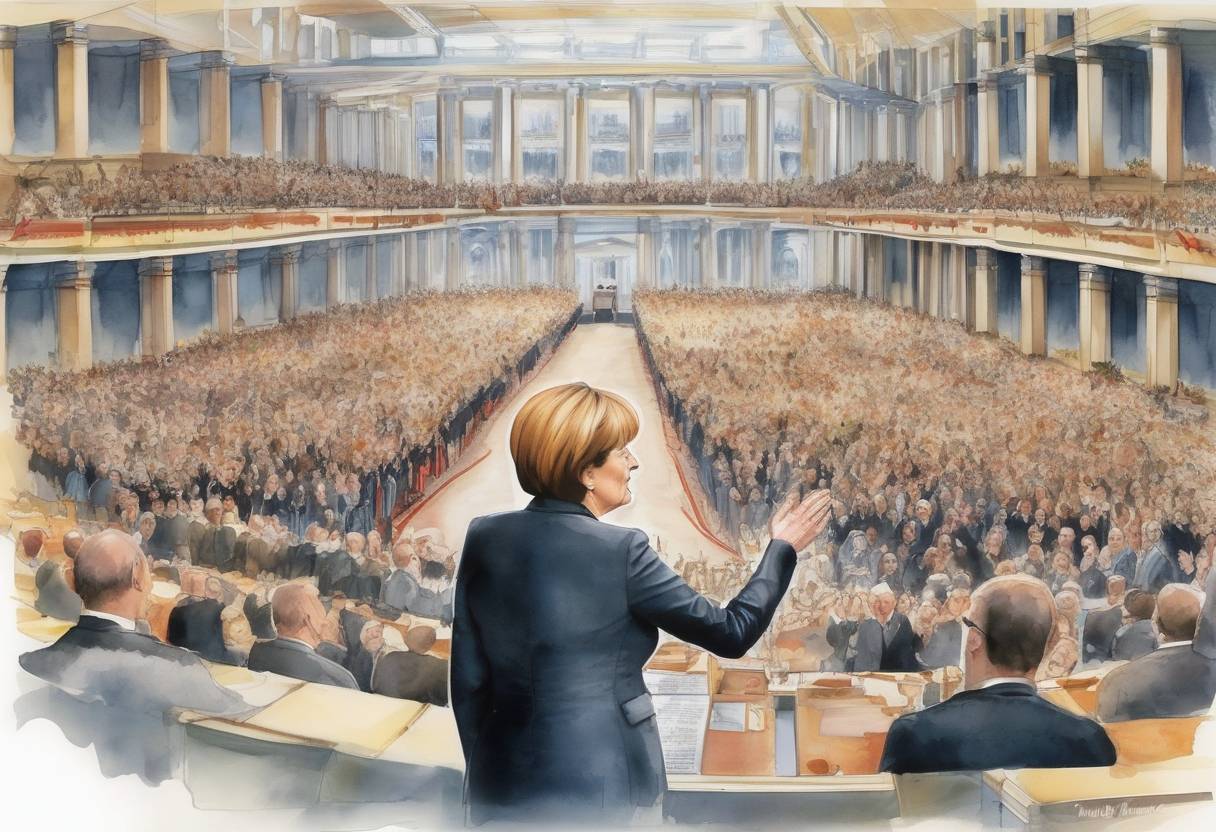
On November 22, 2005, Angela Merkel was sworn in as the Chancellor of Germany, marking a historic moment as she became the first woman to hold this position in the country. Her ascension to the chancellorship was not only a significant milestone for Germany but also a pivotal moment in European politics.
Angela Merkel, born in Hamburg in 1954, grew up in East Germany and pursued a career in physics before entering politics after the fall of the Berlin Wall. She joined the Christian Democratic Union (CDU) and quickly rose through the ranks, serving in various ministerial roles under Chancellor Helmut Kohl.
The 2005 federal election was closely contested, with Merkel’s CDU/CSU alliance narrowly defeating the Social Democratic Party (SPD) led by incumbent Chancellor Gerhard Schröder. The election results led to a grand coalition between the CDU/CSU and the SPD, with Merkel emerging as the consensus candidate for Chancellor.
On November 22, 2005, Merkel was officially sworn in as Chancellor in a ceremony held at the Bundestag, Germany’s federal parliament. Her election was confirmed by a vote in the Bundestag, where she received 397 out of 611 votes. This event marked the beginning of her tenure as the head of government.
Merkel’s appointment as Chancellor was groundbreaking for several reasons:
Gender Barrier: Merkel broke the glass ceiling in German politics, becoming the first female Chancellor in a country where political leadership had traditionally been male-dominated.
East German Roots: As a former citizen of East Germany, Merkel’s rise symbolized the reunification of Germany and the integration of East and West.
European Influence: Merkel’s leadership would soon extend beyond Germany, as she became a key figure in European Union politics, known for her pragmatic and cautious approach to governance.
Angela Merkel went on to serve as Chancellor for 16 years, making her one of the longest-serving leaders in German history. Her tenure was marked by significant events, including the global financial crisis, the European debt crisis, and the migrant crisis. Merkel’s leadership style, characterized by consensus-building and stability, earned her respect both domestically and internationally.
Her legacy includes a stronger European Union, advancements in renewable energy policy, and a reputation as a steady hand during turbulent times. Merkel’s departure from office in 2021 marked the end of an era in German and European politics.
In conclusion, Angela Merkel’s swearing-in as Chancellor on November 22, 2005, was a transformative moment that reshaped the political landscape in Germany and had lasting implications for Europe and the world.
Source: www.bbc.com