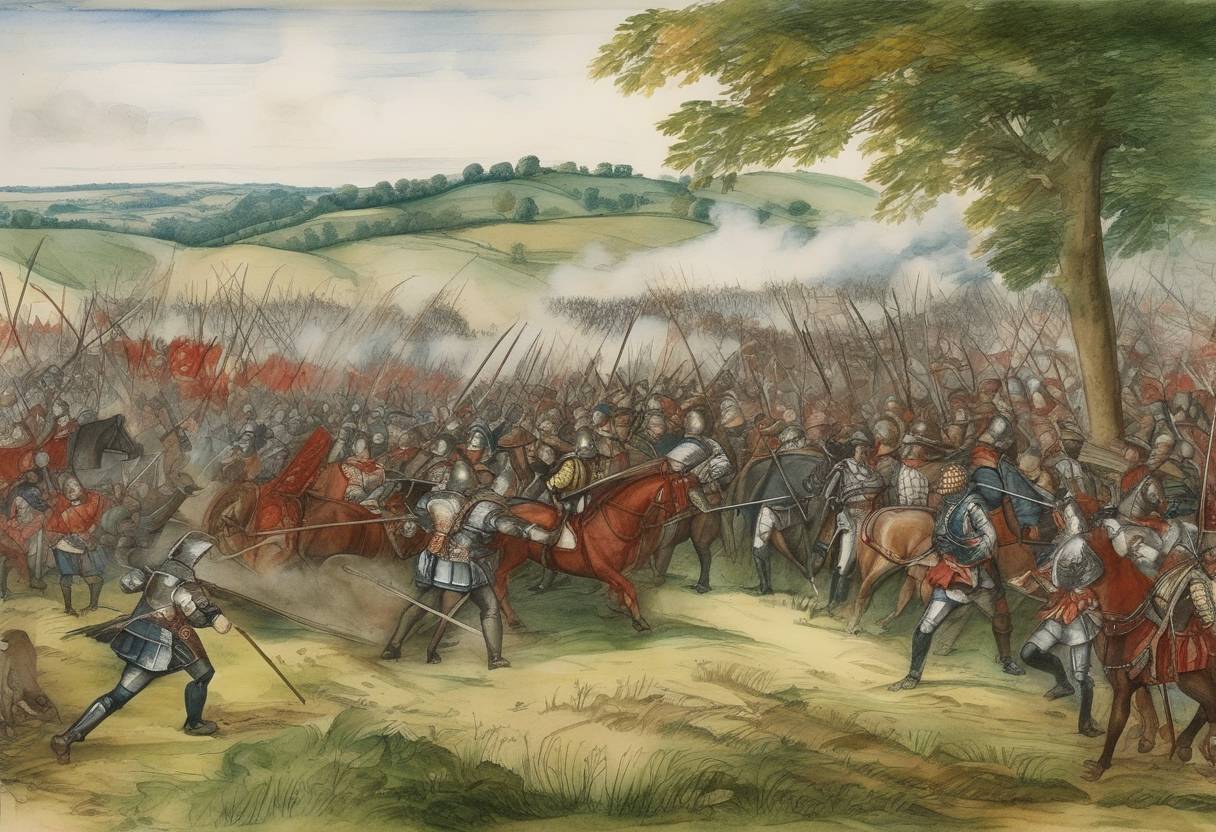
The Battle of Sampford Courtenay: July 27, 1549
The Battle of Sampford Courtenay was a decisive engagement during the Prayer Book Rebellion, which erupted in 1549 in Devon and Cornwall, England. This uprising was fueled by the imposition of religious reforms by King Edward VI’s government. The reforms included the introduction of the English-language Book of Common Prayer, replacing traditional Latin services. This change was met with fierce resistance, especially in the counties of Devon and Cornwall, where Catholic traditions held strong sway.
Background
In the wake of the English Reformation, Edward VI’s government sought to standardize religious practices across England. Under the guidance of the Lord Protector Edward Seymour, Duke of Somerset, and Archbishop Thomas Cranmer, these reforms were part of a broader agenda to establish Protestantism. The use of the English-language Book of Common Prayer was a pivotal reform that many in the southwestern counties viewed as an attack on their longstanding religious customs.
Lead-Up to the Battle
The discontent in Devon and Cornwall led to widespread rebellion in 1549. Insurgents, including farmers, laborers, and local gentry, quickly organized under leaders such as Humphrey Arundell, a Cornishman with military experience. The rebels besieged Exeter, a strategic city, as an act of defiance. The rebellion spread rapidly, prompting a strong military response from the Crown.
The Battle
On July 27, 1549, government forces and the insurgents met at Sampford Courtenay, a small village in Devon. Led by Lord John Russell, the Royalist army was tasked with quelling the rebellion. Russell’s forces outnumbered the insurgents and were better equipped, featuring a combination of infantry, cavalry, and artillery.
Outcome
The battle saw the government forces decisively defeat the insurgents. Despite their initial fervor and local support, the rebels could not withstand the disciplined and well-supplied home army. The defeat at Sampford Courtenay effectively marked the end of significant organized resistance.
Aftermath and Significance
The suppression of the Prayer Book Rebellion was brutal. Many leaders were captured and executed, while severe measures were implemented to further secure the Reformation’s religious changes. The rebellion underscored the deep-seated religious and cultural divisions within England and highlighted the challenges Tudor rulers faced in enforcing religious conformity.
The Battle of Sampford Courtenay, as part of the larger rebellion, demonstrated the volatility of religious transition during this period and its capacity to provoke widespread dissent. It was a pivotal moment in the intensifying religious conflicts of 16th-century England, indicative of the broader European struggles between Protestant and Catholic powers.