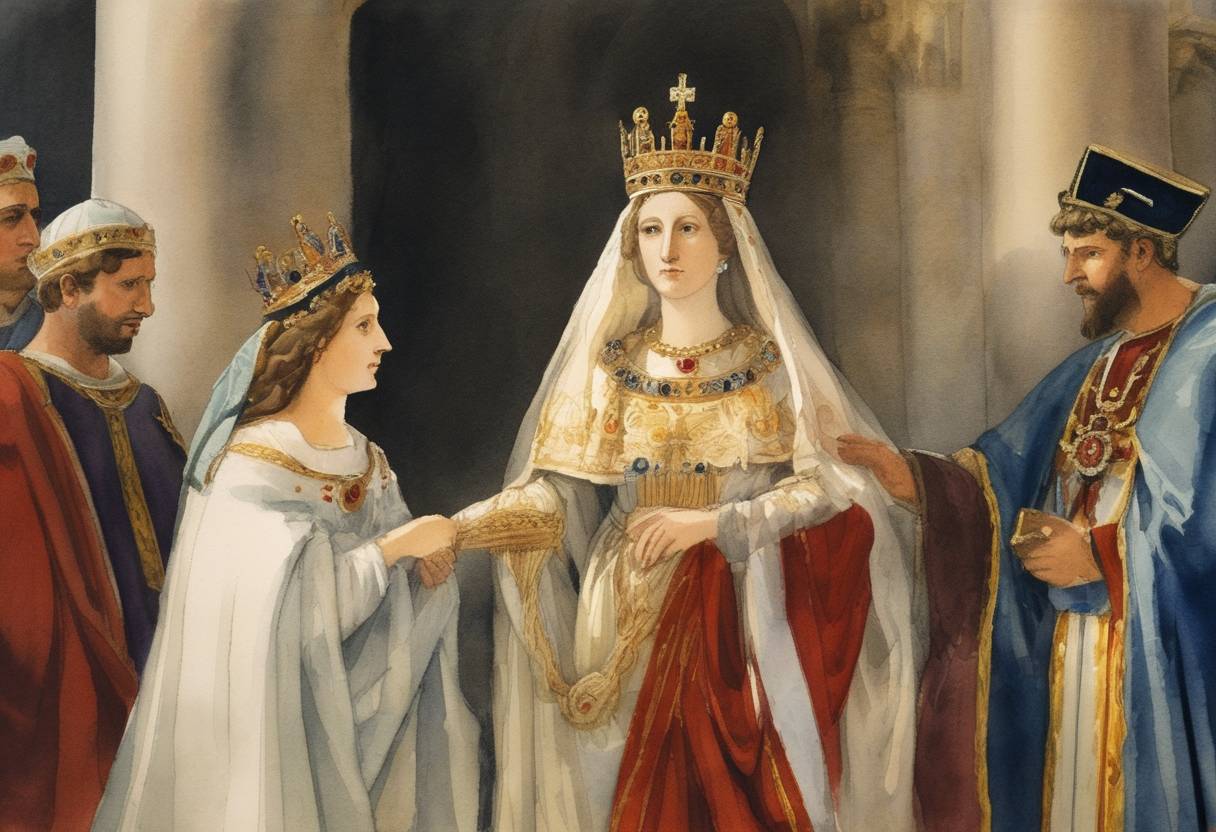
Constance of Arles Crowned as Holy Roman Empress on April 14, 1028
On April 14, 1028, Constance of Arles was crowned as the Holy Roman Empress in a ceremony held at the Basilica of St. Peter in Rome. This event marked her elevation alongside her husband, Conrad II, who was already serving as the Holy Roman Emperor, having been crowned in 1027.
Background
Constance of Arles
Constance was born around 986 into the noble lineage of the County of Arles, located in modern-day southern France. She was the daughter of William I, Count of Provence, and Adelaide-Blanche of Anjou, which connected her to various influential European noble families. Her marriage to Conrad II in 1016 served to consolidate political alliances between the Kingdom of Burgundy, the Holy Roman Empire, and the regions in and around Arles, a critical area during this period.
Conrad II
Conrad II was a member of the Salian Dynasty and became King of Germany before being elected emperor by the nobility. His reign began with his election in 1024 and established a new phase of the Holy Roman Empire’s expansion and internal consolidation. By 1028, he had firmly established his rule across the empire, and his crowning as emperor by Pope John XIX in 1027 reinforced his authority.
The Coronation Event
On April 14, 1028, the coronation of Constance took place at Rome’s Basilica of St. Peter. This ceremony was significant as it emphasized the unity of the Church with the Holy Roman Empire, visibly endorsed by the Pope’s presence and blessing. The coronation of an empress was not only a religious ritual but also a political statement, reinforcing the legitimacy and divine sanction of the imperial couple’s rule.
Significance
The crowning of Constance as Holy Roman Empress underscored the importance of matrimonial alliances in consolidating the empire’s territories and securing loyalty among the various vassals and nobility. It demonstrated the ecclesiastical authority of the Pope and the church in affirming the divine right of European monarchs to rule.
Furthermore, this event solidified Conrad II’s position and influence throughout the empire, reinforcing his marital ties as a source of legitimacy and power. Constance’s elevation as empress was essential not just for its ceremonial aspects but also for its contribution to the political stability and continuity of the Salian Dynasty.
Aftermath
Constance and Conrad II maintained a strong partnership throughout their reign. Constance’s role went beyond the ceremonial, as she was actively involved in various political affairs, including mediations and administrative matters. Although the empire faced numerous internal challenges during their reign, their legacy endured, laying the groundwork for future imperial endeavors and territorial expansions.
After Conrad’s death in 1039, their son, Henry III, ascended to the throne, continuing the Salian Dynasty’s influence over the Holy Roman Empire, a testament to the strength and foresight of his parent’s rule.