Thomas Edison's Demonstration of Incandescent Lighting
1879 · Menlo Park, United States
Thomas Edison demonstrated incandescent lighting to the public for the first time in Menlo Park, New Jersey, revolutionizing the use of electric light.
January 19, 1883
The first electric lighting system employing overhead wires goes into service at the Roselle, New Jersey, demonstrating the efficiency of the incandescent light bulb.
Roselle, United States | Edison Electric Illuminating Company
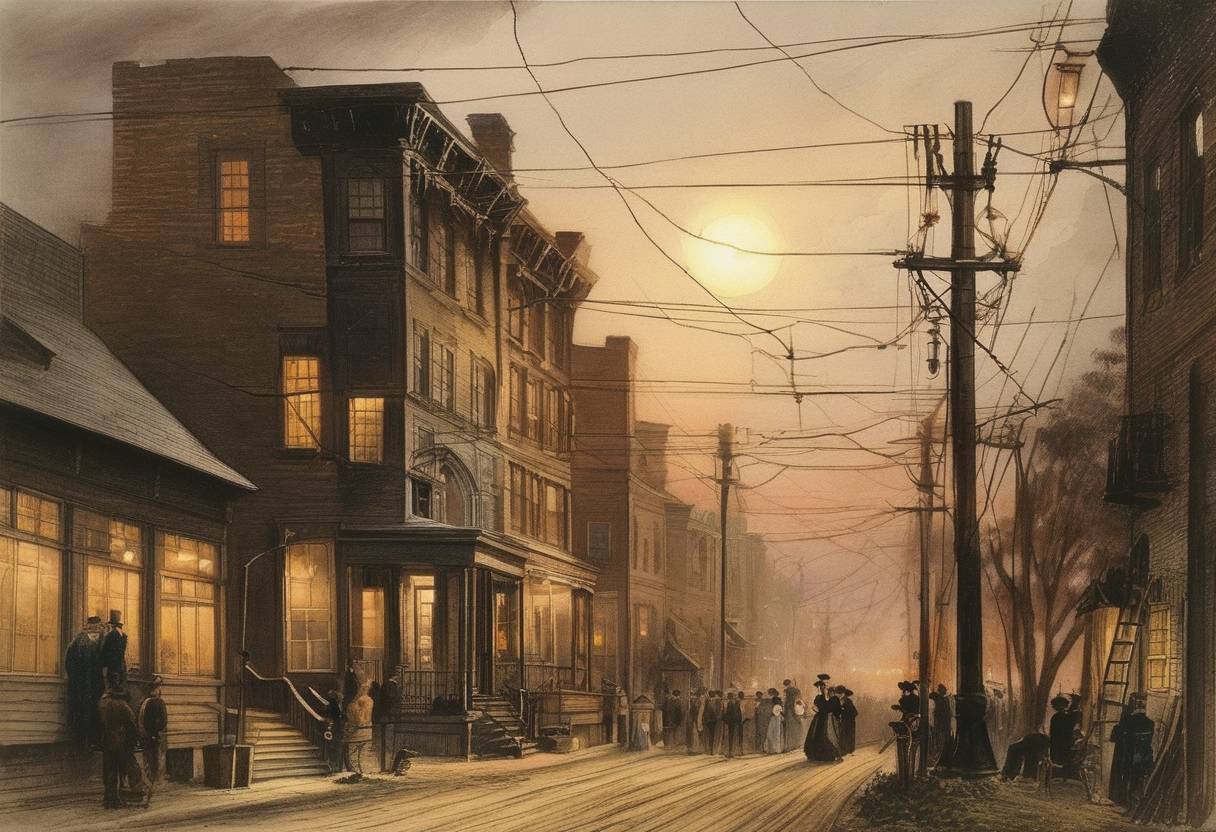
On January 19, 1883, the world witnessed a significant milestone in the realm of public utilities with the inauguration of the first practical electric lighting system utilizing overhead wires in Roselle, New Jersey. This momentous event marked the successful demonstration of the efficiency of the incandescent light bulb, a pivotal innovation by Thomas Edison.
Thomas Alva Edison, already a prolific inventor by this time, had been refining the incandescent light bulb and developing systems to distribute electric power. In the late 19th century, the concept of using electricity for public lighting was still novel and largely untested in practical community settings outside of private or experimental spaces.
Roselle was chosen as the site for this groundbreaking development due to its strategic location and community willingness. Edison supplied the town with a direct current (DC) system, which encompassed the power station, the light bulbs, and distribution infrastructure, primarily employing overhead wires. This system powered not only street lighting but also homes and businesses in the area, illustrating the practical application of electric illumination and its potential for widespread community use.
The success of the electric lighting system in Roselle had far-reaching consequences for the adoption of electric lighting worldwide. It demonstrated the feasibility and efficiency of electricity for public and private lighting, paving the way for future developments in electrical infrastructure and utilities.
The Roselle demonstration underscored the practicality of Edison’s inventions and laid the foundational work for modern electrical distribution systems, fundamentally altering how communities worldwide approached energy and public lighting.
Source: edison.rutgers.edu