Alhambra Decree's Final Stages: The January 20, 1502 Edict
1502 · Granada, Spain
Isabella I of Castile issues the Alhambra Decree, ordering the expulsion of remaining Moores from Spain.
August 2, 1492
Spanish Jews were expelled by the Alhambra Decree, following an order issued by the Catholic Monarchs Ferdinand and Isabella, leading to the diaspora of the Jewish community from Spain.
Granada, Spain | Spanish Monarchy
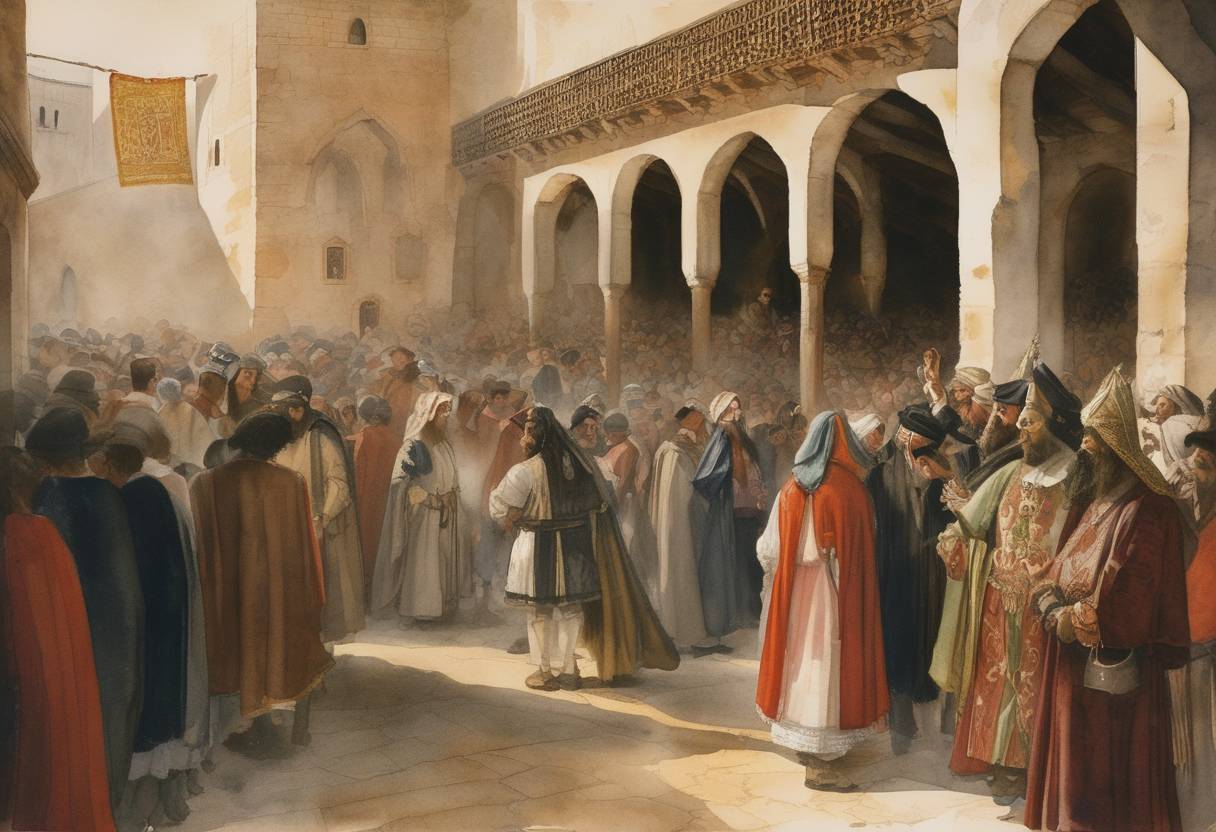
On August 2, 1492, a significant and tragic event unfolded in the history of Spain’s Jewish community: the expulsion of Jews from Spain, following the Alhambra Decree. This event marked the beginning of a major diaspora that had profound cultural and historical implications.
The Alhambra Decree, also known as the Edict of Expulsion, was issued on March 31, 1492, by the Catholic Monarchs, Ferdinand II of Aragon and Isabella I of Castile. This decree ordered all practicing Jews to leave the Kingdoms of Castile and Aragon by the end of July 1492. Jews were given until August 2, the 7th of Av in the Hebrew calendar, to leave Spain. The decree was a culmination of significant religious and political shifts, aiming to unify Spain under Christian rule and eliminate religious diversity, which was perceived as a threat to political stability and religious uniformity.
The period leading up to the expulsion was characterized by increasing hostility against Jews. The Spanish Inquisition, established in 1478, was particularly aimed at conversos, Jews who had converted to Christianity but were suspected of secretly practicing Judaism. Additionally, there was social and economic tension exacerbated by anti-Jewish sentiments, which often resulted in violence against Jewish communities.
By August 2, thousands of Jews had packed their belongings and sought refuge elsewhere, leading to a mass exodus. They departed from Spanish ports like Algeciras, Cartagena, and the prosperous trading city of Valencia, embarking on perilous journeys across the Mediterranean, caught between uncertainties and the hope of finding new places of safety and acceptance.
The expulsion led to a significant demographic change in Spain. Many Jews found refuge in the Ottoman Empire, North Africa, and various parts of Europe, including Italy, the Netherlands, and the Balkans. This diaspora led to the spread of Sephardic culture and Jewish traditions, which continued to influence the countries that received these communities.
The decree had long-standing effects on Spanish society. Economically, the loss of the Jewish community, which included skilled professionals, merchants, and financiers, had a detrimental impact on Spain’s economic vitality. Culturally, the expulsion marked the erosion of Spain’s rich tradition of interfaith interactions, setting a precedent for religious intolerance.
The Alhambra Decree was formally revoked only in 1968, highlighting the enduring legacy of this historical event. The expulsion remains a poignant example of religious intolerance and the devastating impact of enforced cultural and religious homogeneity.
Source: www.britannica.com