Operation Shingle: The Allied Amphibious Landing at Anzio
1944 · Anzio, Italy
Operation Shingle, the Allied amphibious landing at Anzio, Italy, begins during World War II.
August 17, 1943
The Allies complete the conquest of Sicily during World War II, marking the end of the Italian Campaign's first phase.
Sicily, Italy | Allied Forces
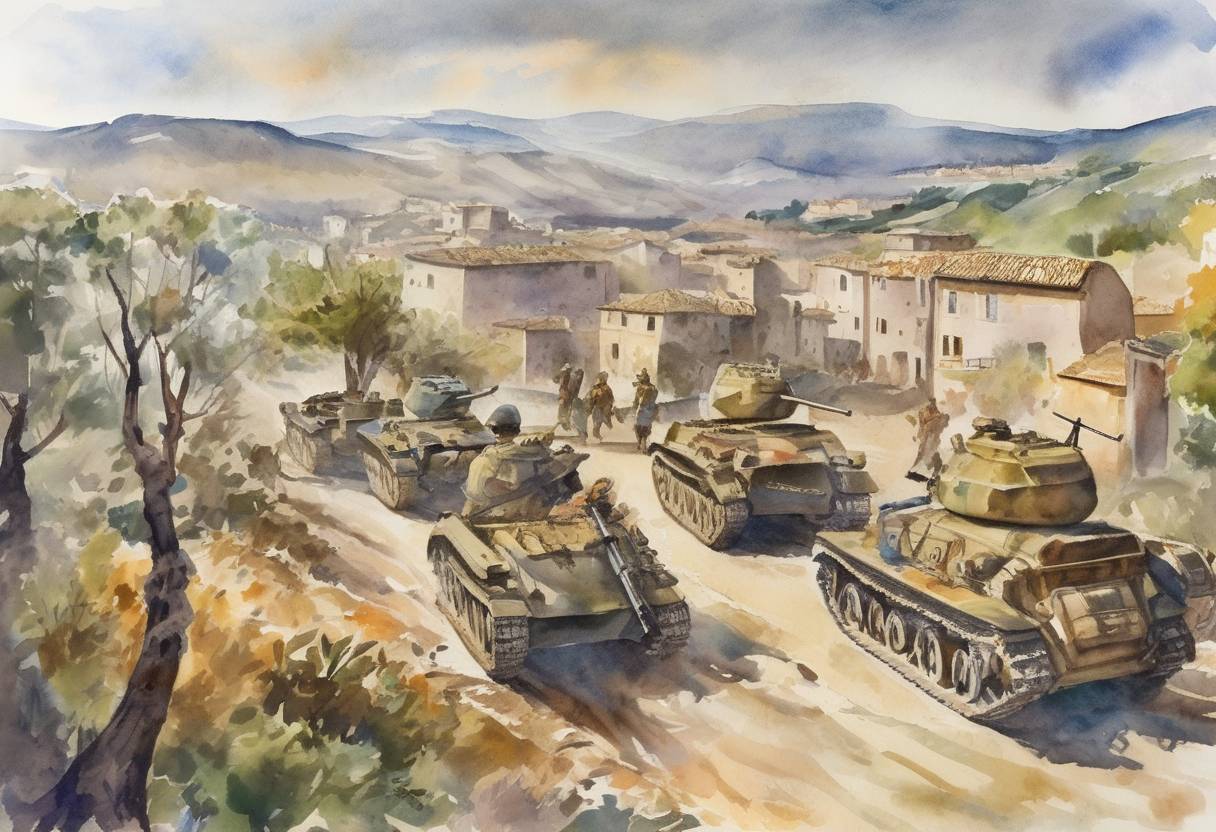
On August 17, 1943, the Allied forces completed the conquest of Sicily, marking the end of the first phase of the Italian Campaign during World War II. This significant military operation, known as Operation Husky, was a crucial step in the Allies’ strategy to weaken Axis powers in Europe and pave the way for the invasion of mainland Italy.
Strategic Importance: Sicily was strategically important due to its location in the Mediterranean Sea, serving as a gateway to the Italian peninsula. Its capture would not only disrupt Axis supply lines but also provide a base for further operations in Europe.
Allied Forces: The operation was a joint effort primarily involving American, British, and Canadian forces. Key commanders included General Dwight D. Eisenhower as the Supreme Allied Commander, General Bernard Montgomery leading the British Eighth Army, and General George S. Patton commanding the U.S. Seventh Army.
Axis Defenders: The Axis defense comprised German and Italian troops under the command of General Alfredo Guzzoni. Despite being outnumbered, they utilized the island’s rugged terrain to mount a strong defense.
Operation Husky Launch: The invasion began on the night of July 9-10, 1943, with airborne and amphibious landings on the southern coast of Sicily. Despite initial challenges, including adverse weather conditions and strong resistance, the Allies established a foothold.
Progress Across the Island: Over the following weeks, Allied forces advanced across the island. The British pushed northward along the eastern coast, while American troops moved westward and then northward, capturing key towns and cities.
Axis Withdrawal: Facing overwhelming pressure and the threat of encirclement, Axis forces began a strategic withdrawal to the Italian mainland. The evacuation was conducted under the cover of darkness, allowing a significant number of German and Italian troops to escape.
Final Push: The campaign culminated with the capture of Messina on August 17, 1943. This marked the end of organized Axis resistance on the island and completed the Allied conquest of Sicily.
Significance: The fall of Sicily had several important consequences. It led to the downfall of Italian dictator Benito Mussolini, who was deposed on July 25, 1943, and contributed to Italy’s eventual surrender to the Allies in September 1943.
Impact on Axis Powers: The loss of Sicily was a severe blow to Axis morale and military capability. It forced Germany to divert resources to defend the Italian mainland, weakening their position on other fronts.
Allied Momentum: The successful campaign boosted Allied morale and demonstrated the effectiveness of joint operations. It set the stage for the subsequent invasion of Italy, beginning with the landings at Salerno in September 1943.
Legacy: The conquest of Sicily is remembered as a pivotal moment in the Mediterranean theater of World War II, showcasing the strategic importance of coordinated Allied efforts and the beginning of the end for Axis dominance in Southern Europe.
In summary, the completion of the conquest of Sicily on August 17, 1943, was a decisive victory for the Allies, marking a turning point in the Italian Campaign and contributing significantly to the broader efforts to defeat the Axis powers in Europe.
Source: www.britannica.com