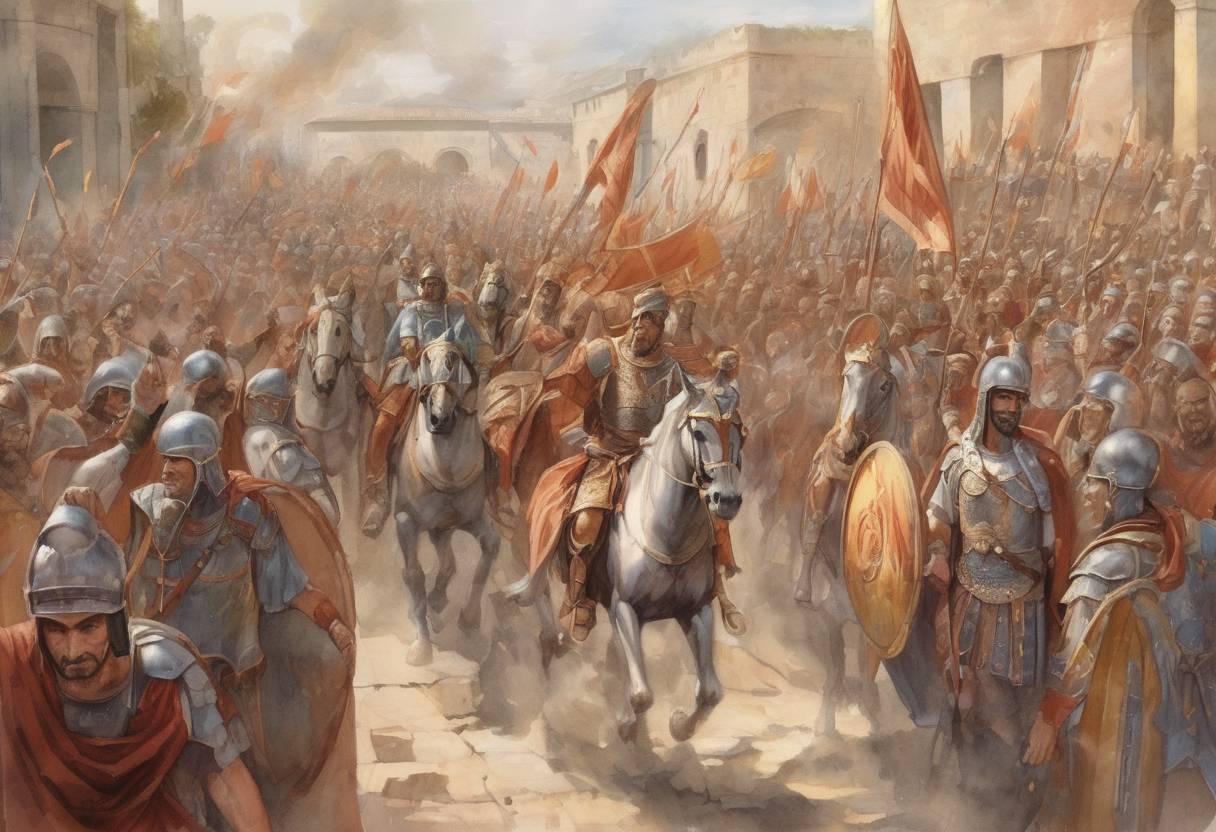
Roman Emperor Julian’s Campaign Against the Sassanid Empire
On March 5, 363, Roman Emperor Julian, often known as Julian the Apostate, embarked on a significant military campaign against the Sassanid Empire. This event marked a pivotal moment in Roman-Persian relations and was one of the last major Roman attempts to assert dominance over the eastern frontier.
Context and Background
Julian ascended to the throne in 361 AD, following the death of his cousin, Emperor Constantius II. Known for his philosophical inclinations and efforts to restore paganism in the Roman Empire, Julian’s reign was marked by his ambition to strengthen and expand Roman influence.
The Sassanid Empire, under the rule of Shapur II, was a formidable power in the East, and tensions between the two empires had been simmering for decades. The Sassanids had previously captured the important city of Nisibis and had been a persistent threat to Roman territories in the East.
The Campaign
Julian’s decision to launch a campaign against the Sassanids was driven by a desire to secure the eastern borders and possibly to emulate the military successes of his predecessors, such as Trajan and Alexander the Great. Departing from Antioch, a key city in the Roman East, Julian led an army reportedly numbering around 90,000 troops, although historical estimates vary.
Key Objectives
- Recapture Lost Territories: Julian aimed to reclaim territories lost to the Sassanids and to secure Roman dominance in the region.
- Demonstrate Military Prowess: By achieving a decisive victory, Julian sought to solidify his reputation as a capable military leader.
- Weaken the Sassanid Power: A successful campaign would potentially destabilize Shapur II’s rule and reduce the threat posed by the Sassanids.
The March and Initial Successes
Julian’s forces moved swiftly through Mesopotamia, capturing several key fortresses and cities. His strategy involved a combination of direct assaults and psychological warfare, aiming to demoralize the Sassanid forces and local populations.
Consequences and Aftermath
Despite initial successes, Julian’s campaign ultimately faced significant challenges. The harsh terrain, logistical difficulties, and the strategic acumen of Shapur II’s forces led to a protracted and difficult campaign. Julian’s untimely death in June 363, during the Battle of Samarra, marked a turning point. His successor, Jovian, was forced to negotiate a peace treaty that was unfavorable to the Romans, ceding several territories to the Sassanids.
Historical Significance
- End of Roman Expansion in the East: Julian’s campaign was one of the last major Roman attempts to expand into Persian territories.
- Impact on Roman-Persian Relations: The campaign and subsequent treaty highlighted the shifting balance of power between the two empires.
- Legacy of Julian: Despite his military ambitions, Julian is often remembered more for his religious policies and philosophical pursuits than his military endeavors.
Julian’s departure from Antioch on March 5, 363, remains a significant event in the annals of Roman military history, illustrating the complexities and challenges of imperial ambition in the ancient world.