Lothair I Crowned King of Italy
823 · Rome, Papal States
Lothair I is crowned King of Italy by Pope Paschal I.
February 12, 0881
Pope John VIII crowns Charles the Fat as Emperor of the Carolingian Empire.
Rome, Papal States | Catholic Church
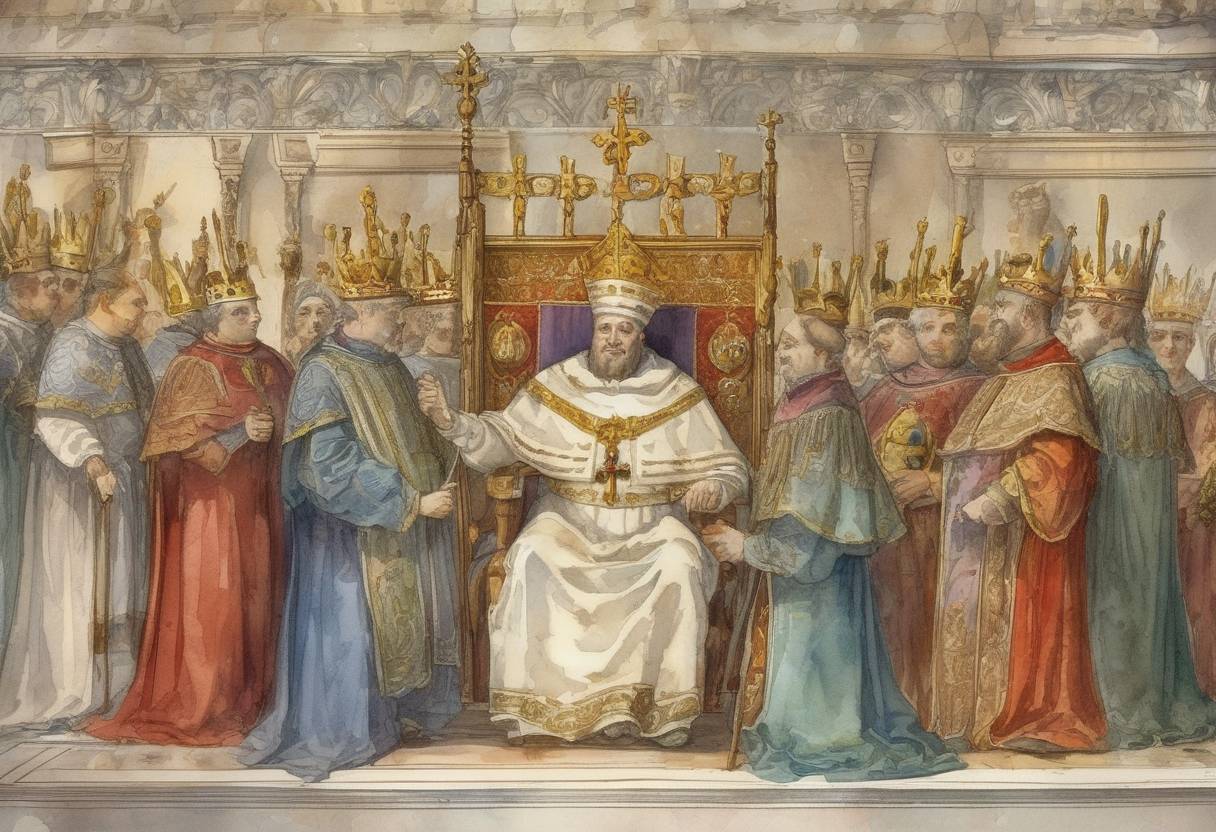
On February 12, 881, Pope John VIII crowned Charles the Fat as Emperor of the Carolingian Empire in Rome. This significant event marked a pivotal moment in the history of the Carolingian dynasty and the broader political landscape of medieval Europe.
The Carolingian Empire, established by Charlemagne in 800, had experienced fragmentation following his death. The empire was divided among his grandsons by the Treaty of Verdun in 843, leading to the formation of distinct territories: West Francia, East Francia, and Middle Francia. Charles the Fat, a grandson of Charlemagne, was initially King of East Francia and later became King of Italy.
Rise to Power: Charles the Fat ascended to the throne of East Francia in 876 after the death of his brother, Louis the German. He later became King of Italy in 879, consolidating his power in the region.
Political Context: The late 9th century was a period of instability and external threats, including Viking raids and internal strife among the Carolingian rulers. Charles sought to unify the empire under his rule to address these challenges.
Papal Support: Pope John VIII, facing threats from Saracen incursions in Italy and needing a strong ally, supported Charles’s claim to the imperial title. The papacy’s endorsement was crucial for legitimizing his authority.
The coronation took place in Rome, a city of immense religious and political significance. By crowning Charles the Fat, Pope John VIII reinforced the alliance between the papacy and the Carolingian rulers, emphasizing the role of the Church in legitimizing imperial authority.
Imperial Authority: Charles’s coronation as emperor was an attempt to restore the unity of the Carolingian Empire. However, his reign was marked by continued fragmentation and challenges to his authority.
Legacy: Charles the Fat’s reign was short-lived; he was deposed in 887 due to his inability to effectively manage the empire’s challenges. His deposition marked the end of the Carolingian Empire’s unity, leading to the rise of regional powers and the eventual emergence of the Holy Roman Empire.
Historical Significance: The coronation underscored the complex relationship between the papacy and the secular rulers of Europe, highlighting the papal influence in imperial politics and the ongoing struggle for power within the Carolingian dynasty.
In summary, the coronation of Charles the Fat as Emperor of the Carolingian Empire was a significant event that reflected the political dynamics of the time, the role of the papacy in imperial affairs, and the challenges of maintaining a unified empire in medieval Europe.
Source: en.wikipedia.org