Establishment of the World's First Commercial Telephone Service
1877 · Hamilton, Canada
Alexander Graham Bell installs the world's first commercial telephone service in Hamilton, Ontario, Canada.
March 10, 1876
Alexander Graham Bell makes the first successful telephone call, saying 'Mr. Watson, come here, I want to see you.'
Boston, United States | Bell Telephone Company
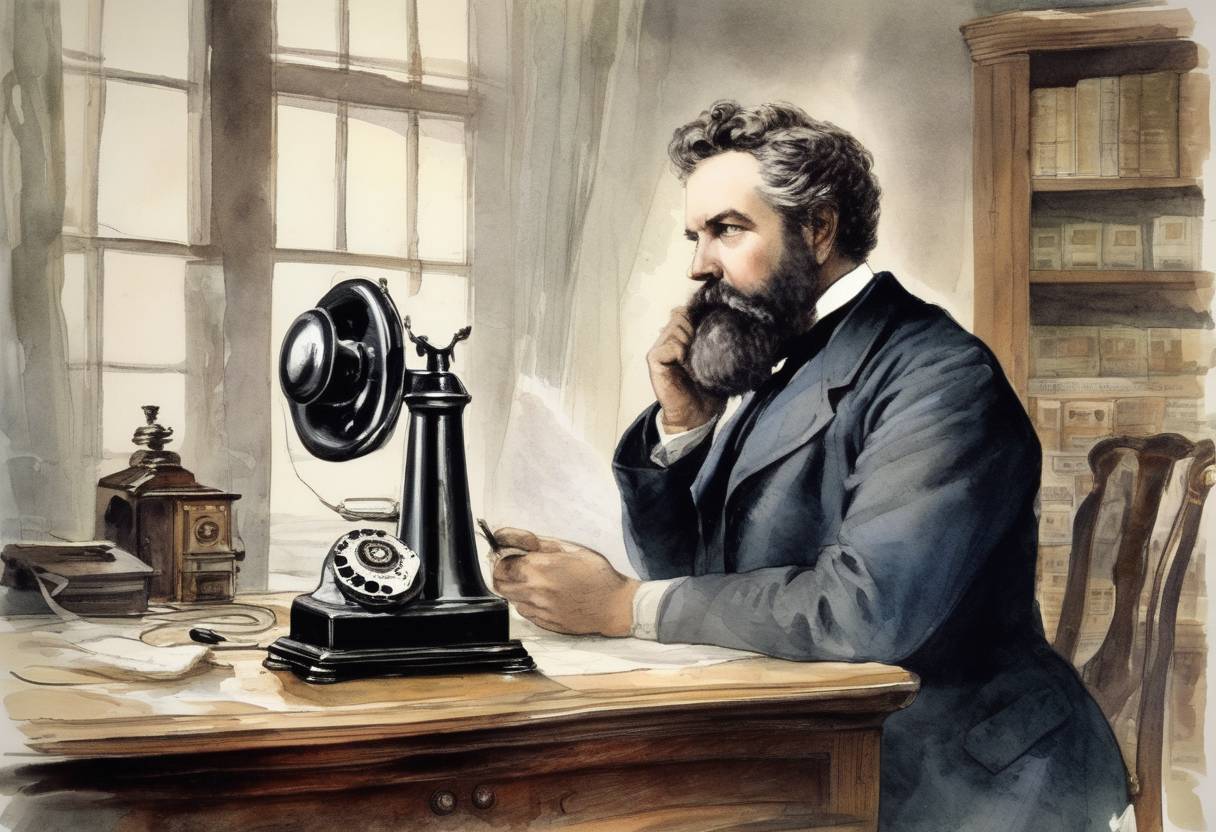
On March 10, 1876, Alexander Graham Bell made history by conducting the first successful telephone call. This pivotal moment in communication technology took place in Boston, Massachusetts, and marked a significant breakthrough in the way humans could interact over long distances.
Alexander Graham Bell, a Scottish-born inventor, had been deeply involved in the study of sound and speech. His interest in these fields was partly influenced by his family background; his father, Alexander Melville Bell, was a renowned elocutionist, and his mother was deaf, which spurred Bell’s interest in acoustics and communication.
Bell’s work on the telephone was conducted alongside his assistant, Thomas Watson. The two had been experimenting with various designs and concepts to transmit vocal sounds electrically. Their efforts were part of a broader wave of innovation during the late 19th century, a period marked by rapid advancements in communication technologies.
On the afternoon of March 10, 1876, Bell and Watson were working in their laboratory. Bell spoke the now-famous words, “Mr. Watson, come here, I want to see you,” into the device they had been developing. Watson, who was in a different room, heard Bell’s voice clearly through the receiver. This successful transmission demonstrated the viability of the telephone as a means of communication.
The success of this experiment was a monumental step forward in telecommunications. It paved the way for the development and commercialization of the telephone, which would revolutionize personal and business communication worldwide.
Following this breakthrough, Bell continued to refine his invention. In 1877, he founded the Bell Telephone Company, which would eventually evolve into the American Telephone and Telegraph Company (AT&T), one of the largest telecommunications companies in the world.
The telephone’s invention had profound implications, not only in connecting people across distances but also in shaping modern society and economies. It facilitated faster business transactions, improved emergency response systems, and contributed to the globalization of communication.
Bell’s invention is often credited with laying the groundwork for the modern telecommunications industry. It set the stage for further innovations, including the development of mobile phones and the internet, which continue to transform how people connect and communicate.
In recognition of his contributions, Alexander Graham Bell is remembered as one of the most influential inventors in history, and his work remains a testament to the power of innovation and perseverance in the face of technical challenges.
Source: en.wikipedia.org