The Siege of Constantinople: April 2, 1453
1453 · Constantinople, Byzantine Empire
Mehmed II, the Ottoman Sultan, began the siege of Constantinople, which would eventually lead to the fall of the Byzantine Empire.
May 29, 1453
The Fall of Constantinople occurred, marking the end of the Byzantine Empire as the Ottoman Empire, led by Sultan Mehmed II, captured the city.
Constantinople, Byzantine Empire (modern-day Turkey) | Ottoman Empire
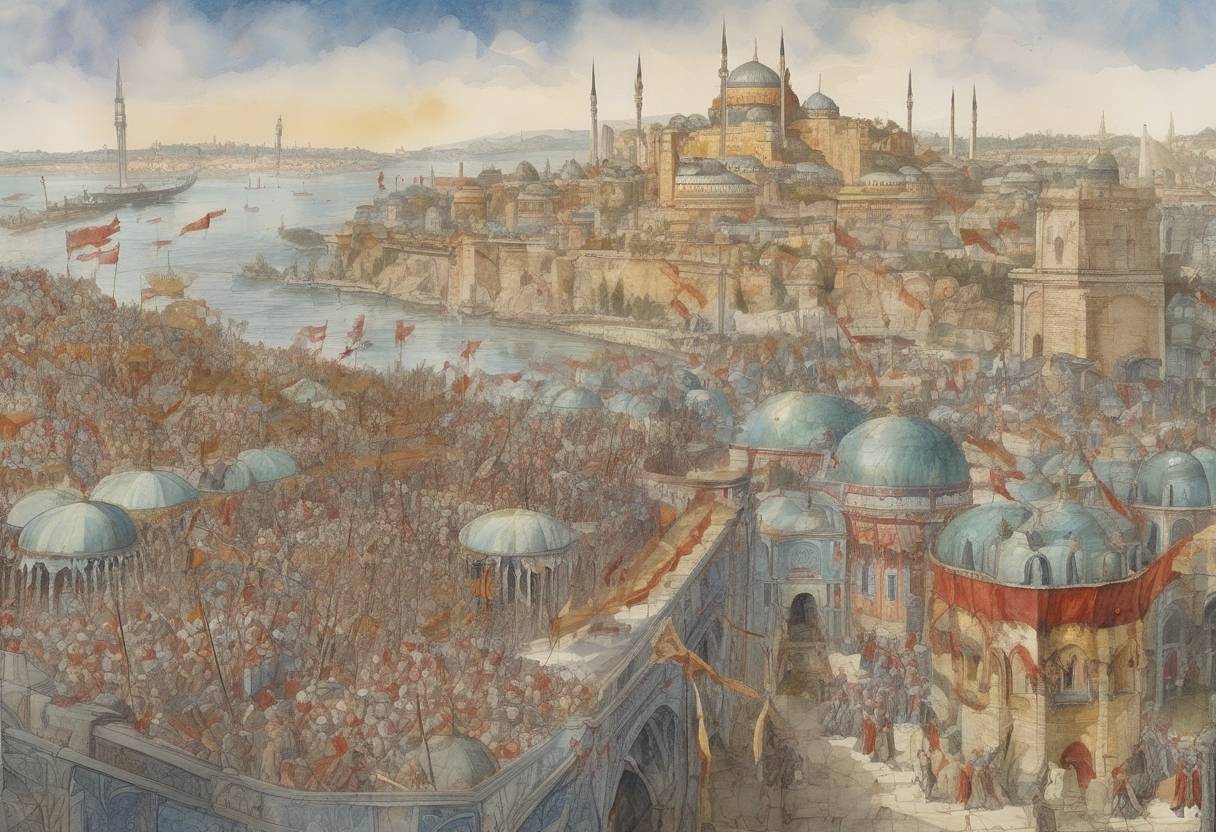
The Fall of Constantinople on May 29, 1453, marks a pivotal moment in world history, symbolizing the end of the Byzantine Empire and the rise of the Ottoman Empire as a dominant power in the region. This event not only reshaped the political landscape of Europe and Asia but also had profound cultural and economic implications.
Byzantine Empire: By the mid-15th century, the Byzantine Empire had significantly weakened, reduced to the city of Constantinople and a few surrounding territories. The empire had been in decline for centuries, beset by internal strife, economic difficulties, and external pressures from both the West and the East.
Ottoman Empire: The Ottomans, under the leadership of Sultan Mehmed II, were a rising power. Mehmed, who ascended to the throne in 1451, was determined to capture Constantinople, a city of immense strategic and symbolic importance. The Ottomans had already surrounded the city with their territories, effectively isolating it.
Preparation: Sultan Mehmed II meticulously prepared for the siege. He amassed a large army, estimated to be between 80,000 and 100,000 men, and constructed a formidable navy. Crucially, he commissioned the creation of large cannons, including the massive “Basilica” cannon, capable of breaching the city’s ancient walls.
Defense of Constantinople: The city’s defenders, led by Emperor Constantine XI Palaiologos, numbered around 7,000, including a contingent of Genoese soldiers under Giovanni Giustiniani. Despite being heavily outnumbered, the defenders relied on the city’s formidable Theodosian Walls and the strategic use of the Golden Horn, a natural harbor protected by a massive chain.
The Siege Begins: The siege began on April 6, 1453. The Ottomans bombarded the city walls with their cannons, while their navy attempted to breach the chain across the Golden Horn. Despite fierce resistance, the defenders were gradually worn down by the relentless assault.
Final Assault: On May 29, 1453, Mehmed launched a final, all-out assault. After weeks of bombardment, a breach was made in the walls. Ottoman forces poured into the city, overwhelming the exhausted defenders.
Death of Constantine XI: Emperor Constantine XI reportedly died fighting on the walls, becoming a symbol of the city’s valiant but doomed defense.
Aftermath: The city was subjected to three days of looting, as was customary in the period. Mehmed II entered the city and converted the Hagia Sophia, the great cathedral of Eastern Orthodoxy, into a mosque, symbolizing the city’s transformation into an Islamic capital.
End of the Byzantine Empire: The fall of Constantinople marked the definitive end of the Byzantine Empire, which had lasted for over a thousand years.
Rise of the Ottoman Empire: The capture of Constantinople established the Ottomans as a major power in both Europe and Asia. The city, renamed Istanbul, became the capital of the Ottoman Empire.
Impact on Europe: The fall of Constantinople sent shockwaves through Christian Europe, leading to increased efforts to find alternative trade routes to Asia, eventually contributing to the Age of Exploration.
Cultural and Religious Impact: The city’s fall marked a significant shift in the balance of power between Christianity and Islam in the region. It also led to the migration of Greek scholars to the West, which helped fuel the Renaissance.
The Fall of Constantinople remains a defining moment in history, illustrating the dynamic shifts in power and culture that characterize the medieval and early modern periods.
Source: en.wikipedia.org