The Tet Offensive: January 31, 1968
1968 · Saigon, Vietnam
The Tet Offensive begins during the Vietnam War, as North Vietnamese and Viet Cong forces launch surprise attacks against South Vietnamese and U.S. forces.
April 30, 1975
The Vietnam War officially ended with the fall of Saigon to North Vietnamese forces, marking the reunification of Vietnam under communist control.
Saigon, Vietnam | North Vietnamese Army
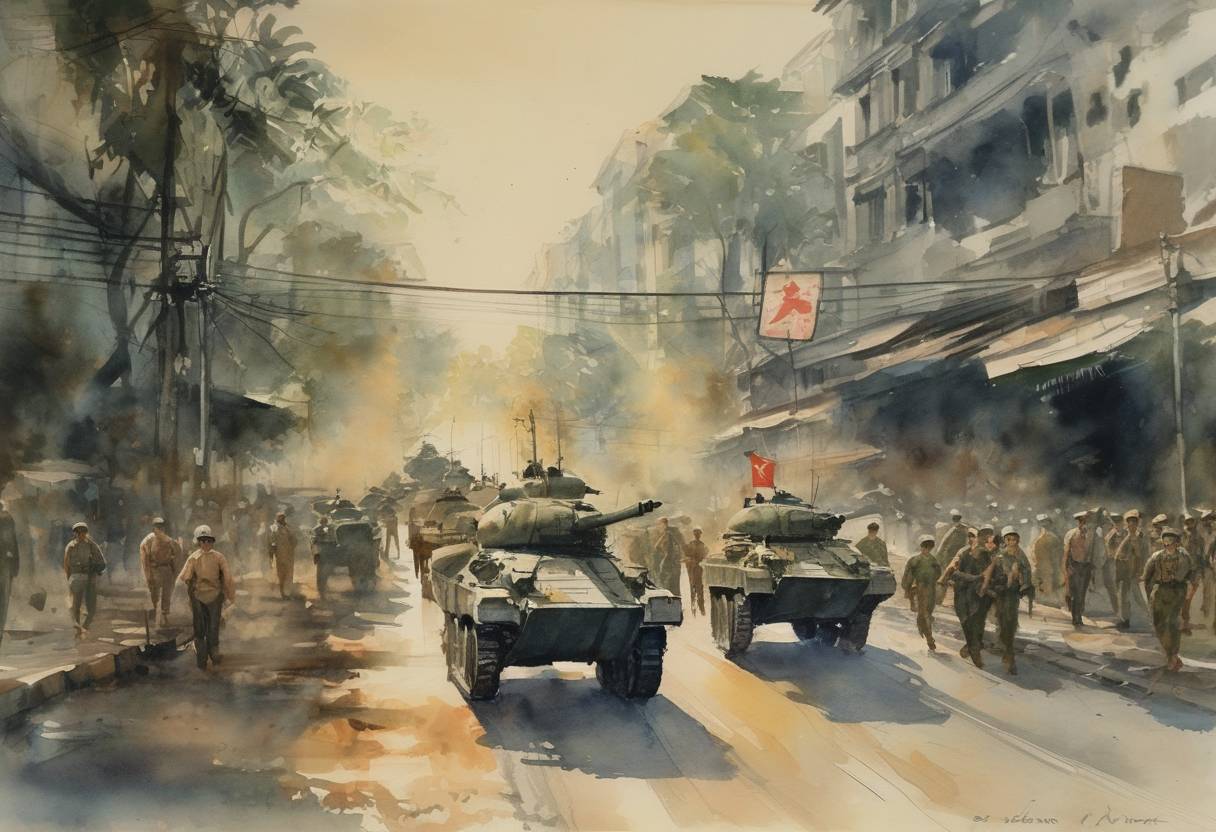
The Vietnam War, a protracted conflict that lasted from November 1, 1955, to April 30, 1975, officially concluded with the fall of Saigon. This event marked a significant turning point in Vietnamese history, leading to the reunification of Vietnam under communist control.
The Vietnam War was primarily a struggle between the communist forces of North Vietnam, supported by the Soviet Union and China, and the non-communist government of South Vietnam, backed by the United States and other anti-communist allies. The conflict was part of the larger Cold War struggle between the communist and capitalist blocs.
In the early 1970s, the United States began to withdraw its troops from Vietnam under President Richard Nixon’s policy of “Vietnamization,” which aimed to transfer combat responsibilities to South Vietnamese forces. Despite the 1973 Paris Peace Accords, which intended to establish peace and end direct U.S. military involvement, fighting continued between North and South Vietnam.
North Vietnamese Offensive: In early 1975, North Vietnamese forces launched a major offensive, rapidly advancing through South Vietnam. By April, they had reached the outskirts of Saigon, the capital of South Vietnam.
Evacuation Efforts: As North Vietnamese troops closed in on Saigon, the United States initiated “Operation Frequent Wind,” the largest helicopter evacuation in history, to evacuate American personnel and at-risk South Vietnamese citizens. The operation was conducted under chaotic conditions, with helicopters airlifting people from the U.S. Embassy and other locations in Saigon.
Capture of Saigon: On April 30, 1975, North Vietnamese tanks rolled into Saigon, encountering little resistance. The South Vietnamese government, led by President Duong Van Minh, surrendered unconditionally. The iconic image of a North Vietnamese tank crashing through the gates of the Presidential Palace symbolized the end of the war.
Reunification of Vietnam: Following the fall of Saigon, Vietnam was officially reunified under communist control on July 2, 1976, as the Socialist Republic of Vietnam, with its capital in Hanoi.
Impact on the United States: The fall of Saigon marked a significant moment in U.S. history, symbolizing the end of American involvement in Vietnam and a broader reassessment of U.S. foreign policy. It also led to a period of reflection and debate over the war’s conduct and consequences.
Legacy in Vietnam: The reunification of Vietnam under a communist government led to significant social and economic changes. The new government implemented socialist policies, which included land reforms and the nationalization of industries. The war’s legacy continues to influence Vietnam’s domestic and foreign policies.
The fall of Saigon remains a pivotal moment in 20th-century history, representing the culmination of a complex and deeply divisive conflict that had profound implications for Vietnam, the United States, and the world.
Source: en.wikipedia.org