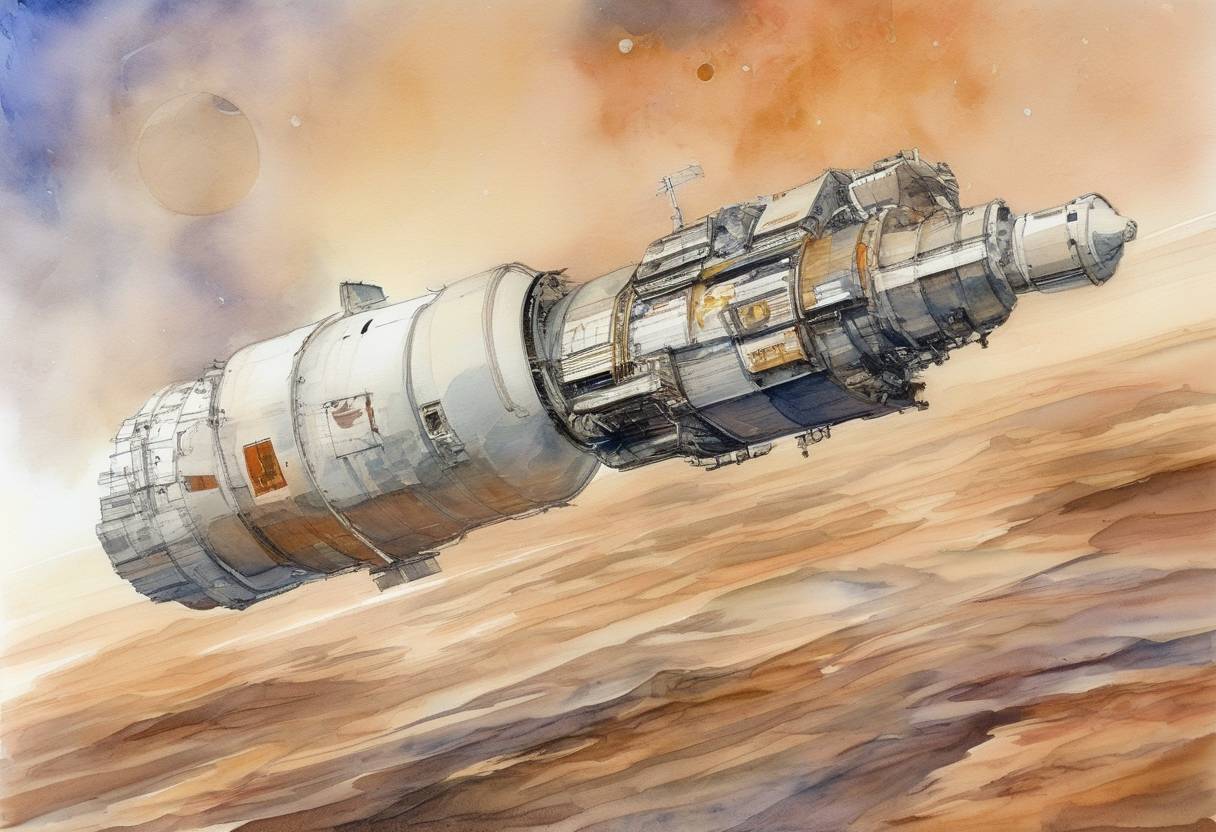
Mars Express Mission: Europe’s First Mission to Another Planet
On June 2, 2003, the European Space Agency (ESA) launched its first interplanetary mission, Mars Express, marking a significant milestone in European space exploration. This mission was designed to study the Martian atmosphere, surface, and subsurface, contributing valuable data to our understanding of the Red Planet.
Background and Objectives
Mars Express was conceived in the late 1990s as part of ESA’s Horizon 2000 program, which aimed to enhance Europe’s capabilities in space science. The mission’s primary objectives included:
- Mapping the Martian Surface: Using high-resolution imaging to create detailed maps of the planet’s topography.
- Studying the Atmosphere: Analyzing the composition and dynamics of the Martian atmosphere.
- Searching for Water: Investigating the presence and distribution of water and ice beneath the surface.
- Understanding Geological Processes: Examining the planet’s geology to understand its history and evolution.
Key Components
Mars Express consisted of an orbiter and a lander, Beagle 2:
Mars Express Orbiter: Equipped with seven scientific instruments, including the High Resolution Stereo Camera (HRSC) and the Mars Advanced Radar for Subsurface and Ionosphere Sounding (MARSIS), the orbiter was designed to conduct comprehensive studies of Mars from orbit.
Beagle 2 Lander: Named after Charles Darwin’s ship, the Beagle 2 was intended to land on Mars and conduct experiments on the surface. Unfortunately, contact with Beagle 2 was lost upon its descent, and it was declared lost until it was later found on the Martian surface in 2015.
Launch and Journey
Mars Express was launched aboard a Soyuz-FG rocket from the Baikonur Cosmodrome in Kazakhstan. The spacecraft embarked on a six-month journey to Mars, arriving in December 2003. Upon arrival, the orbiter successfully entered Martian orbit, beginning its scientific mission.
Scientific Achievements
Since its arrival, Mars Express has made numerous significant contributions to Martian science:
- Water Discovery: Mars Express provided evidence of water ice at the planet’s poles and detected subsurface water ice.
- Methane Detection: The mission detected methane in the Martian atmosphere, sparking debates about potential biological or geological sources.
- Geological Insights: The orbiter’s instruments have helped map the planet’s surface in unprecedented detail, revealing insights into its geological history.
Broader Significance
Mars Express has been a cornerstone of ESA’s planetary exploration efforts, demonstrating Europe’s capability to conduct complex interplanetary missions. It has paved the way for subsequent missions and international collaborations in the exploration of Mars and beyond.
The mission continues to operate beyond its expected lifespan, providing valuable data and contributing to our understanding of Mars as a potential habitat for life and a target for future human exploration.