The Battle of Jena-Auerstedt: October 14, 1806
1806 · Jena and Auerstedt, Germany
The Battle of Jena-Auerstedt occurred, where Napoleon's forces decisively defeated the Prussian army.
December 2, 1800
The Battle of Hohenlinden, a significant battle during the War of the Second Coalition, was fought between the French army led by Jean Victor Marie Moreau and the forces of Austria and Bavaria.
Hohenlinden, Electorate of Bavaria | French Army
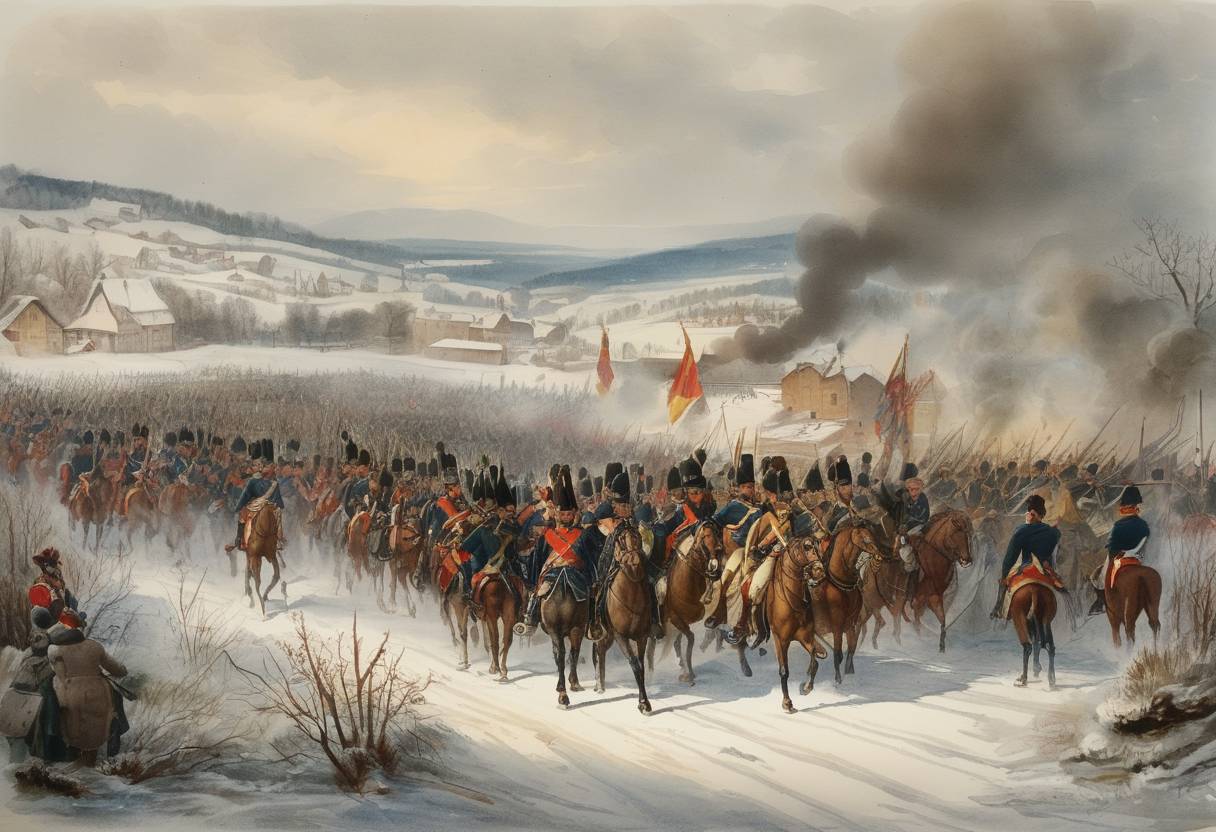
The Battle of Hohenlinden, which took place on December 2, 1800, during the War of the Second Coalition, stands as a decisive engagement between the French forces under General Jean Victor Marie Moreau and the combined Austrian-Bavarian army. This battle occurred near the village of Hohenlinden, located approximately 20 miles east of Munich in Bavaria.
The War of the Second Coalition (1798–1802) was part of the broader series of French Revolutionary Wars. Opposed to revolutionary France were several European monarchies, including Austria, Russia, the United Kingdom, the Ottoman Empire, and others forming the Second Coalition. The conflict was driven by the desire to curtail the spread of revolutionary ideas and to restore monarchical authority across Europe.
In 1800, military operations resumed following a brief period of armistice. French forces, having achieved a strategic advantage, sought to solidify their position. The decision to engage the Austrian and Bavarian forces at Hohenlinden was informed by the need to disrupt the coalition’s plans and secure French dominance in the region.
On the morning of December 2, under conditions of heavy snow, the coalition forces, commanded by Austrian Archduke John and comprising approximately 60,000 troops, advanced through the dense forest to engage the French army. The 56,000-strong French forces under General Moreau were well-prepared, having established a strong defensive position.
Moreau’s strategic foresight was evident in his use of the terrain and deployment of artillery. He orchestrated a pincer movement, effectively cutting off the Austro-Bavarian forces. The French divisions launched coordinated counterattacks against the disorganized enemy columns. A particular highlight of the battle was General Antoine Richepanse’s bold maneuver through the forest, which struck at the coalition’s flank and rear, causing chaos and disarray.
The battle concluded with a decisive victory for the French. The Austro-Bavarian forces suffered heavy casualties, with around 5,000 killed and wounded and another 10,000 captured. French losses were significantly lower, further demonstrating the effectiveness of Moreau’s tactics.
The victory at Hohenlinden was a pivotal moment in the War of the Second Coalition. It forced the Austrians into a rapid retreat toward Austria and led to the Treaty of Lunéville, signed in February 1801. This treaty marked the end of hostilities between Austria and France, consolidating French influence over large parts of Europe.
The battle underscored the competence of French military leadership and tactics developed during the Revolutionary Wars, allowing France to effectively counter the coalition forces. It also foreshadowed the emergence of Napoleon Bonaparte as a dominant figure in European politics, as his earlier victory at the Battle of Marengo in June had already set the stage for French successes during this period.
Source: en.wikipedia.org