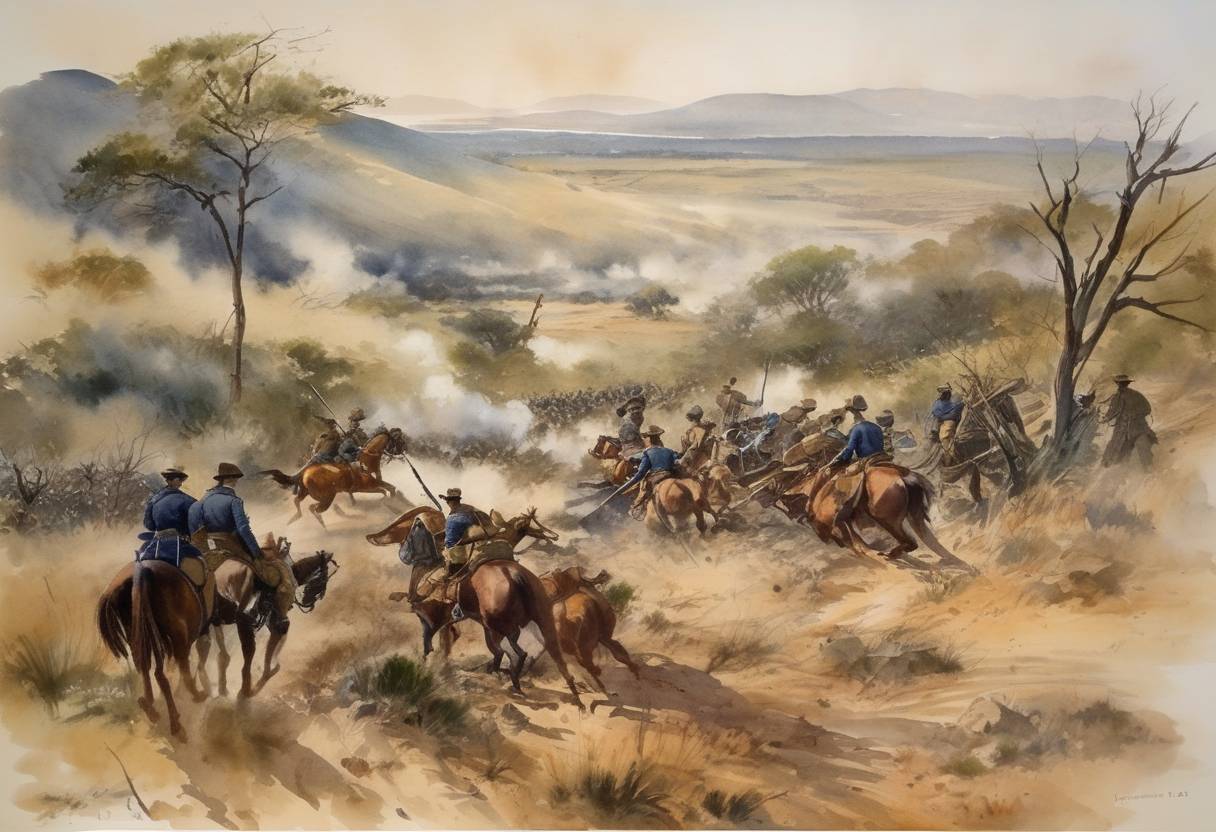
Battle of Talana Hill: October 13, 1899
The Battle of Talana Hill, fought on October 13, 1899, marked one of the initial engagements of the Second Boer War, a conflict between the British Empire and two Boer republics: the South African Republic (Transvaal) and the Orange Free State. This battle was fought near the town of Dundee in the Colony of Natal, South Africa.
Background
The Second Boer War began after tensions escalated due to British imperial aims in southern Africa and the resistance from the Boer republics. The British sought to consolidate their control over the region, which was rich in resources, including gold. The Boers, predominantly of Dutch descent, opposed this expansion, seeking to remain independent.
The Battle
Combatants
- British Forces: Led by Major General Sir William Penn Symons, the British troops stationed in northern Natal faced the challenge of confronting Boer movements in the area.
- Boer Forces: Under the command of General Lucas Meyer, approximately 4,000 Boer forces prepared to confront the British.
Engagement
- Location and Terrain: The battle took place on Talana Hill, a strategically important position. The terrain was challenging, comprising steep climbs and rocky outcrops, advantageous to the Boers with their knowledge of local geography.
- British Assault: Early in the morning, the British launched a direct assault, climbing the steep slopes of Talana Hill under heavy fire. Despite the challenging conditions, the British managed to reach the summit and engage in close combat with the Boer forces.
- Outcome: The British succeeded in driving the Boers off the hill but suffered significant casualties. Among those casualties was Major General Penn Symons, who was mortally wounded during the attack.
Consequences
Though technically a British victory given their control of the field after the battle, the high cost in lives and the wounded general signified the formidable resistance they faced. The battle highlighted the determination and resourcefulness of the Boer fighters, who were skilled marksmen adept in their guerrilla-style warfare.
Historical Significance
- Tactical Lessons: The ferocious resistance at Talana Hill underscored the need for the British to adjust their tactics to contend with the Boers’ unconventional warfare techniques.
- Motivation: The engagement solidified both sides’ resolve. The British continued their campaign to subdue the Boer republics, while the Boers leveraged this and similar engagements to fuel their determination to defend their sovereignty.
In retrospect, the Battle of Talana Hill set the tone for a protracted and bitter conflict that would last until 1902, influencing military tactics and colonial policy in the era.