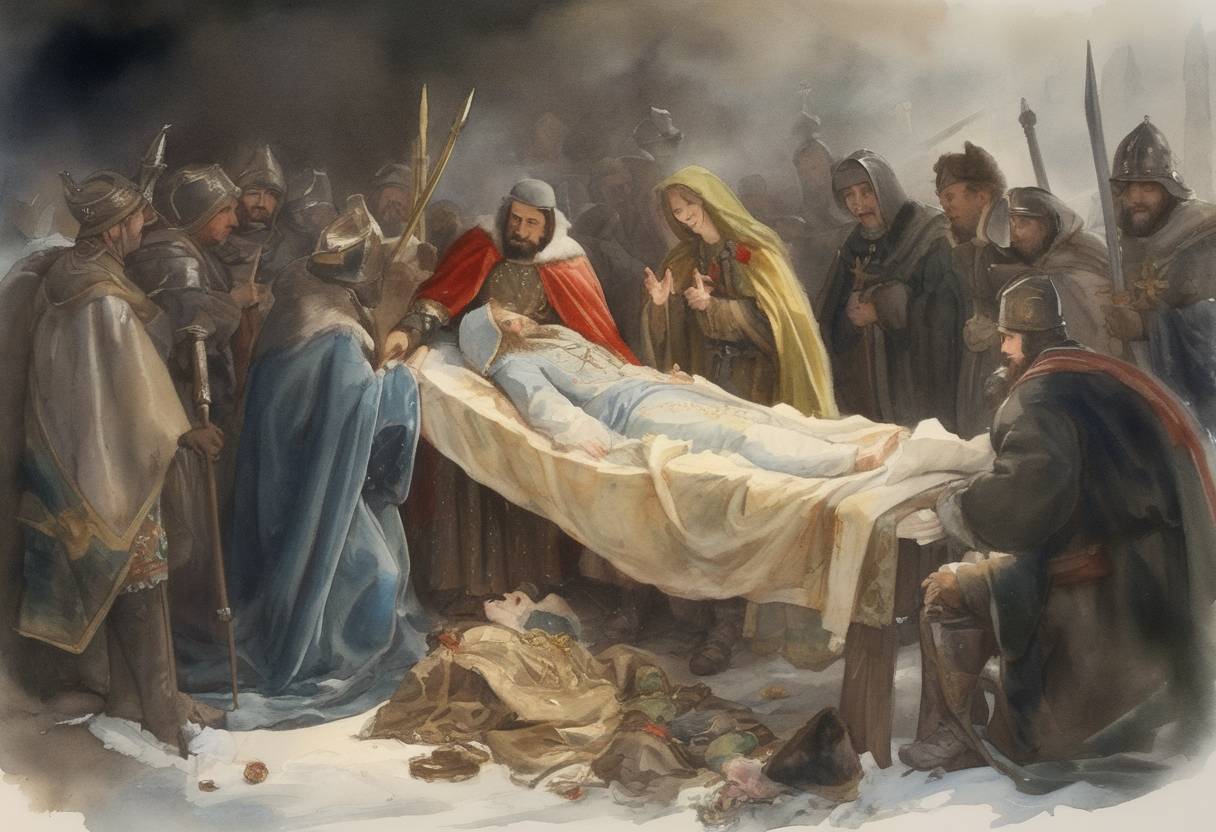
Death of Saint Wenceslas, Duke of Bohemia
Historical Context
Wenceslas I, Duke of Bohemia, was a paramount figure in the history of the Czech lands, known for his principled governance and promotion of Christianity throughout his realm. Born circa 907, he ascended to the ducal throne around 921 following the death of his father, Vratislaus I. His reign marked a pivotal shift towards the establishment of Christianity as a vital pillar of Bohemian culture and politics, in part influenced by his Christian mother, Drahomíra, and his grandmother, Ludmila, who had been converted by the influential Saint Methodius.
Events Leading Up to His Death
Tensions during Wenceslas’s rule grew primarily from his pro-German policies and steadfast support of Christianity, which was at odds with the pagan traditions upheld by certain factions within Bohemia. This ideological divide was further exacerbated by Wenceslas’s brother, Boleslaus the Cruel, who resented Wenceslas for his favorable stance towards ties with the Holy Roman Empire and the Christian church.
The Assassination on September 28, 935
On September 28, 935, Wenceslas was assassinated by his own brother, Boleslaus, near the church of St. Cosmas and Damian in Stará Boleslav, a small town near Prague. This event became a landmark in Bohemian history due to both the fratricidal nature of the act and its implications on the region’s political landscape. The murder occurred after Boleslaus invited Wenceslas to a feast celebrating the feast of Saints Cosmas and Damian. It was here that loyal followers of Boleslaus ambushed and killed Wenceslas as he was en route to attend church services.
Aftermath and Canonization
The assassination of Wenceslas drastically affected Bohemia, catapulting Boleslaus to power. However, Wenceslas’s death galvanized his legacy as a champion of Christian virtues and martyrdom. His posthumous canonization as a saint not only solidified his status in ecclesiastical history but also made him a central patron figure in Czech tradition.
Wenceslas was canonized shortly after his death, revered as a martyr who gave his life for the Christian faith and Czech sovereignty. His relics were transferred to St. Vitus Cathedral in Prague, and his legacy as a symbol of moral righteousness and national identity has endured through the centuries, with echoes of his story immortalized in the Christmas carol “Good King Wenceslas.”
Broader Historical Significance
The martyrdom of Saint Wenceslas is more than a tale of familial betrayal; it underscores the turbulent waters of early medieval European politics, where nascent states grappled with internal religious transformations amid broader political contests. Wenceslas’s death marked both a literal and symbolic passage from pagan traditions to a Christian Bohemia, setting a foundational bedrock for the region’s future development.
His legacy persists prominently in Czech culture and religious celebrations, reflecting the enduring influence of his life and martyrdom on national identity.