Jadwiga is Crowned King of Poland - October 16, 1384
1384 · Kraków, Poland
Jadwiga is crowned King of Poland, a title she holds despite being female, marking a significant moment in Polish history.
October 19, 1466
The Pomeranian city of Kolberg accepts Polish King Casimir IV Jagiellon's overlordship, marking a significant event in the regional power dynamics of the time.
Kolberg, Poland | Kingdom of Poland
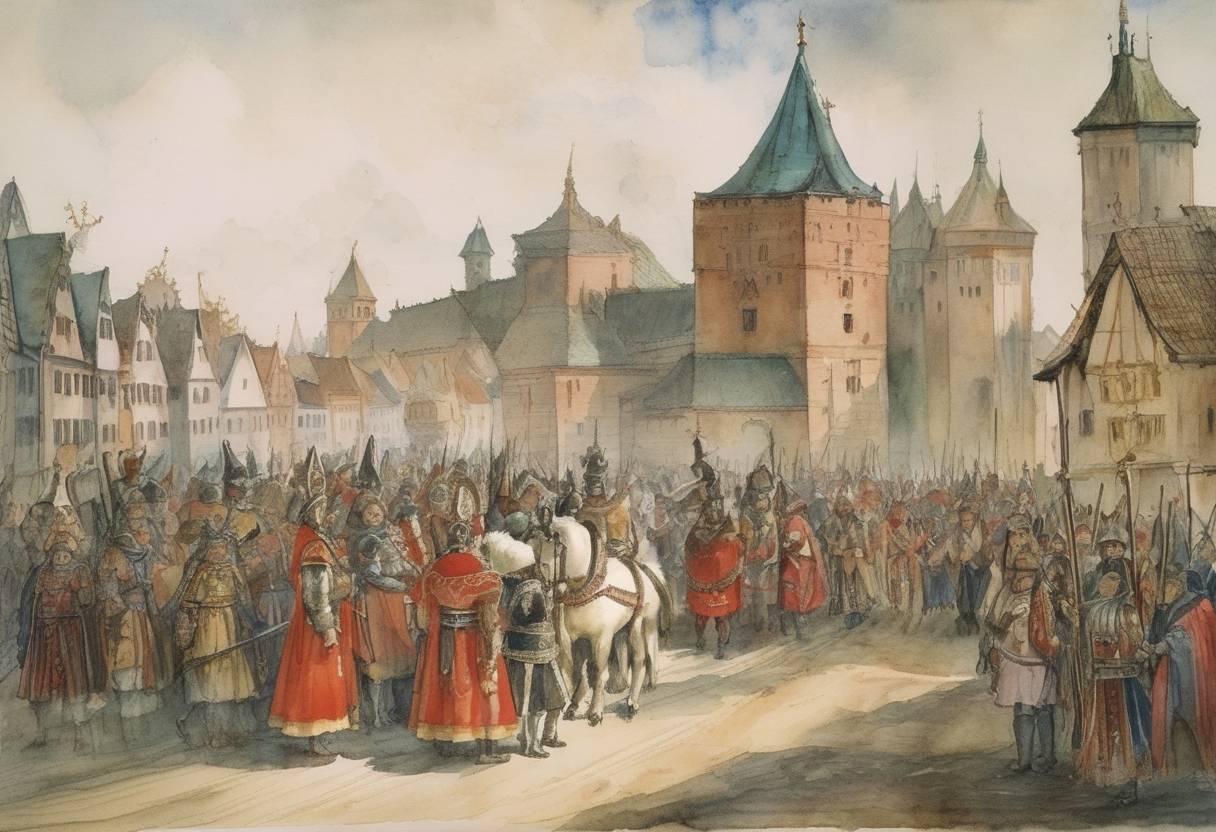
On October 19, 1466, the city of Kolberg (now Kołobrzeg, Poland), a significant town in Pomerania, acknowledged the sovereignty of the Polish King Casimir IV Jagiellon. This event was an integral part of the concluding phases of the Thirteen Years’ War (1454–1466) between the Kingdom of Poland and the Teutonic Knights, which ended with the Second Peace of Thorn.
The Thirteen Years’ War was fundamentally a struggle over influence in Central Europe, with the Teutonic Order seeking to maintain its control over the Prussian regions against burgeoning Polish influence. Following years of conflict, the signing of the Second Peace of Thorn on October 19, 1466, dramatically shifted regional power dynamics. This treaty saw substantial territorial cessions from the Teutonic Order to Poland and transformed the balance of power in the Baltic region.
Kolberg’s acceptance of Polish overlordship signaled a broader realignment in the region. Situated strategically on the Baltic Sea, control over Kolberg was significant for maintaining trade routes and exerting influence in Pomerania. Its submission under Polish control demonstrated the effectiveness of Poland’s diplomatic and military campaigns and marked the decline of the Teutonic Order’s territorial dominance.
Territorial Changes: The treaty restored several territories to Polish control, including the cities of Danzig (Gdańsk), Thorn (Toruń), and Elbing (Elbląg), alongside Warmia, and parts of Pomerania.
Influence in the Baltic Sea: Poland’s acquisition of coastal cities enhanced its position in the Baltic trade and increased its influence across the northern European political sphere.
Decline of the Teutonic Order: The weakened Teutonic Order was reduced to a vassal state of Poland, signaling a significant decline in its power and setting the stage for future conflicts and transformations within the Order.
Casimir IV’s Reign: This marked a continued expansion and consolidation of Casimir IV Jagiellon’s power, reinforcing the authority of the Polish crown over the diverse regions under its control.
Kolberg’s submission, as part of the Second Peace of Thorn, demonstrated the shifting allegiances and power structures within late medieval Europe. It exemplified the complex interactions between emerging nation-states and multinational military orders, which were common in this period. This event, along with the broader treaty outcomes, solidified the Polish Kingdom’s central role in shaping Central and Eastern European politics at the time.
Source: en.wikipedia.org