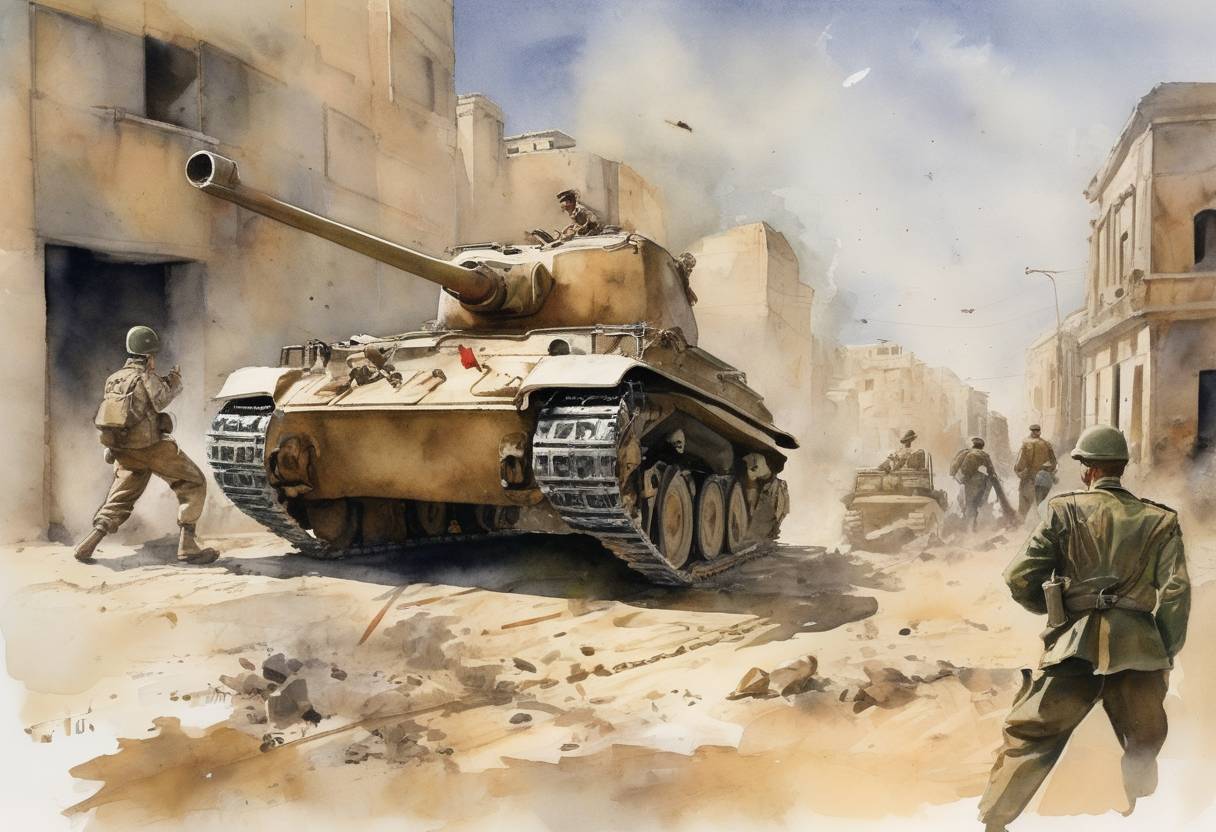
Capture of Tripoli by British Forces - January 23, 1943
On January 23, 1943, British forces successfully captured the city of Tripoli, marking a significant milestone in the North African Campaign of World War II. This event was a crucial victory for the Allies against the Axis powers, particularly the German-Italian Panzer Army led by Field Marshal Erwin Rommel.
Context and Background
- North African Campaign: The North African Campaign was a series of battles for control of the North African desert regions, primarily between the Axis powers (Germany and Italy) and the Allies (primarily the United Kingdom and Commonwealth nations, later joined by the United States).
- Strategic Importance: Tripoli, the capital of Libya, was strategically important due to its location and its role as a supply hub for Axis forces. Control of Tripoli allowed for better logistical support and a base for further operations in the region.
Key Events Leading Up to the Capture
- Operation Torch: In November 1942, the Allies launched Operation Torch, a major campaign involving landings in North Africa. This operation aimed to relieve pressure on the Soviet Union by opening a second front and to secure North Africa for the Allies.
- Battle of El Alamein: Prior to the capture of Tripoli, the Second Battle of El Alamein (October 23 – November 11, 1942) was a turning point in the North African Campaign. The victory by the British Eighth Army, under the command of General Bernard Montgomery, forced Rommel’s forces to retreat westward.
- Pursuit Across Libya: Following El Alamein, the British Eighth Army pursued the retreating Axis forces across Libya. The relentless pursuit and continuous pressure eventually led to the capture of key locations, including Benghazi and eventually Tripoli.
The Capture of Tripoli
- British Eighth Army: Led by General Bernard Montgomery, the British Eighth Army entered Tripoli on January 23, 1943, after a swift advance across the Libyan desert. The capture was achieved with minimal resistance as Axis forces had already withdrawn.
- Significance: The fall of Tripoli deprived the Axis of a critical supply and communication center, further weakening their position in North Africa. It also boosted Allied morale and demonstrated the effectiveness of coordinated Allied operations.
Aftermath and Consequences
- Axis Retreat: The capture of Tripoli forced the Axis powers to continue their retreat into Tunisia, where they would eventually be cornered and defeated in the subsequent Tunisian Campaign.
- Allied Momentum: The victory at Tripoli contributed to the momentum of Allied forces in North Africa, setting the stage for the eventual Allied invasion of Italy.
- Strategic Shift: The success in North Africa allowed the Allies to shift focus towards the European mainland, leading to further operations in the Mediterranean and the eventual invasion of Sicily in July 1943.
The capture of Tripoli was a pivotal moment in the North African Campaign, showcasing the strategic prowess of the Allied forces and marking the beginning of the end for Axis ambitions in Africa.