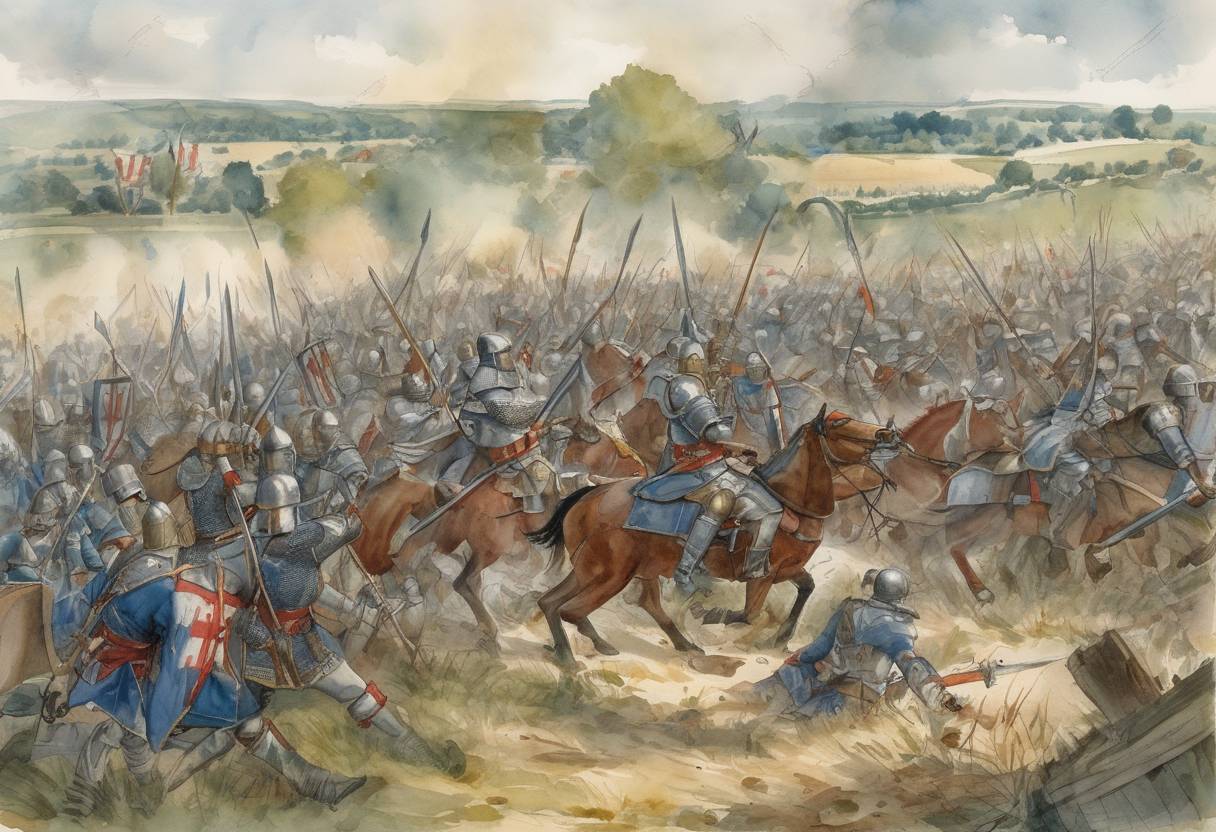
The Battle of Crécy: August 26, 1346
The Battle of Crécy, fought on August 26, 1346, was a pivotal engagement during the Hundred Years’ War, a protracted conflict between England and France that lasted from 1337 to 1453. This battle is renowned for the decisive victory of the English forces, led by King Edward III, over a numerically superior French army commanded by King Philip VI.
Context and Prelude
The Hundred Years’ War was primarily a dynastic struggle over claims to the French throne, exacerbated by territorial disputes and economic tensions. By 1346, Edward III had launched a major campaign into northern France, aiming to assert his claim to the French crown and to secure English territories in the region.
Edward’s army, composed of approximately 12,000 men, including a significant contingent of longbowmen, had been conducting a chevauchée—a fast-moving raid—through Normandy. As Edward moved his forces towards the English Channel, the French army, estimated at around 20,000 to 30,000 troops, sought to intercept and crush the English invaders.
The Battle
The battle took place near the village of Crécy-en-Ponthieu in northern France. Edward III strategically positioned his forces on a ridge, providing a defensive advantage. The English army was organized into three divisions, with longbowmen placed on the flanks and dismounted knights and men-at-arms in the center.
The French, confident in their numerical superiority, launched a series of frontal assaults. However, the English longbowmen, armed with the powerful longbow, unleashed devastating volleys of arrows that decimated the advancing French cavalry and infantry. The muddy terrain, compounded by a sudden rainstorm, further hindered the French assaults.
The French army, lacking coordination and hampered by the terrain, suffered heavy casualties. Notably, the Genoese crossbowmen, hired by the French, were ineffective against the English longbows and were quickly overwhelmed. The French knights, charging in disarray, were unable to break the English lines.
Aftermath and Significance
The Battle of Crécy was a catastrophic defeat for the French, with thousands of French soldiers, including many nobles, killed. The victory demonstrated the effectiveness of the English longbow and marked a shift in medieval warfare, highlighting the decline of heavily armored cavalry in favor of infantry and ranged weaponry.
Edward III’s triumph at Crécy paved the way for further English successes in the war, including the subsequent siege and capture of Calais in 1347, which became a vital English stronghold for over two centuries.
The battle also underscored the importance of tactical innovation and battlefield discipline, setting a precedent for future military engagements during the Hundred Years’ War. The English victory at Crécy remains a significant event in medieval military history, illustrating the evolving nature of warfare during the period.