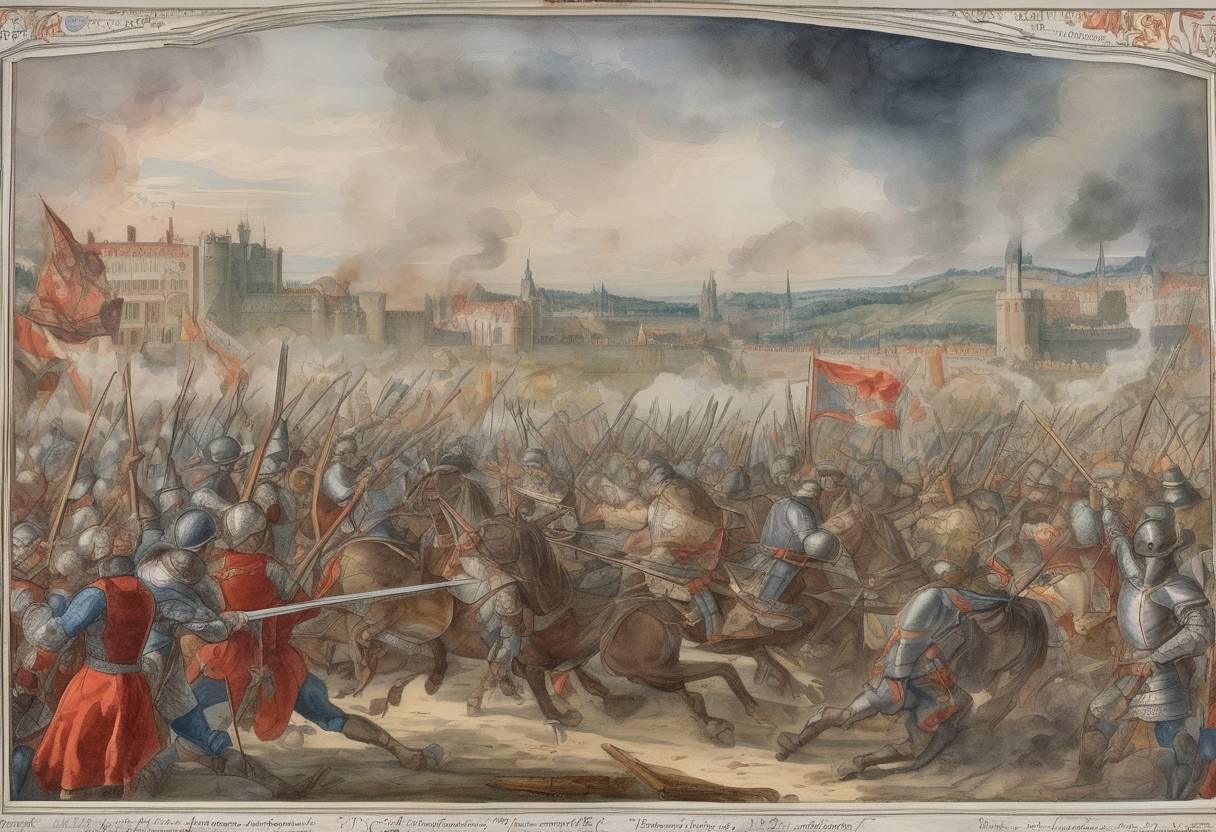
Battle of Ivry: March 14, 1590
The Battle of Ivry, fought on March 14, 1590, was a significant engagement during the French Wars of Religion, a series of conflicts that plagued France in the late 16th century. This battle saw the forces of Henry IV of France achieve a decisive victory over the Catholic League, led by Charles, Duke of Mayenne.
Context
The French Wars of Religion (1562–1598) were primarily fought between Catholics and Huguenots (French Protestants). The conflict was not only religious but also political, involving various factions vying for control of the French crown. Henry IV, originally Henry of Navarre, was a Huguenot and a key figure in these wars. His claim to the French throne was contested by the Catholic League, a coalition of Catholic nobles and cities supported by Spain.
Key Events Leading to the Battle
- 1589: Henry III of France was assassinated, leaving Henry of Navarre as his successor. However, his Protestant faith made his rule unacceptable to many Catholics.
- Catholic League: Led by the Duke of Mayenne, the League sought to prevent Henry IV from consolidating power, supporting instead the Catholic claimant to the throne.
- Military Campaigns: In the months leading up to Ivry, Henry IV had been campaigning to secure his position, facing off against the League’s forces in various skirmishes.
The Battle
- Location: The battle took place near Ivry-la-Bataille, in Normandy.
- Forces: Henry IV commanded a diverse army of about 12,000 men, including both Huguenots and Catholic loyalists. The Duke of Mayenne led a slightly larger force of around 15,000, predominantly Catholic League troops.
- Tactics: Henry IV’s forces were well-organized and motivated. He famously rallied his troops with the words, “Ralliez-vous à mon panache blanc!” (“Rally to my white plume!”), referring to the white plume he wore in his helmet.
- Outcome: The battle was a decisive victory for Henry IV. His cavalry charge broke the League’s lines, leading to a rout. The Duke of Mayenne’s forces suffered heavy casualties, and many were captured.
Aftermath and Significance
- Consolidation of Power: The victory at Ivry allowed Henry IV to strengthen his claim to the French throne, although he continued to face resistance.
- Paris Siege: Following the battle, Henry IV laid siege to Paris, a stronghold of the Catholic League, although he was unable to capture it immediately.
- Edict of Nantes: The ongoing conflict eventually led to the Edict of Nantes in 1598, which granted substantial rights to the Huguenots and ended the Wars of Religion.
- Legacy: Henry IV’s leadership at Ivry and his subsequent conversion to Catholicism in 1593 (“Paris is worth a Mass”) were pivotal in his eventual acceptance as king, leading to a period of relative peace and stability in France.
The Battle of Ivry remains a notable example of Henry IV’s military acumen and his ability to unite disparate factions under his leadership, setting the stage for his successful reign as one of France’s most popular monarchs.