Execution of the Girondists: October 31, 1793
1793 · Paris, France
Execution of the Girondists: Twenty-one leaders of the Girondin political faction are executed during the French Revolution.
May 8, 1794
Antoine Lavoisier, the 'father of modern chemistry,' is executed by guillotine during the French Revolution.
Paris, France | Revolutionary Tribunal
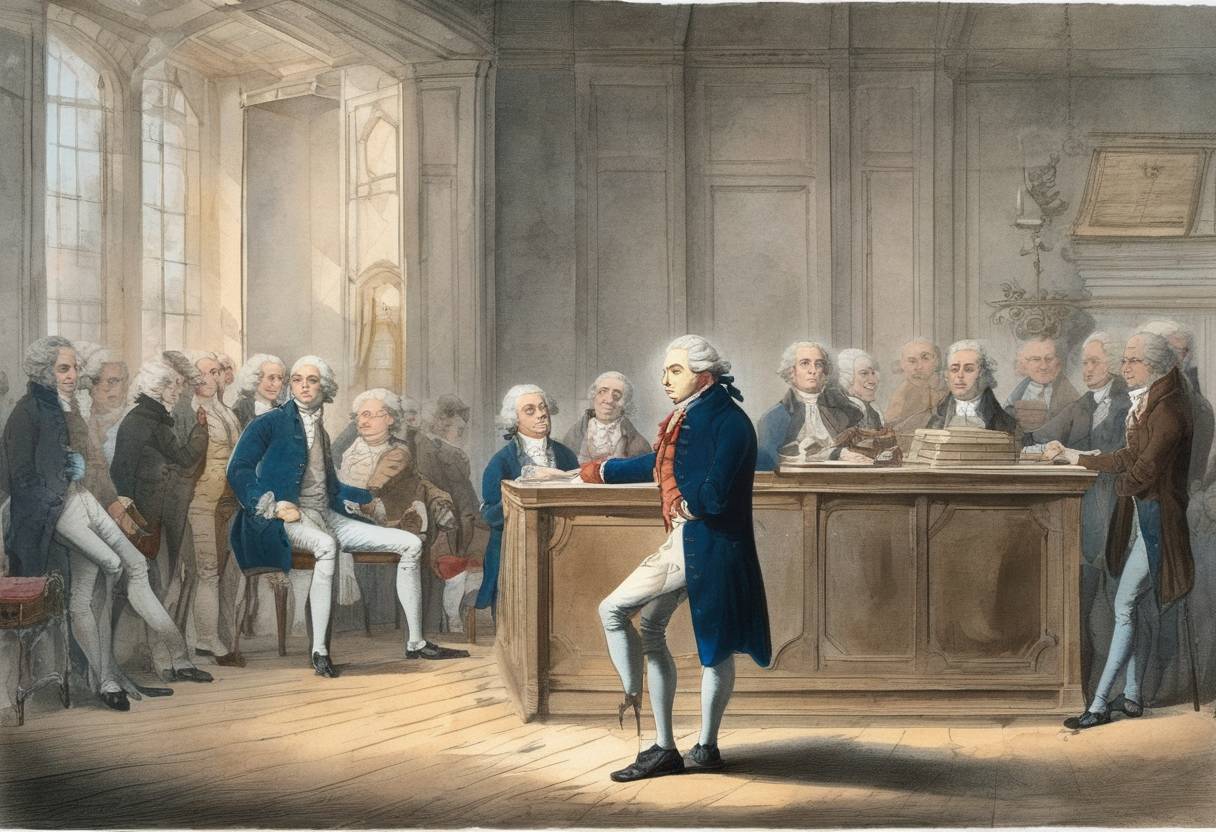
Antoine-Laurent de Lavoisier, often referred to as the “father of modern chemistry,” was executed by guillotine on May 8, 1794, during the tumultuous period of the French Revolution. His death marked a significant and tragic moment in the history of science and the Revolution itself.
Lavoisier was born on August 26, 1743, in Paris, France. He was a pioneering chemist whose work laid the foundations for modern chemistry. Among his many contributions, Lavoisier is best known for:
Despite his scientific achievements, Lavoisier’s involvement in financial and political affairs led to his downfall. He was a member of the Ferme Générale, a private tax collection agency that was deeply unpopular among the French populace. The agency was seen as a symbol of the Ancien Régime’s corruption and exploitation.
During the French Revolution, the revolutionary government sought to dismantle the old structures of power and privilege. In 1793, the Ferme Générale was abolished, and its members, including Lavoisier, were arrested. He was charged with various offenses, including conspiracy against the state and financial misconduct.
Lavoisier’s trial was swift and politically motivated. Despite his contributions to science and his attempts to defend himself, the revolutionary tribunal showed little interest in his scientific achievements. He was found guilty and sentenced to death.
On May 8, 1794, Lavoisier was executed by guillotine in Paris. His death was famously lamented by the mathematician Joseph-Louis Lagrange, who reportedly said, “It took them only an instant to cut off that head, but France may not produce another like it in a century.”
Lavoisier’s execution was a stark reminder of the Revolution’s capacity for both progress and destruction. His death underscored the volatile intersection of science, politics, and social upheaval during this period.
In the years following the Revolution, Lavoisier’s contributions to chemistry were increasingly recognized and celebrated. His work laid the groundwork for future scientific advancements and established principles that continue to underpin modern chemistry.
Today, Lavoisier is remembered not only for his scientific achievements but also as a victim of the revolutionary fervor that swept through France, claiming the lives of many who were caught in its path. His legacy endures as a testament to the enduring power of scientific inquiry and the often perilous intersection of science and politics.
Source: en.wikipedia.org