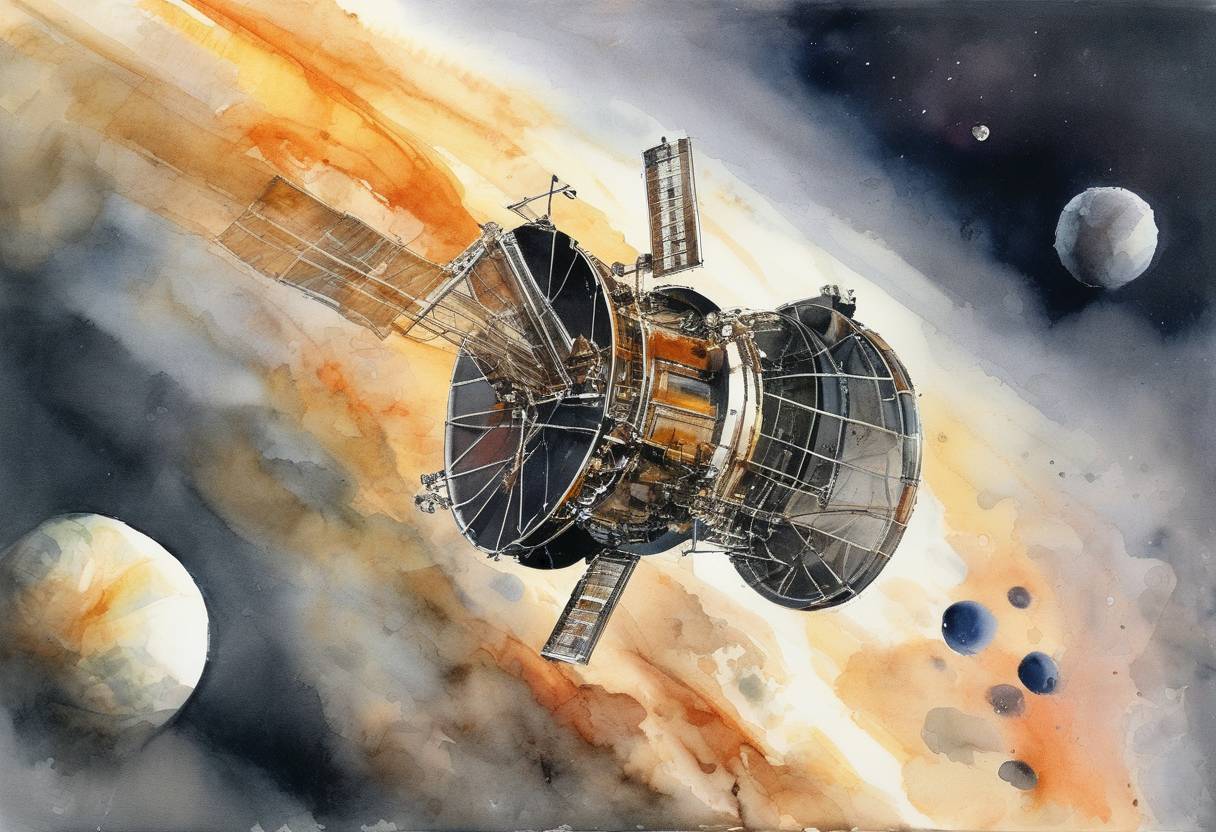
Pioneer 10 Launch: March 2, 1972
On March 2, 1972, NASA launched the Pioneer 10 spacecraft from Cape Canaveral, Florida, marking a significant milestone in space exploration. Pioneer 10 was the first spacecraft designed to travel through the asteroid belt and conduct a flyby of Jupiter, providing humanity with unprecedented data about the outer solar system.
Background and Objectives
Pioneer 10 was part of NASA’s Pioneer program, which aimed to explore the outer planets and the interstellar medium. The mission’s primary objectives included:
- Asteroid Belt Navigation: To become the first spacecraft to traverse the asteroid belt, a region filled with rocky debris between Mars and Jupiter, and assess the potential hazards for future missions.
- Jupiter Flyby: To conduct a close encounter with Jupiter, capturing detailed images and data about the planet’s atmosphere, magnetic field, and moons.
- Interstellar Exploration: To continue its journey beyond Jupiter, eventually leaving the solar system and entering interstellar space.
Key Events Leading Up to the Launch
- Design and Development: Pioneer 10 was developed by NASA’s Ames Research Center, with TRW Inc. as the primary contractor. The spacecraft was equipped with a suite of scientific instruments, including imaging systems, magnetometers, and radiation detectors.
- Launch Vehicle: The spacecraft was launched aboard an Atlas-Centaur rocket, a reliable launch vehicle that provided the necessary velocity to escape Earth’s gravitational pull and set Pioneer 10 on its trajectory toward Jupiter.
The Journey and Achievements
- Asteroid Belt Passage: Pioneer 10 successfully navigated the asteroid belt, a journey that lasted from July 1972 to February 1973. This achievement dispelled fears about the density of the asteroid belt and the potential for collisions.
- Jupiter Encounter: On December 3, 1973, Pioneer 10 made its closest approach to Jupiter, coming within 81,000 miles (130,000 kilometers) of the planet’s cloud tops. The spacecraft transmitted the first close-up images of Jupiter, revealing details about its Great Red Spot, cloud bands, and intense radiation belts.
- Scientific Contributions: The data collected by Pioneer 10 provided critical insights into Jupiter’s magnetosphere, atmosphere, and internal structure. It also helped refine our understanding of the solar system’s formation and dynamics.
Aftermath and Legacy
- Continued Mission: After its successful Jupiter flyby, Pioneer 10 continued its journey toward the outer reaches of the solar system. It became the first human-made object to cross the orbit of Neptune, the farthest planet from the Sun at the time, in June 1983.
- Communication and Final Contact: NASA maintained contact with Pioneer 10 until January 23, 2003, when the final weak signal was received. The spacecraft is now on a trajectory toward the star Aldebaran in the constellation Taurus, a journey that will take over two million years.
- Historical Significance: Pioneer 10 paved the way for subsequent missions to the outer planets, including the Voyager and Galileo missions. Its success demonstrated the feasibility of long-duration space exploration and expanded our understanding of the solar system.
Pioneer 10’s launch and mission remain a testament to human ingenuity and the quest for knowledge beyond our planet. Its achievements continue to inspire future generations of scientists and explorers.