The Nanking Massacre Begins: December 13, 1937
1937 · Nanjing, China
The Nanking Massacre begins as Japanese troops capture Nanjing, China.
July 7, 1937
The Marco Polo Bridge Incident occurs, marking the beginning of the Second Sino-Japanese War.
Beijing, China | Imperial Japanese Army
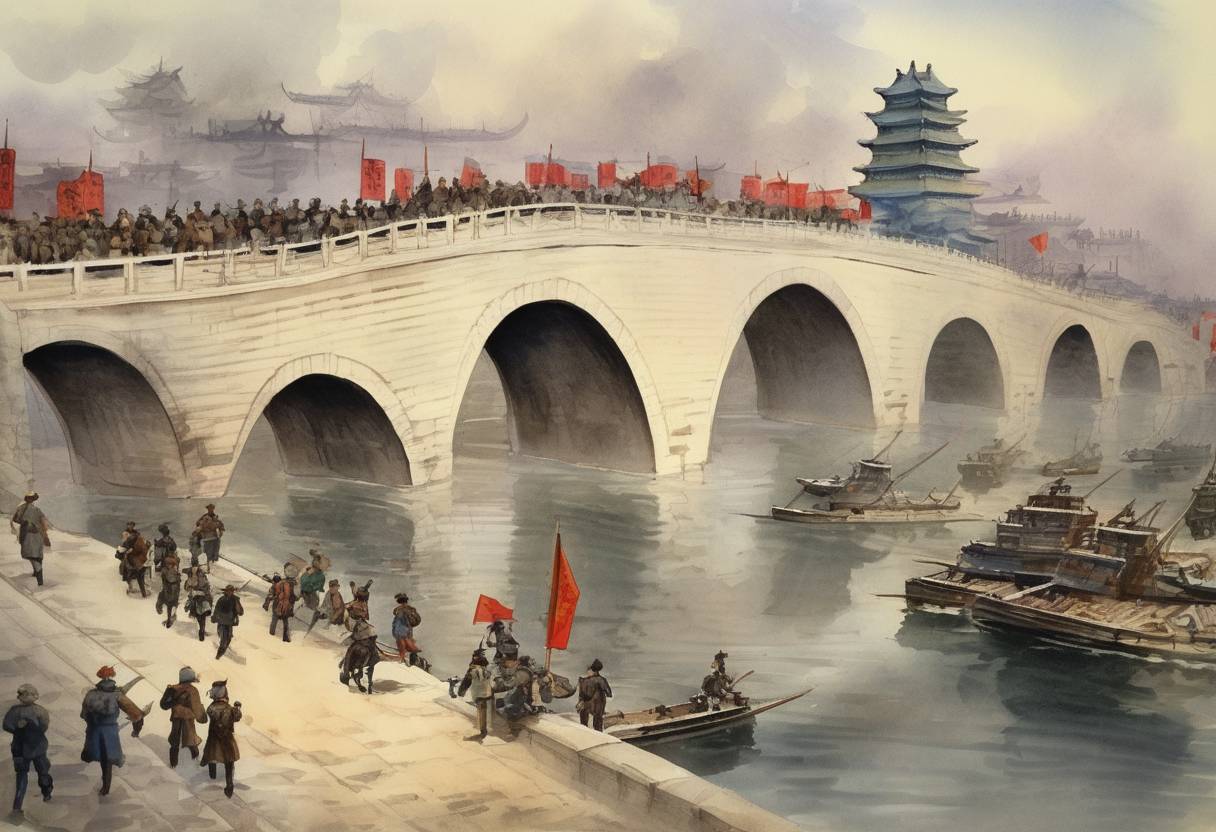
The Marco Polo Bridge Incident, which occurred on July 7, 1937, is widely regarded as the catalyst for the Second Sino-Japanese War. This conflict marked a significant escalation in hostilities between the Empire of Japan and the Republic of China, setting the stage for a prolonged and brutal war that would last until 1945.
In the early 20th century, Japan had been expanding its influence in East Asia, driven by its imperial ambitions. Following the Mukden Incident in 1931, Japan had already seized control of Manchuria, establishing the puppet state of Manchukuo. Tensions between Japan and China had been simmering due to Japan’s aggressive expansionist policies and its increasing military presence in northern China.
The Marco Polo Bridge, known as Lugou Bridge in Chinese, is located near the town of Wanping, just outside Beijing. On the night of July 7, 1937, Japanese troops stationed near the bridge conducted a routine military exercise. During these maneuvers, a Japanese soldier was reported missing, and the Japanese army demanded entry into the nearby town of Wanping to search for him.
The Chinese garrison stationed at Wanping refused the Japanese demand, leading to a standoff. Tensions quickly escalated, and by the early hours of July 8, both sides had exchanged gunfire. The situation deteriorated rapidly, with reinforcements being called in by both the Japanese and Chinese forces.
The Marco Polo Bridge Incident quickly spiraled into a full-scale conflict. Despite attempts at negotiation, neither side was willing to back down. The Japanese military used the incident as a pretext to launch a broader invasion of China, leading to the outbreak of the Second Sino-Japanese War.
The war would become one of the largest and most devastating conflicts of the 20th century, resulting in significant loss of life and widespread destruction. It also played a crucial role in the broader context of World War II, as it eventually merged into the larger global conflict following the attack on Pearl Harbor in 1941.
The Marco Polo Bridge Incident is significant for several reasons:
Escalation of Hostilities: It marked the transition from localized skirmishes to a full-scale war between Japan and China.
Impact on Chinese Society: The war had a profound impact on Chinese society, leading to immense suffering and displacement of millions of civilians.
International Reactions: The conflict drew international attention and condemnation, influencing global perceptions of Japanese aggression.
Prelude to World War II: The Second Sino-Japanese War is often seen as a precursor to the broader conflicts of World War II, highlighting the interconnectedness of global events during this period.
The Marco Polo Bridge Incident remains a pivotal moment in East Asian history, symbolizing the beginning of a long and arduous struggle for China and setting the stage for significant geopolitical changes in the region.
Source: en.wikipedia.org