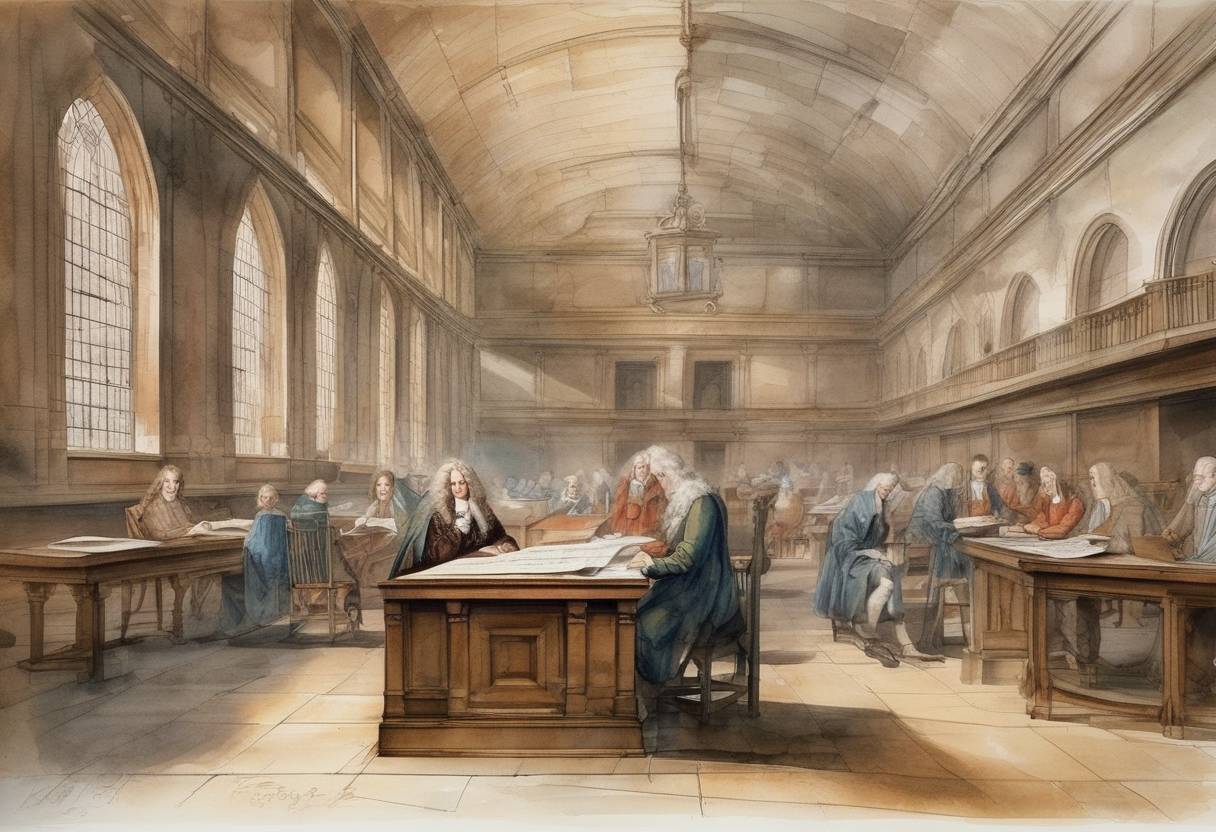
Isaac Newton’s Admission to Trinity College, Cambridge
On June 5, 1661, Isaac Newton was admitted to Trinity College, Cambridge, marking a pivotal moment in the history of science and mathematics. This event signified the beginning of Newton’s formal education in mathematics and physics, setting the stage for his groundbreaking contributions to these fields.
Context and Background
Early Life: Isaac Newton was born on January 4, 1643, in Woolsthorpe, Lincolnshire, England. He was raised by his maternal grandmother after his mother remarried. Newton’s early education took place at The King’s School in Grantham, where he showed an aptitude for mechanics and mathematics.
Pre-University Education: Before attending Cambridge, Newton was expected to manage the family farm, but his lack of interest in agriculture led his mother to send him back to school to prepare for university.
Admission to Trinity College
Trinity College, Cambridge: Founded in 1546 by King Henry VIII, Trinity College was one of the most prestigious colleges at Cambridge University. It was known for its rigorous academic environment and had produced many notable scholars.
Newton’s Enrollment: Newton enrolled as a subsizar, a student who received financial assistance in exchange for performing menial tasks. This status reflected his modest financial background.
Academic Pursuits and Influences
Curriculum: At the time of Newton’s admission, the curriculum at Cambridge was heavily influenced by Aristotelian philosophy. However, Newton’s interests soon shifted towards the new scientific ideas emerging from the works of René Descartes, Galileo Galilei, and Johannes Kepler.
Key Influences: Newton was particularly influenced by the works of mathematician Isaac Barrow and philosopher Henry More, who were faculty members at Cambridge. Barrow, in particular, recognized Newton’s potential and became a mentor to him.
Significance and Aftermath
Development of Theories: During his time at Cambridge, Newton began developing his theories on calculus, optics, and the laws of motion and gravitation. These ideas would later culminate in his seminal work, “Philosophiæ Naturalis Principia Mathematica” (Mathematical Principles of Natural Philosophy), published in 1687.
Impact on Science: Newton’s contributions laid the foundation for classical mechanics and significantly advanced the scientific revolution. His work in mathematics, particularly calculus, provided essential tools for future scientific inquiry.
Legacy: Newton’s admission to Trinity College was the starting point of a career that would transform the scientific landscape. His discoveries and theories continue to influence modern science and mathematics.
In summary, Isaac Newton’s admission to Trinity College, Cambridge, on June 5, 1661, was a crucial step in his journey to becoming one of the most influential scientists in history. His time at Cambridge allowed him to explore and develop ideas that would revolutionize our understanding of the natural world.