Inaugural 24 Hours of Le Mans - May 27, 1923
1923 · Le Mans, France
The 24 Hours of Le Mans, the world's oldest active sports car race in endurance racing, is held for the first time at Circuit de la Sarthe, Le Mans, France.
June 26, 1906
The first Grand Prix motor race was held in Le Mans, France.
Le Mans, France | Automobile Club de France
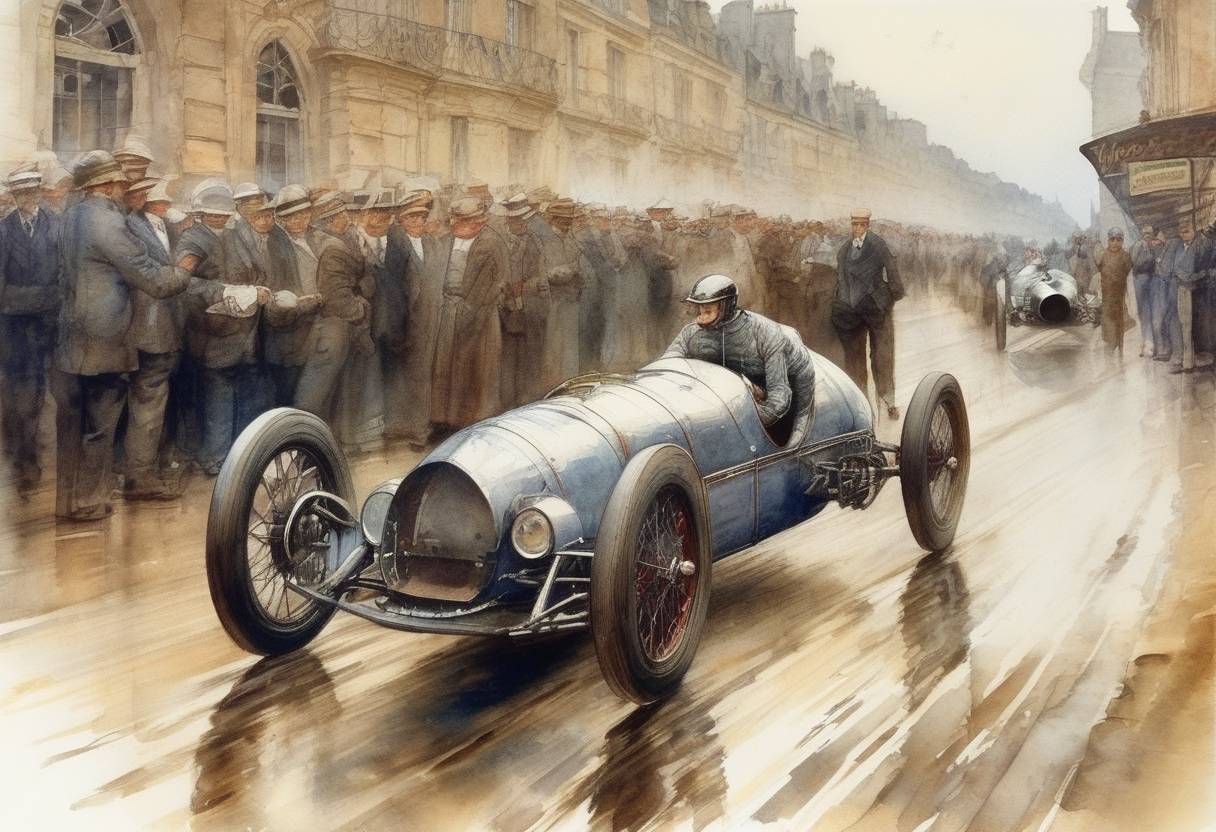
The first Grand Prix motor race, a landmark event in the history of automobile racing, took place on June 26 and 27, 1906, near Le Mans, France. This race marked the beginning of a new era in motorsport, setting the stage for the development of the Grand Prix racing tradition that continues to this day.
Early Automobile Racing: Prior to the 1906 Grand Prix, automobile races were primarily city-to-city events. These races were often long and perilous, with little regulation or standardization. The need for a more structured form of competition led to the creation of the Grand Prix.
Organizers: The race was organized by the Automobile Club de France (ACF), which sought to establish a prestigious event that would showcase the capabilities of both drivers and manufacturers.
Location: The race was held on a circuit near Le Mans, a city in northwestern France. The circuit was approximately 103 kilometers (about 64 miles) long, and competitors had to complete six laps each day, totaling 12 laps over two days.
Participants: The event attracted 32 entries from 12 different manufacturers, including Renault, Fiat, and Mercedes. This diversity highlighted the international interest in automobile racing.
Race Format: Unlike modern Grand Prix races, which are typically held on closed circuits, the 1906 race took place on public roads. The course featured a mix of straights and challenging turns, testing the endurance and skill of both drivers and their vehicles.
Winner: The race was won by Hungarian driver Ferenc Szisz, driving a Renault. Szisz completed the race in a total time of 12 hours, 14 minutes, and 7 seconds, with an average speed of approximately 101 kilometers per hour (about 63 mph).
Technological Innovations: The race was notable for several technological advancements. Renault’s victory was partly attributed to the use of detachable rims, which allowed for quicker tire changes—a significant advantage given the rough road conditions.
Impact on Motorsport: The success of the 1906 Grand Prix established the format as a premier event in the world of motorsport. It paved the way for future Grand Prix races and eventually the formation of the Formula One World Championship.
Cultural Influence: The race captured the public’s imagination and contributed to the growing popularity of automobile racing as a spectator sport. It also spurred technological innovation in the automotive industry, as manufacturers sought to improve their vehicles’ performance.
Legacy: The Grand Prix de l’Automobile Club de France is remembered as a pioneering event that laid the foundation for modern motor racing. It demonstrated the potential of automobiles and the excitement of competitive racing, influencing the development of motorsport for generations to come.
In summary, the first Grand Prix motor race in 1906 was a transformative event that not only showcased the capabilities of early automobiles but also set the stage for the evolution of competitive racing as a global phenomenon.
Source: en.wikipedia.org