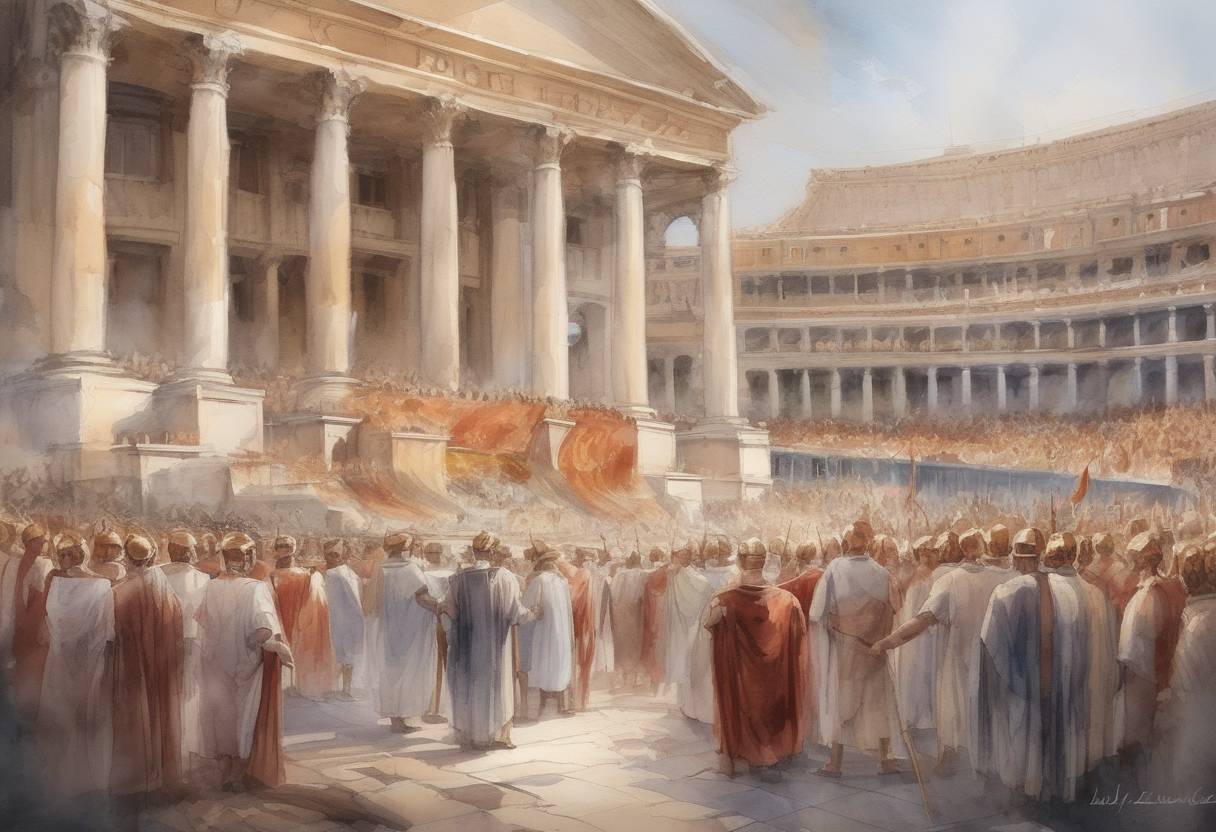
The Roman Senate Declares Galba as Emperor: January 5, 69 AD
On January 5, 69 AD, the Roman Senate declared Servius Sulpicius Galba as the emperor of Rome, an event that marked the beginning of a tumultuous period in Roman history known as the Year of the Four Emperors. This year was characterized by rapid changes in leadership and significant political instability.
Background
The death of Emperor Nero in June 68 AD left a power vacuum in the Roman Empire. Nero’s suicide was the culmination of a series of revolts and political machinations that had weakened his rule. In the aftermath, several claimants to the throne emerged, each backed by different factions within the Roman military and political elite.
Galba, a seasoned military commander and governor of Hispania Tarraconensis (modern-day Spain), was one of the first to challenge Nero’s rule. With the support of the legions in his province and the influential governor of Lusitania, Marcus Salvius Otho, Galba marched on Rome. Nero’s death paved the way for Galba’s recognition as emperor by the Senate.
Galba’s Ascension
Galba’s ascension to the throne was initially met with optimism. He was seen as a capable and experienced leader who could restore stability to the empire. However, his reign was short-lived and fraught with difficulties. Galba’s attempts to impose financial austerity and his failure to reward the Praetorian Guard, who played a crucial role in his rise, quickly eroded his support.
The Year of the Four Emperors
Galba’s rule lasted only a few months. His unpopularity and the dissatisfaction among the military led to his assassination on January 15, 69 AD, orchestrated by Otho, who then declared himself emperor. This event marked the beginning of a chaotic year in which four different emperors—Galba, Otho, Vitellius, and Vespasian—would claim the imperial throne.
- Otho: After Galba’s assassination, Otho assumed power but faced immediate challenges from Vitellius, who had been declared emperor by the legions in Germania.
- Vitellius: Otho’s forces were defeated by Vitellius’s troops, leading to Otho’s suicide in April 69 AD. Vitellius then took control of Rome.
- Vespasian: Meanwhile, Vespasian, a commander in the Eastern provinces, was proclaimed emperor by his troops. He eventually defeated Vitellius, entering Rome in December 69 AD, and establishing the Flavian dynasty.
Significance
The Year of the Four Emperors was a pivotal moment in Roman history, highlighting the fragility of imperial power and the critical role of the military in determining the succession of emperors. It underscored the need for strong leadership and set the stage for the rise of the Flavian dynasty under Vespasian, who would bring a measure of stability to the empire.
This period also demonstrated the Senate’s limited influence in imperial succession, as military support proved to be the decisive factor in determining the emperor. The events of 69 AD were a testament to the complex interplay of political, military, and social forces that shaped the Roman Empire during this era.