Capture of Fort Niagara - July 25, 1759
1759 · Youngstown, United States
British forces capture Fort Niagara during the French and Indian War, securing a critical position for control over North America.
July 3, 1754
The Battle of Fort Necessity took place, marking one of the first engagements of the French and Indian War.
Farmington, United States | British Army
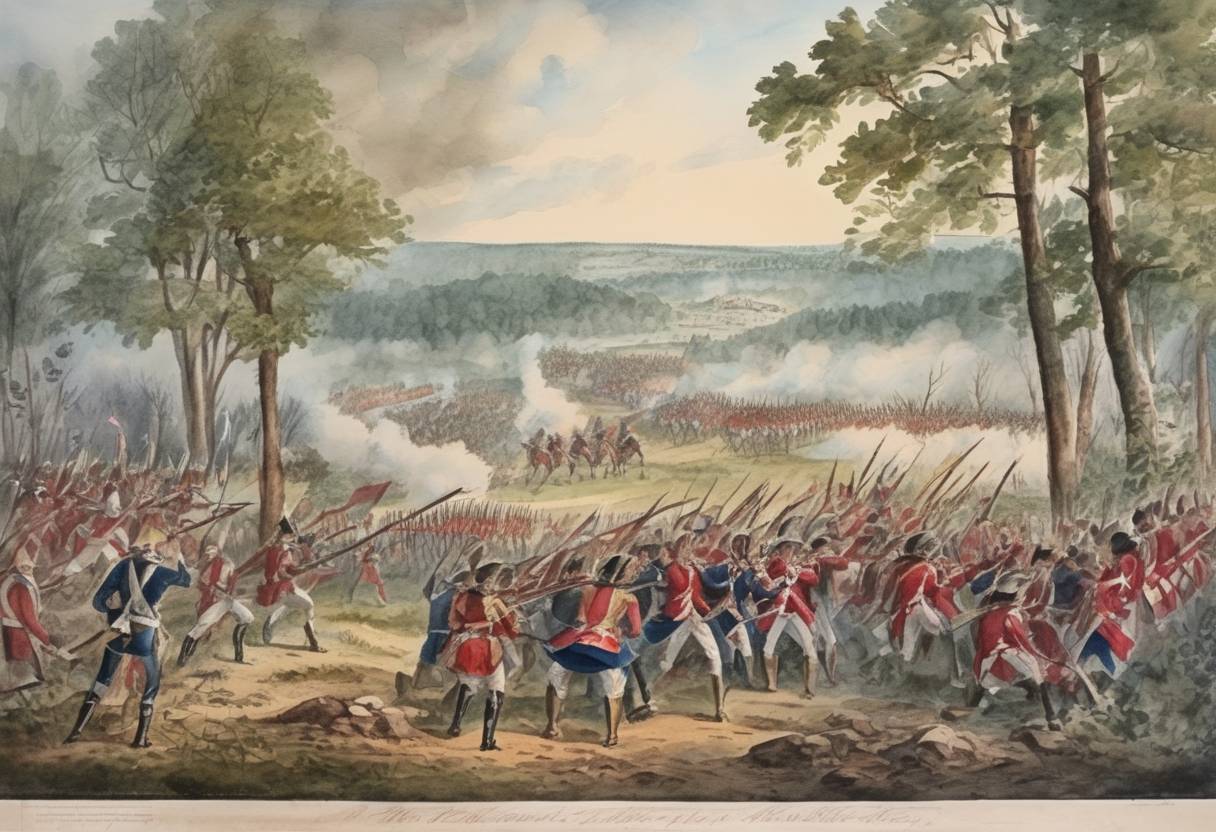
The Battle of Fort Necessity, which occurred on July 3, 1754, stands as one of the initial engagements of the French and Indian War, a conflict that was part of the larger Seven Years’ War. This battle marked a significant moment in the early military career of George Washington and set the stage for the broader conflict between British and French colonial interests in North America.
Colonial Tensions: By the mid-18th century, both Britain and France were vying for control over the Ohio Valley, a region rich in resources and strategic for trade and expansion. This competition led to increasing tensions and skirmishes between the two colonial powers and their respective Native American allies.
Washington’s Expedition: In late 1753, the Governor of Virginia, Robert Dinwiddie, dispatched a young George Washington to deliver a message to the French, demanding they vacate the Ohio Valley. The French refusal led to further military preparations by the British.
Jumonville Glen: On May 28, 1754, Washington, leading a small force, ambushed a French scouting party at Jumonville Glen, resulting in the death of the French commander, Ensign Joseph Coulon de Jumonville. This incident escalated tensions and prompted a French response.
Construction of Fort Necessity: Anticipating a French counterattack, Washington and his men hastily constructed a circular stockade, named Fort Necessity, in the Great Meadows of present-day Pennsylvania.
French Assault: On July 3, a French force led by Captain Louis Coulon de Villiers, Jumonville’s brother, attacked Fort Necessity. The French, along with their Native American allies, outnumbered Washington’s troops and had superior positioning in the surrounding woods.
Surrender: After a day of fighting in heavy rain, which rendered the fort’s defenses ineffective, Washington agreed to surrender. The terms allowed Washington and his men to return to Virginia, albeit with the condition that they would not build another fort in the Ohio Valley for a year.
Diplomatic Consequences: The battle and subsequent surrender highlighted the volatility of colonial claims in North America and contributed to the escalation of the French and Indian War.
Washington’s Reputation: Despite the defeat, Washington’s leadership during the engagement began to establish his reputation, which would grow significantly in the coming years.
Broader Conflict: The French and Indian War eventually expanded into the global conflict known as the Seven Years’ War, fundamentally altering the balance of power in North America and setting the stage for future American independence.
The Battle of Fort Necessity is a pivotal moment in early American history, illustrating the complex interplay of colonial ambitions, military strategy, and the personal trajectories of key historical figures like George Washington.
Source: en.wikipedia.org