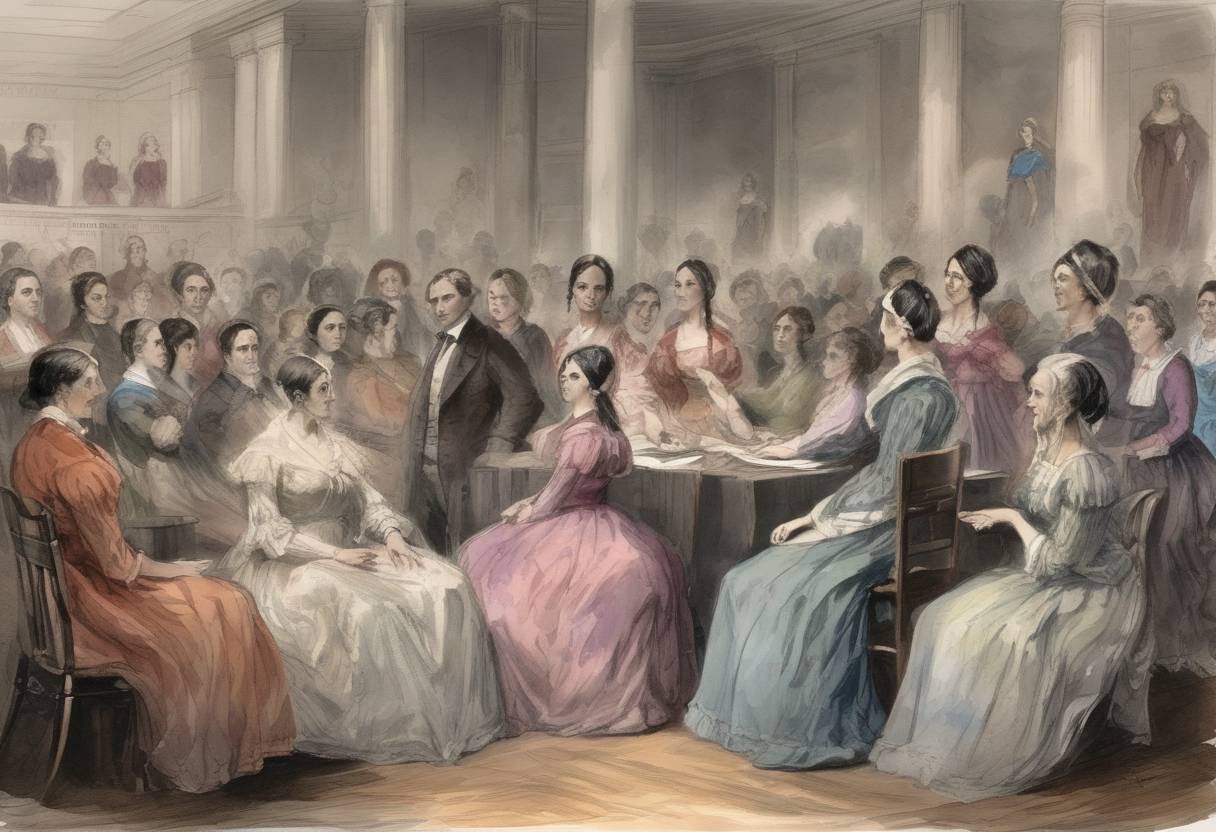
The Seneca Falls Convention: July 19, 1848
The Seneca Falls Convention, held on July 19-20, 1848, in Seneca Falls, New York, is widely regarded as the beginning of the organized women’s rights movement in the United States. This pivotal event was the first of its kind, focusing on the social, civil, and religious rights of women.
Background
The mid-19th century was a period of significant social reform in the United States, with movements such as abolitionism gaining momentum. Many women who were active in these reform movements began to recognize the parallels between their own lack of rights and the oppression faced by enslaved people. This realization led to a growing awareness and advocacy for women’s rights.
Key figures in the women’s rights movement, such as Elizabeth Cady Stanton and Lucretia Mott, were instrumental in organizing the Seneca Falls Convention. Stanton, in particular, was motivated by her experiences of gender discrimination, including being denied participation in the 1840 World Anti-Slavery Convention in London because of her gender.
The Convention
The Seneca Falls Convention was attended by approximately 300 people, including both women and men. Notable attendees included Frederick Douglass, a prominent abolitionist and advocate for equality.
The Declaration of Sentiments
One of the most significant outcomes of the convention was the adoption of the “Declaration of Sentiments,” a document primarily authored by Elizabeth Cady Stanton. Modeled after the Declaration of Independence, it outlined the grievances and demands of women, asserting their right to equality in all spheres of life. The document famously began with the assertion that “all men and women are created equal.”
The Declaration of Sentiments listed 18 grievances, including the lack of women’s suffrage, unequal educational opportunities, and the legal subjugation of women in marriage. It called for a range of rights, most controversially, the right to vote.
Resolutions
The convention passed 12 resolutions, 11 of which were unanimously approved. The resolution calling for women’s suffrage was the most contentious but ultimately passed with the support of Frederick Douglass, who argued passionately for its inclusion.
Aftermath and Significance
The Seneca Falls Convention marked the start of a sustained campaign for women’s rights in the United States. It inspired subsequent conventions and gatherings, such as the Rochester Women’s Rights Convention in 1848 and the National Women’s Rights Convention in 1850.
The convention also laid the groundwork for future advocacy, leading to significant milestones such as the eventual passage of the 19th Amendment in 1920, which granted women the right to vote.
The Seneca Falls Convention remains a symbol of the struggle for gender equality and a testament to the power of organized activism. Its legacy continues to inspire movements for women’s rights and social justice around the world.