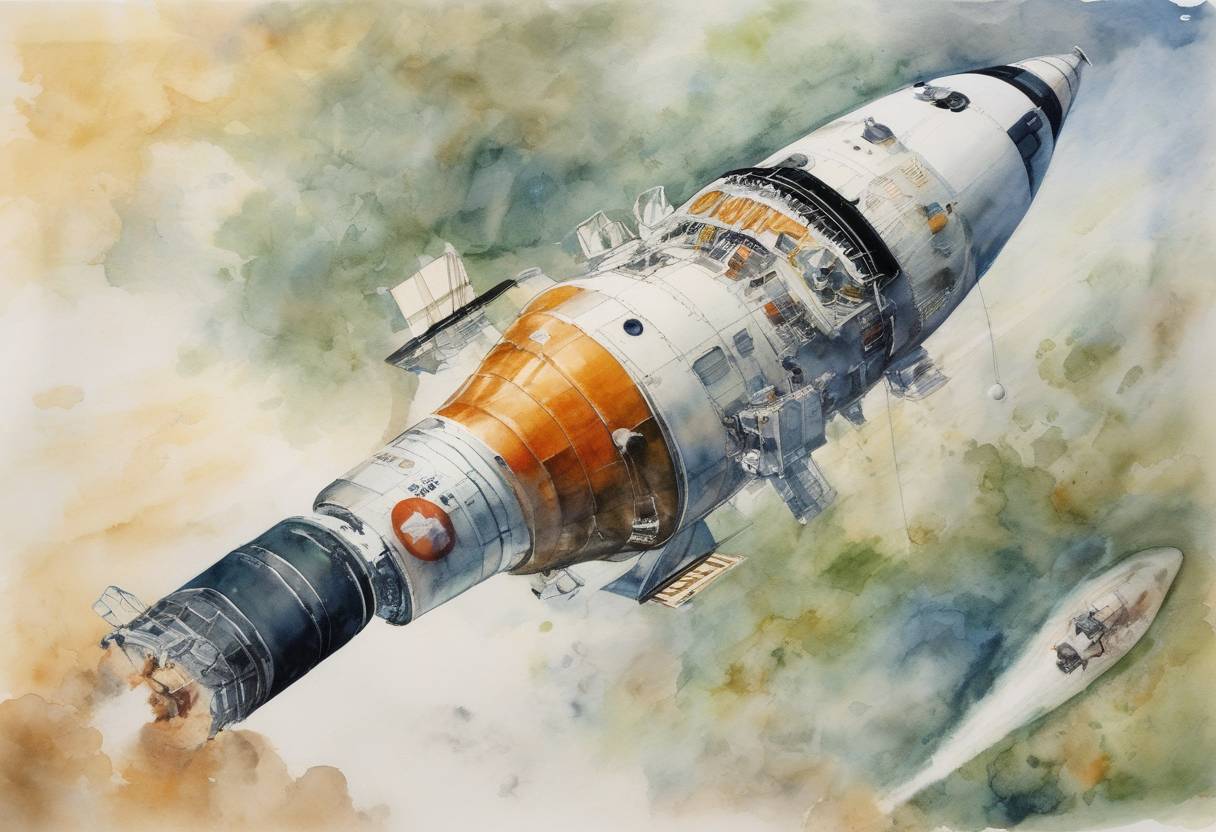
The Apollo-Soyuz Test Project: A Milestone in Space Cooperation
Overview
On July 17, 1975, the Apollo-Soyuz Test Project (ASTP) marked a historic moment in space exploration and international diplomacy. This mission was the first international human spaceflight, involving the United States and the Soviet Union, two superpowers engaged in the Cold War. The project symbolized a thaw in US-Soviet relations and demonstrated the potential for cooperation in space exploration.
Background
The Apollo-Soyuz Test Project was conceived during a period of détente, a relaxation of tensions between the US and the Soviet Union. The idea for a joint mission was proposed in the early 1970s as a means to improve bilateral relations and to ensure that spacecraft from different nations could dock in orbit, a crucial capability for future international space missions.
Key Events
Launch: The mission involved two separate launches. The American Apollo spacecraft was launched from Kennedy Space Center in Florida on July 15, 1975. The Soviet Soyuz spacecraft was launched from the Baikonur Cosmodrome in Kazakhstan on the same day.
Docking: On July 17, 1975, the two spacecraft successfully docked in orbit. This docking was a complex maneuver that required precise coordination and compatibility between the two different spacecraft systems.
Crew: The Apollo crew consisted of three astronauts: Thomas P. Stafford, Vance D. Brand, and Donald K. Slayton. The Soyuz crew included two cosmonauts: Alexei Leonov and Valeri Kubasov.
Joint Activities: During the mission, the crews conducted joint scientific experiments, exchanged gifts, and shared meals. The mission was broadcast live on television, showcasing the cooperation to audiences around the world.
Significance
Technological Achievement: The successful docking of the Apollo and Soyuz spacecraft demonstrated the feasibility of international collaboration in space technology, paving the way for future joint missions and the development of the International Space Station (ISS).
Diplomatic Impact: The mission served as a symbol of peace and cooperation during a period of geopolitical tension. It helped to ease Cold War hostilities and fostered a spirit of collaboration between the two nations.
Legacy: The Apollo-Soyuz Test Project laid the groundwork for future international partnerships in space exploration. It highlighted the potential for space to serve as a unifying force, transcending political and ideological differences.
Aftermath
Following the success of the Apollo-Soyuz Test Project, both the US and the Soviet Union continued to pursue cooperative efforts in space. The mission’s legacy is evident in the ongoing international collaborations that define modern space exploration, including the ISS, which involves multiple countries working together in space.
In conclusion, the Apollo-Soyuz Test Project was a landmark event that not only advanced space technology but also contributed to a more cooperative international atmosphere during the Cold War.