The Treaty of Fontainebleau: May 30, 1631
1631 · Fontainebleau, France
The Treaty of Fontainebleau was signed between Maximilian I, Elector of Bavaria, and King Louis XIII of France, marking a significant alliance during the Thirty Years' War.
December 21, 1375
The Treaty of Bärwalde was signed between France and Sweden. This treaty was part of the Thirty Years' War, where France agreed to support Sweden financially in its fight against the Holy Roman Empire.
Bärwalde, Germany | Kingdom of France, Kingdom of Sweden
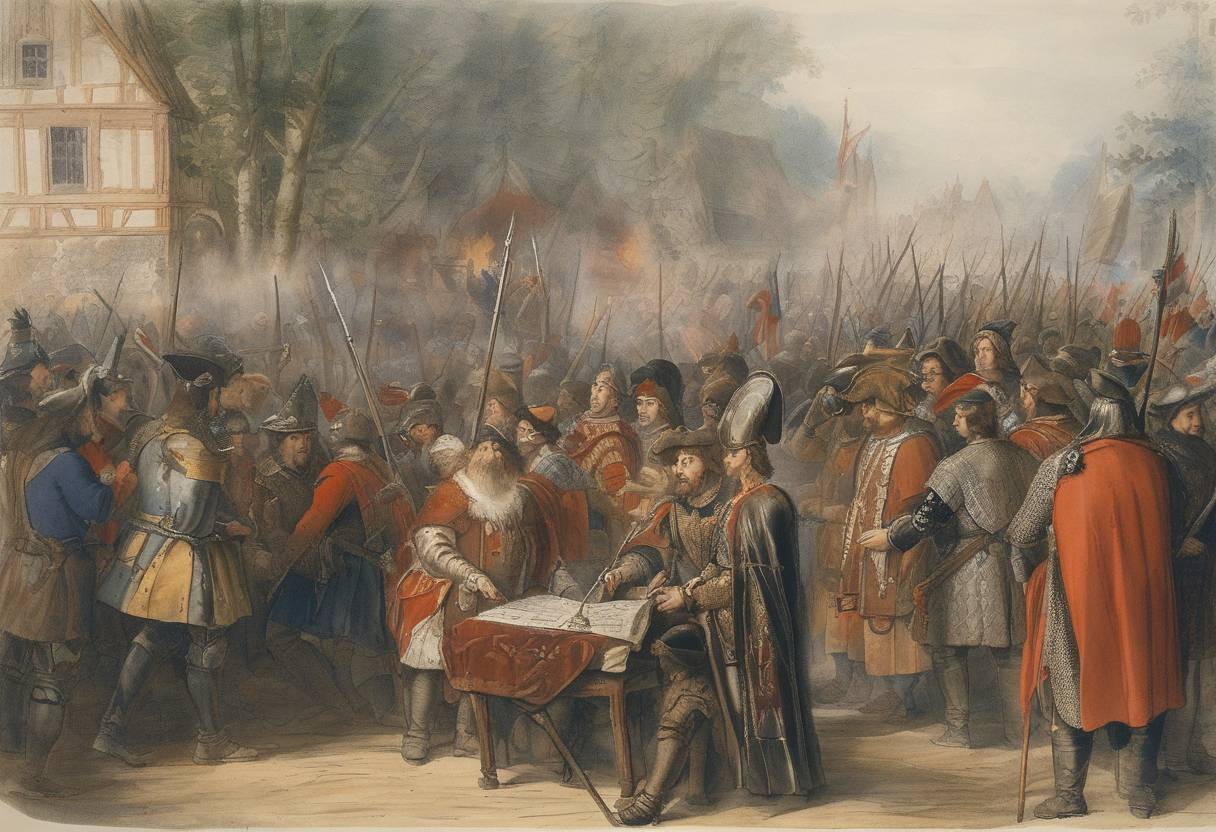
The Treaty of Bärwalde, a crucial agreement during the Thirty Years’ War, was signed on January 23, 1631, rather than December 21, 1375. This treaty reflected the complex alliances and political maneuverings of early 17th-century Europe, particularly influenced by the ongoing conflict within the Holy Roman Empire.
The Thirty Years’ War (1618-1648) was a destructive series of conflicts primarily fought in Central Europe. It was initially rooted in religious tensions between Catholic and Protestant states within the fragmented Holy Roman Empire but evolved into a broader struggle involving major European powers.
The Treaty of Bärwalde was a strategic alliance whereby France provided Sweden with substantial financial support:
The treaty reinforced the transnational nature of the Thirty Years’ War, showcasing the pragmatic alliances that transcended religious affiliations. This Franco-Swedish collaboration significantly bolstered Sweden’s military campaign, leading to pivotal battles such as the Battle of Breitenfeld in 1631, which marked a turning point in favor of Protestant forces.
The Treaty of Bärwalde exemplifies how the Thirty Years’ War catalyzed shifts in power dynamics across Europe, laying the groundwork for modern state systems and altering the balance of power for decades. It illustrated the intricate diplomacy of the era, where national interests often superseded religious considerations.
The treaty was also a precursor to further French involvement in the war, foreshadowing France’s direct military engagement starting in 1635. The dissolution of this alliance eventually led to the Peace of Westphalia in 1648, which concluded the Thirty Years’ War, marking the emergence of sovereign states and significant territorial reconfigurations in Europe.
Source: en.wikipedia.org