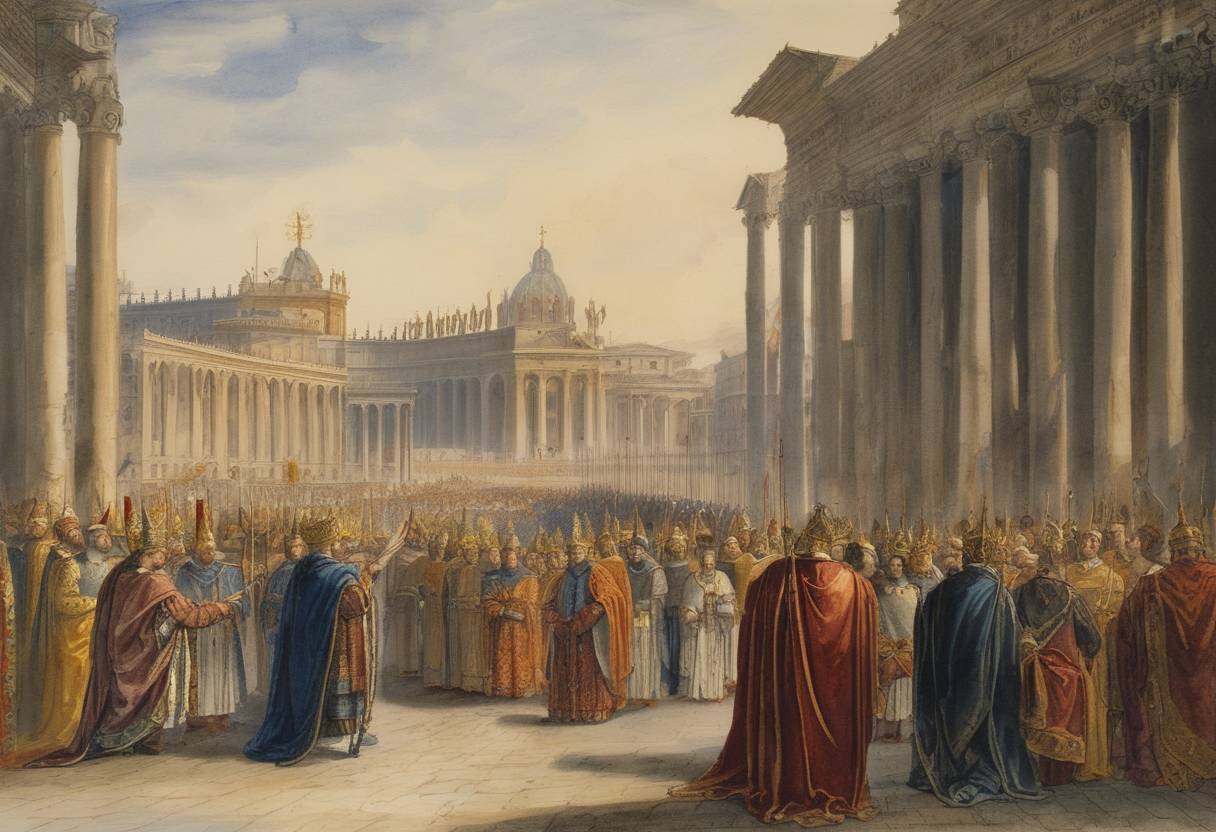
Henry III’s Coronation as Holy Roman Emperor
On October 5, 1046, Henry III was crowned Holy Roman Emperor by Pope Clement II, not October 7, 1044. This event was significant in the history of the Holy Roman Empire and marked the beginning of Henry III’s influential reign. His coronation, which took place in Rome, signified the height of cooperation between the secular and religious authorities of Europe during this period.
Context and Prelude
Henry III, a member of the Salian dynasty, became King of Germany in 1039 following the death of his father, Conrad II. His ascension to the title of Emperor was a culmination of efforts to consolidate power both within the German territories and over the broader Holy Roman Empire. By the time of his coronation, Henry had effectively subdued challenges to his authority within Germany and was already exerting influence over the papacy.
The Coronation
Pope Clement II, elected with the support of Henry, performed the coronation ceremony. This event was not merely a religious rite but also a political maneuver. It underscored Henry’s role as a protector and decisive force in the papal affairs, particularly during a time of great turmoil within the Church—termed the “saeculum obscurum” or the “dark age” of the papacy due to corruption and factionalism.
Reign and Church Relations
Henry III was known for his active involvement in Church matters, asserting his influence by appointing reform-minded clerics to the papacy. His reign saw him appoint a series of Popes: Clement II, Damasus II, Leo IX, Victor II, and finally Stephen IX. This initiative was part of his broader strategy to reinforce imperial authority and curb secular interference in ecclesiastical appointments. His patronage also tasked the Church with internal reforms to combat simony and clerical marriage, aligning with the ideals that would later be advanced during the Gregorian Reform.
Consequences and Significance
Henry III’s reign is often characterized by his support for reform in the Church, which played a crucial role in the subsequent strengthening of papal power in ecclesiastical matters. While his efforts increased the Emperor’s control over the papacy during his lifetime, they inadvertently set the stage for later conflicts between the papacy and the empire, particularly under his successors. Henry’s appointees as Popes were instrumental in initiating reforms that would have long-lasting impacts on the Church, paving the way for the Investiture Controversy that would define church-state relations in the following century.
The coronation of Henry III stands as a pivotal moment in medieval history, highlighting the complex interplay between imperial power and religious authority. His assertive policies helped shape the political landscape of Medieval Europe, reinforcing the notion of a divinely sanctioned monarchy. His attempts to centralize authority had lasting implications, influencing both European monarchies and the structure of the Catholic Church.
The cooperation between Henry III and the papacy heralded an era of relative stability and reform, albeit briefly interrupted by future conflicts that would arise from the very reforms he initiated.