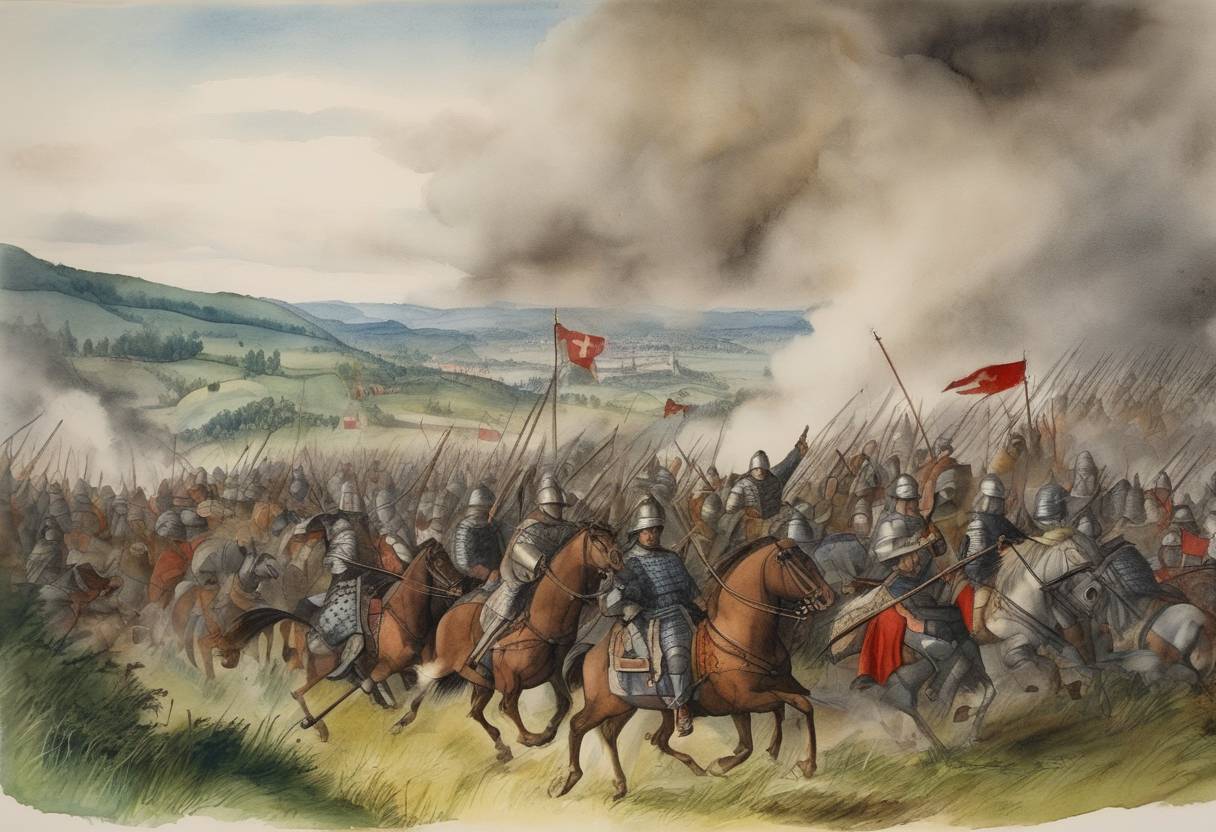
The Battle of St. Jakob an der Birs - August 26, 1444
On August 26, 1444, the Battle of St. Jakob an der Birs became a testament to the exceptional skill and determination of Swiss infantry forces. This conflict took place near Basel, Switzerland, during the Old Zürich War, a civil war among the cantons of the Old Swiss Confederacy. It notably galvanized the Swiss reputation for military prowess and heralded their tactical influence on future European warfare.
Context and Prelude
The battle occurred against the backdrop of a larger geopolitical struggle involving the expansionist policies of the Holy Roman Empire and its regional tensions. The Armagnac mercenaries, hired by the French Dauphin Louis XI, sought to enforce political agendas and subdue Swiss territories. This occurred amidst the Northern Italian Wars, implicating various powers across Europe.
The Battle
On the day of the encounter, an estimated 1,600 Swiss soldiers, primarily drawn from the canton of Bern and surrounding regions, met the advance of the vastly superior Armagnac forces. Reports suggest that the French army numbered between 20,000 and 30,000, signaling an overwhelmingly disproportionate clash.
The Swiss units, committed to their militias’ cause, occupied a defensive position at St. Jakob an der Birs, near the banks of the Birs River. They constructed makeshift fortifications and utilized the terrain to their advantage. This strategic positioning compensated for their smaller numbers against the French-allied Armagnacs.
Tactics and Execution
Swiss tactics during this battle emphasized the use of pike formations, a method that would gain renown for its effectiveness against cavalry. The disciplined and cohesive square formations allowed them to counter repeated assaults by the French heavy cavalry and infantry.
The Swiss soldiers, demonstrating exceptional bravery, held their ground despite severe casualties. Their tenacity forced the Armagnac forces into a costly engagement that dampened the French offensive.
Aftermath and Historical Impact
Although a tactical stalemate, the engagement at St. Jakob an der Birs effectively stalled the French incursion, achieving a strategic victory for Switzerland. The disproportionate losses inflicted on the Armagnacs forced them to rethink their campaigns, further enhancing the Swiss reputation for military endurance and effectiveness.
This battle significantly impacted the development of military tactics throughout Europe, showcasing the potential of well-trained infantry over traditional mounted knights. The Swiss mercenary forces became highly sought after in subsequent conflicts for their combat efficiency, profoundly influencing Renaissance military doctrines.
The valor displayed at St. Jakob an der Birs also contributed to a growing sense of Swiss national identity and unity, deeply ingrained in the collective memory of the Swiss Confederacy.