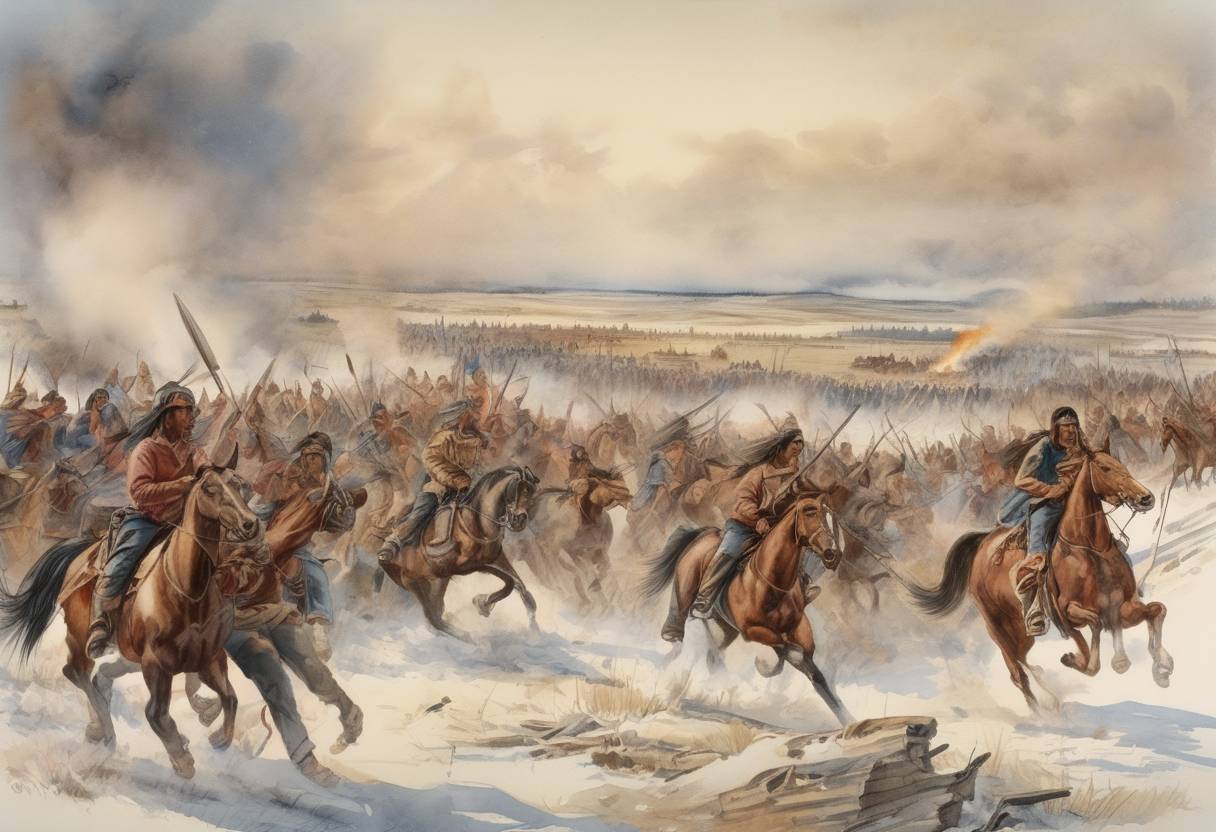
The Dakota War of 1862
Background
The Dakota War of 1862, also known as the Sioux Uprising, was a significant conflict between the United States and several bands of the eastern Dakota (also known as the Santee Sioux). The war erupted due to a combination of factors, including broken treaties, delayed annuity payments, and increasing encroachment on Dakota lands by European-American settlers. Tensions had been building for years as the Dakota faced starvation and hardship due to the loss of their traditional hunting grounds and the failure of the U.S. government to fulfill treaty obligations.
The Beginning of the Conflict
On August 17, 1862, the conflict began when a group of Dakota warriors attacked settlements in Minnesota. The immediate spark for the uprising was a confrontation at Acton Township, where four young Dakota men killed five settlers. This incident escalated rapidly as Dakota leaders, including Chief Little Crow, decided to take advantage of the situation and attempt to drive out the settlers.
Key Events
August 18, 1862: The Dakota launched a series of attacks on settlements and military installations, including the Lower Sioux Agency, Fort Ridgely, and the town of New Ulm. These attacks resulted in significant casualties and widespread panic among settlers.
August 19-23, 1862: The Battle of Fort Ridgely saw Dakota forces attempting to capture the fort, which was a strategic point for the U.S. military. Despite several assaults, the fort held out due to the efforts of its defenders.
August 23, 1862: The Battle of New Ulm involved a large-scale attack by Dakota warriors on the town. The settlers, led by Charles Eugene Flandrau, managed to repel the attackers after intense fighting.
September 2, 1862: The Battle of Birch Coulee was one of the hardest-fought engagements of the war, resulting in heavy casualties for the U.S. forces.
Aftermath
The conflict lasted for six weeks, ending with the surrender of many Dakota warriors. The U.S. military, led by Colonel Henry Sibley, conducted a series of retaliatory campaigns against the Dakota. In the aftermath, over 300 Dakota men were tried by a military commission and sentenced to death. President Abraham Lincoln intervened, reducing the number of executions to 38, which were carried out on December 26, 1862, in Mankato, Minnesota, marking the largest mass execution in U.S. history.
Consequences
The Dakota War of 1862 had profound consequences:
Displacement: The Dakota people were expelled from Minnesota, and their lands were confiscated by the U.S. government.
Legislation: The U.S. Congress annulled all treaties with the Dakota and removed them from their reservations.
Legacy: The conflict left a lasting impact on Minnesota and the Dakota people, shaping the region’s history and relations between Native Americans and settlers.
The Dakota War of 1862 remains a pivotal and tragic event in American history, highlighting the complex and often violent interactions between Native American tribes and the expanding United States during the 19th century.