The Ford Motor Company's Revolutionary Labor Policy: January 5, 1914
1914 · Detroit, United States
The Ford Motor Company announces an eight-hour workday and a minimum daily wage of $5, significantly influencing labor standards in the United States.
December 1, 1913
The Ford Motor Company introduced the first moving assembly line, revolutionizing industrial manufacturing.
Highland Park, United States | Ford Motor Company
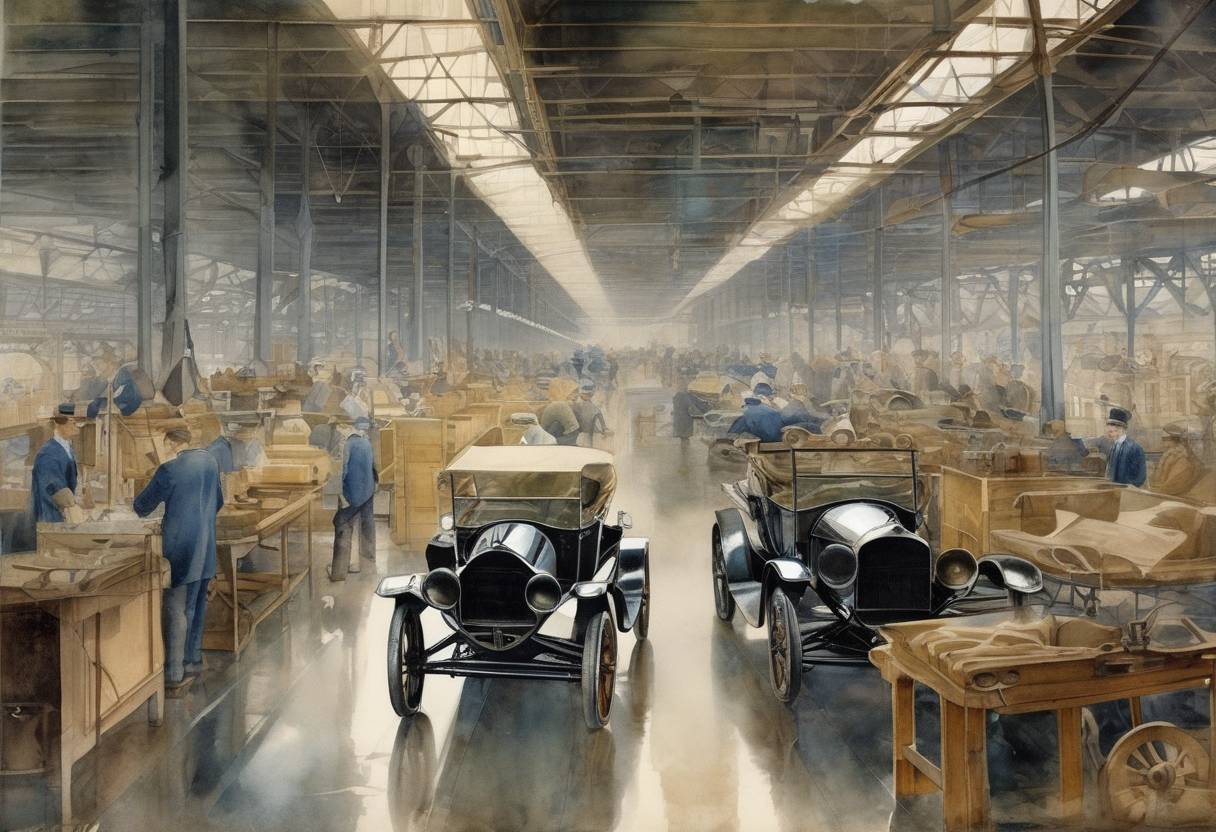
On December 1, 1913, the Ford Motor Company revolutionized industrial manufacturing by introducing the first moving assembly line at its Highland Park plant in Michigan. This innovation fundamentally transformed the production process, not only for the automotive industry but for manufacturing as a whole.
Before the introduction of the moving assembly line, automobiles were assembled by skilled workers who built each car from start to finish. This method was time-consuming and costly, making cars a luxury item affordable only to the wealthy. Henry Ford, the founder of Ford Motor Company, was determined to make automobiles accessible to the average American by reducing production costs and time.
Conceptualization: The idea of the assembly line was inspired by existing practices in other industries, such as meatpacking and watch manufacturing, where tasks were divided into smaller, repetitive steps.
Implementation: Ford’s team, including engineers like Charles E. Sorensen and William C. Klann, developed a system where the car chassis was pulled along a conveyor belt. Workers stationed along the line would perform specific tasks, adding parts to the car as it moved past them.
Efficiency Gains: The introduction of the moving assembly line drastically reduced the time it took to assemble a Model T from over 12 hours to just about 90 minutes. This efficiency allowed Ford to cut costs and lower the price of the Model T, making it affordable for the general public.
Economic Impact: The moving assembly line significantly reduced labor costs and increased production rates. By 1914, Ford was able to double workers’ wages to $5 a day, which was unheard of at the time, while still reducing the price of the Model T.
Cultural Shift: The affordability of the Model T democratized car ownership, transforming American society by increasing mobility and contributing to the growth of suburbs.
Industrial Influence: Ford’s assembly line model was quickly adopted by other industries, leading to mass production techniques that became the standard in manufacturing worldwide.
The success of the moving assembly line cemented Ford’s position as a leader in the automotive industry and set the stage for the mass production era of the 20th century. It also highlighted the potential for industrial innovation to drive economic and social change, influencing countless sectors beyond automotive manufacturing.
In conclusion, the introduction of the moving assembly line by Ford Motor Company on December 1, 1913, was a pivotal moment in industrial history, marking the beginning of modern manufacturing and significantly impacting society and the economy.
Source: en.wikipedia.org