Battle of Biesingen - September 29, 1758
1758 · Biesingen, Germany
During the Seven Years' War, the Battle of Biesingen took place, resulting in a Prussian victory over the French forces, enhancing the strategic power of Frederick the Great.
August 29, 1756
Frederick the Great of Prussia invaded Saxony, initiating the Seven Years' War, a global conflict that involved most of the great powers of the time.
Saxony, Germany | Prussian Army
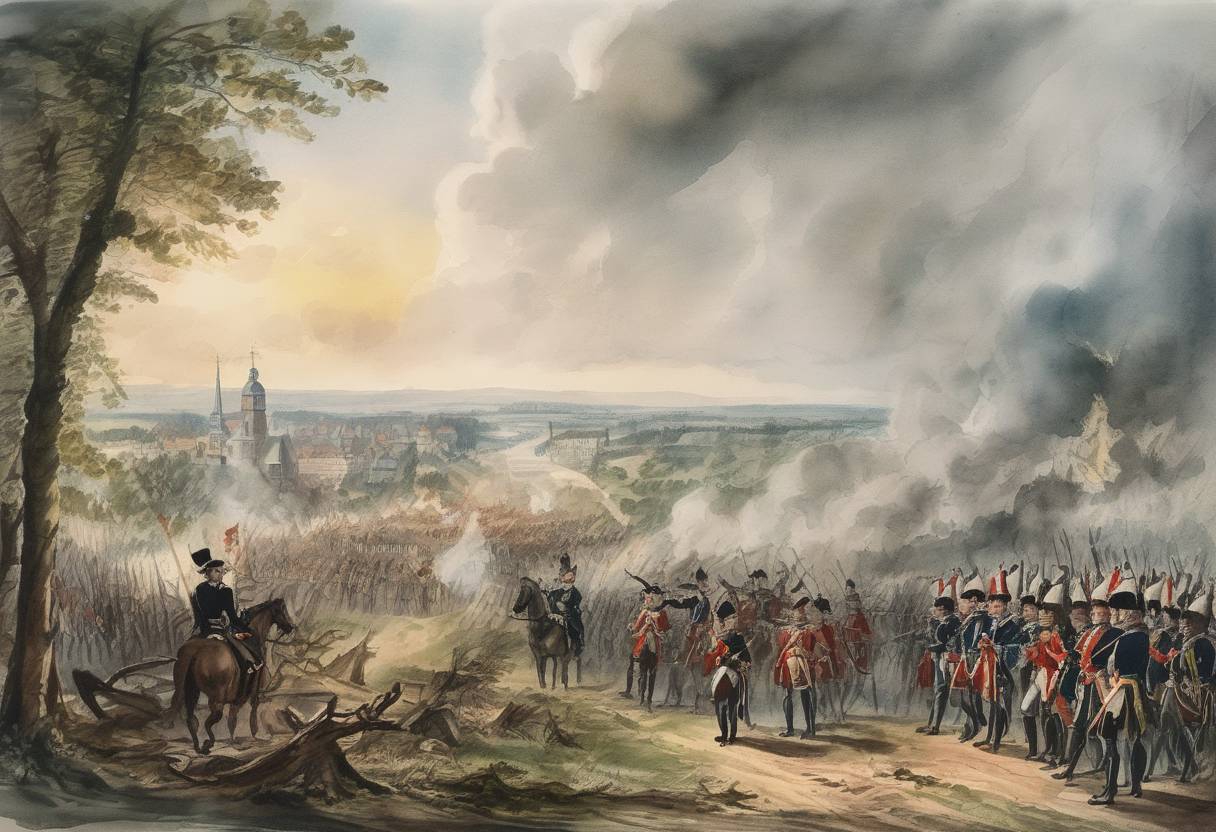
On August 29, 1756, Frederick II of Prussia, known as Frederick the Great, launched an invasion of Saxony, marking the beginning of the Seven Years’ War. This conflict would become a global struggle involving most of the great powers of the 18th century, with battles spanning Europe, North America, South America, Africa, and Asia.
The roots of the Seven Years’ War lay in the complex web of alliances and rivalries among European powers. The War of the Austrian Succession (1740-1748) had left unresolved tensions, particularly between Prussia and Austria. Frederick the Great had seized the resource-rich region of Silesia from Austria during that conflict, and Austria, under Empress Maria Theresa, sought to reclaim it.
The Diplomatic Revolution of 1756 saw a significant realignment of alliances. Traditionally, Austria had been allied with Britain, and France with Prussia. However, Austria and France formed a new alliance, while Britain allied with Prussia. This shift set the stage for renewed hostilities.
Frederick the Great, anticipating a coalition against him, decided to strike preemptively. On August 29, 1756, he invaded Saxony, a strategically located and relatively weak neighbor. Saxony was allied with Austria, and its occupation would provide Frederick with a buffer zone and additional resources.
The invasion was swift and decisive. Prussian forces quickly overran Saxony, capturing its capital, Dresden, and forcing the Saxon army to surrender. Frederick’s actions were justified by his claim that Saxony was plotting against Prussia, though this was largely a pretext for his aggressive expansionism.
The invasion of Saxony triggered a wider war. Austria, determined to regain Silesia, mobilized against Prussia. France, Russia, Sweden, and several smaller German states joined the anti-Prussian coalition. Meanwhile, Britain, concerned with maintaining its colonial interests and countering French influence, supported Prussia.
The Seven Years’ War would see major battles such as the Battle of Rossbach and the Battle of Leuthen, where Frederick demonstrated his military genius. However, the war was not confined to Europe. In North America, it was known as the French and Indian War, with British and French colonial forces clashing over territory. In India, the conflict manifested as part of the struggle for dominance between the British and French East India Companies.
The Seven Years’ War concluded with the Treaty of Paris in 1763. Prussia emerged as a major European power, having successfully defended its territories. Britain gained significant colonial territories, including Canada and Florida, solidifying its position as a global maritime power. France, on the other hand, suffered territorial losses and financial strain, setting the stage for future internal unrest.
The war significantly altered the balance of power in Europe and had lasting impacts on colonial empires, laying the groundwork for future conflicts, including the American Revolution.
Frederick the Great’s invasion of Saxony on August 29, 1756, thus marked the beginning of a pivotal conflict in world history, reshaping nations and empires across the globe.
Source: www.britannica.com