Earthquake Devastates Beijing on November 30, 1731
1731 · Beijing, China
An earthquake ravages parts of Beijing, causing significant destruction.
January 23, 1556
The Shaanxi earthquake, the deadliest earthquake on record, strikes Shaanxi province in China, resulting in an estimated 830,000 deaths.
Huaxian, China | Ming Dynasty
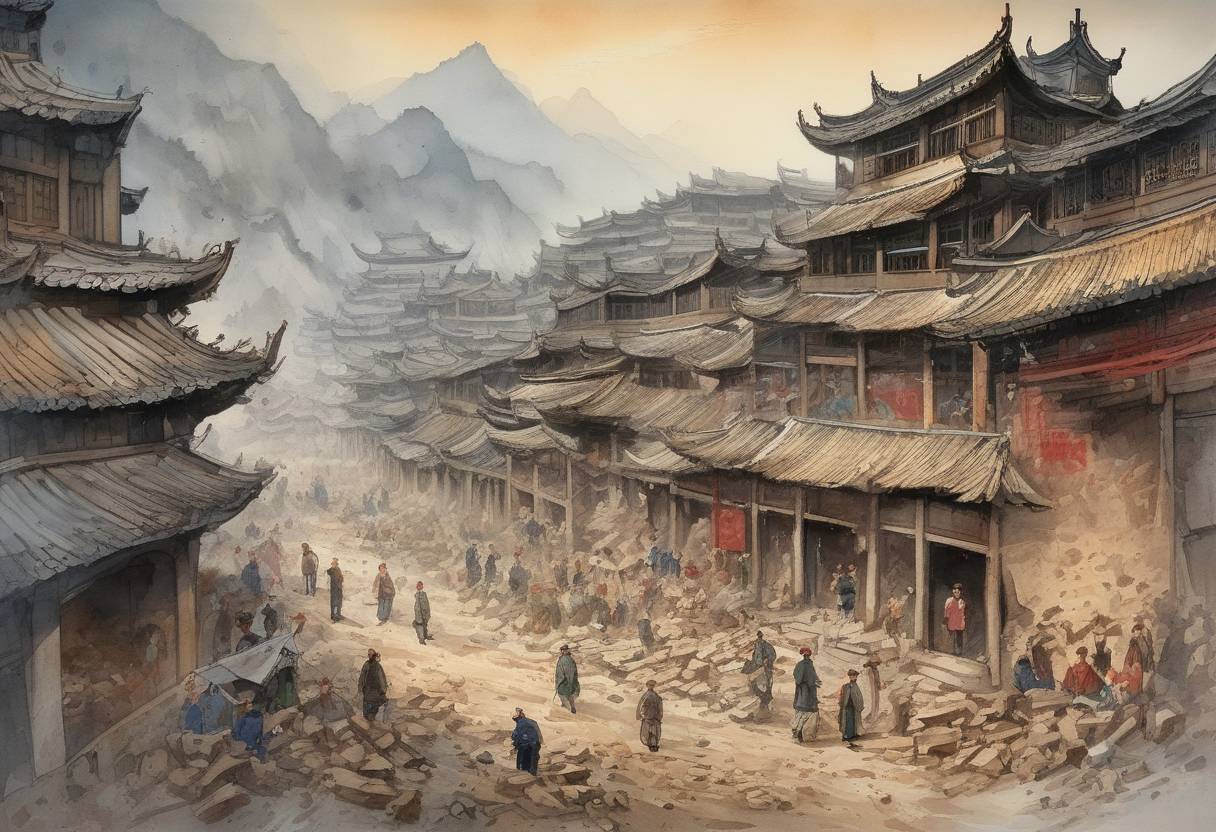
On January 23, 1556, the deadliest earthquake in recorded history struck the Shaanxi province of China. Known as the Jiajing Earthquake, named after the reigning Emperor Jiajing of the Ming dynasty, this catastrophic event resulted in an estimated 830,000 deaths, making it the most lethal earthquake ever documented.
Geographical Setting: The earthquake primarily affected the Wei River Valley in Shaanxi province, a region characterized by its loess soil, which is highly susceptible to erosion and landslides. This type of soil contributed significantly to the devastation, as it easily collapsed during the seismic activity.
Historical Setting: During the mid-16th century, China was under the rule of the Ming dynasty, a period marked by significant cultural and economic development. However, the infrastructure of the time was not equipped to withstand such a natural disaster.
Magnitude and Impact: Although modern instruments were not available to measure the earthquake’s magnitude, it is estimated to have been around 8.0 on the Richter scale. The tremors were felt over a vast area, affecting several provinces, including Shaanxi, Shanxi, Henan, Gansu, Hebei, Shandong, Hubei, Hunan, Jiangsu, and Anhui.
Destruction: The earthquake caused widespread destruction, with entire villages and towns being obliterated. The loess caves, which were common dwellings in the region, collapsed, leading to a high death toll. The landscape was dramatically altered, with landslides and ground fissures contributing to the devastation.
Human Toll: The estimated death toll of 830,000 makes it the deadliest earthquake in history. The massive loss of life was compounded by the destruction of homes and infrastructure, leading to a humanitarian crisis.
Economic and Social Impact: The earthquake severely disrupted the local economy, as agricultural lands were destroyed and trade routes were affected. The social fabric of the region was also impacted, with many communities losing a significant portion of their population.
Historical Significance: The Shaanxi earthquake remains a poignant reminder of the vulnerability of human settlements to natural disasters. It has been studied extensively to understand the impact of seismic activity on densely populated areas and the importance of earthquake-resistant construction.
Ming Dynasty Resilience: Despite the devastation, the Ming dynasty continued to thrive in the following decades, demonstrating resilience and adaptability in the face of natural calamities.
Legacy: The earthquake has been documented in various historical records, including official Ming dynasty annals and local gazetteers, providing valuable insights into the disaster’s impact and the response of the time.
In conclusion, the Shaanxi earthquake of 1556 stands as a significant event in world history, highlighting the catastrophic potential of natural disasters and the enduring human spirit in overcoming such challenges.
Source: en.wikipedia.org