The Completion of the Black Maria: February 1, 1893
1893 · West Orange, United States
Thomas Edison completes the world's first movie studio, the Black Maria, in West Orange, New Jersey.
August 24, 1891
Thomas Edison patents the motion picture camera, a significant development in the history of film and entertainment.
West Orange, United States | Edison Manufacturing Company
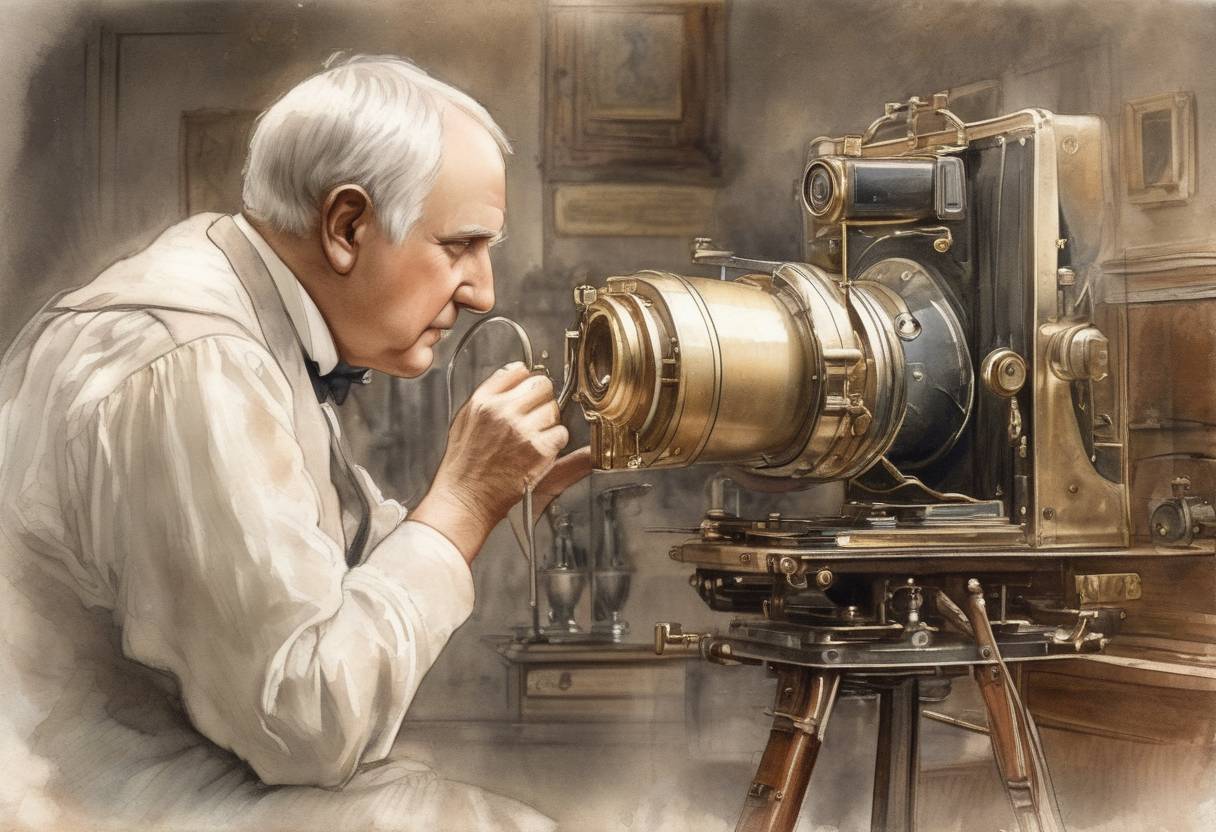
On August 24, 1891, Thomas Edison was granted a patent for the motion picture camera, a pivotal moment in the history of film and entertainment. This invention laid the groundwork for the development of the film industry and transformed the way people consumed visual media.
Thomas Edison, an American inventor and businessman, was already renowned for his work on the phonograph and the electric light bulb. In the late 1880s, Edison turned his attention to the possibility of creating moving pictures. His vision was to develop a device that could do for the eye what the phonograph did for the ear.
Edison’s motion picture camera, known as the Kinetograph, was developed in collaboration with his assistant, William Kennedy Laurie Dickson. The Kinetograph was a revolutionary device that used a strip of film to capture a series of photographs in rapid succession, creating the illusion of motion when played back.
Technical Aspects: The Kinetograph used celluloid film, which was a significant advancement over earlier attempts that used glass plates. The film was perforated along the edges to allow for precise movement through the camera, a technique that became standard in the industry.
Kinetoscope: Alongside the Kinetograph, Edison and his team developed the Kinetoscope, a viewing device that allowed individuals to watch the films created by the camera. The Kinetoscope was a single-viewer device, where the film was looped continuously for individual viewing.
Edison’s patent for the motion picture camera marked the beginning of the commercial motion picture industry. Although Edison’s initial focus was on individual viewing experiences, his work paved the way for the development of projection systems that allowed films to be shown to larger audiences.
Cultural Impact: The invention of the motion picture camera revolutionized entertainment, leading to the creation of a new art form and industry. It enabled storytelling through moving images, influencing culture and society profoundly.
Industry Development: Edison’s work inspired other inventors and filmmakers, leading to rapid advancements in film technology and the establishment of film studios. The motion picture industry grew rapidly in the early 20th century, becoming a dominant form of entertainment worldwide.
Edison’s contributions to the motion picture industry were foundational, but he faced competition from other inventors and filmmakers who further advanced the technology. The Lumière brothers in France, for example, developed the Cinématographe, which allowed for the projection of films to larger audiences, accelerating the transition from individual to communal viewing experiences.
In summary, Thomas Edison’s patent of the motion picture camera on August 24, 1891, was a landmark event that catalyzed the evolution of film and entertainment. His innovations set the stage for the dynamic and influential film industry that continues to captivate audiences around the world today.
Source: en.wikipedia.org