The Second Mongol Invasion of Japan and the Kamikaze
1281 · Hakata Bay, Japan
The second Mongol invasion of Japan ends with the destruction of the Mongol fleet by a typhoon, known as the kamikaze or 'divine wind,' helping repel the invasion forces.
December 18, 1271
Kublai Khan renames his empire 'Yuan', marking the beginning of the Yuan Dynasty in China.
Beijing, China | Yuan Dynasty
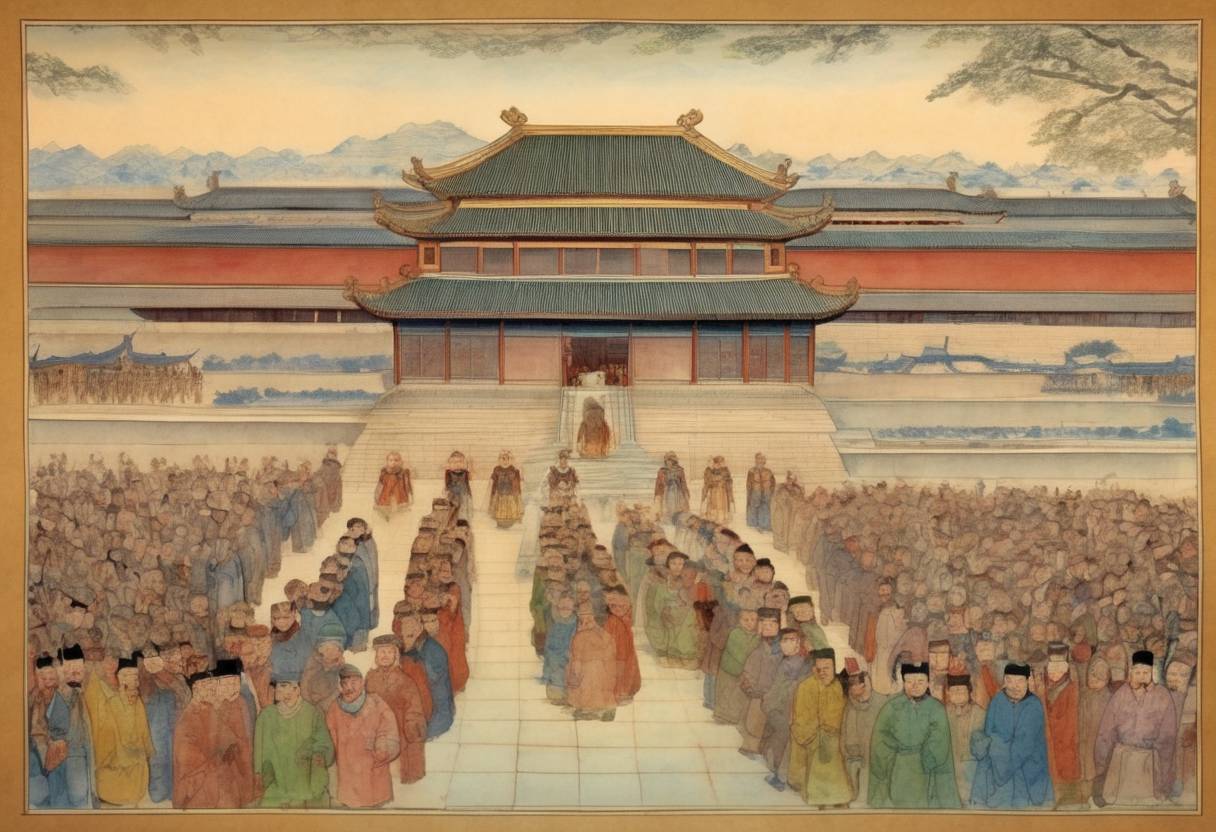
On December 18, 1271, Kublai Khan, the fifth Great Khan of the Mongol Empire, declared the establishment of the Yuan Dynasty in China, marking a significant moment in Chinese and Mongolian history. This event not only signified the beginning of a new era in China but also represented the culmination of the Mongol Empire’s expansion into East Asia.
Kublai Khan, a grandson of Genghis Khan, was a pivotal figure in the Mongol Empire’s history. After a series of internal conflicts and power struggles following the death of his brother Möngke Khan, Kublai emerged as the Great Khan in 1260. However, his authority was initially contested by his brother Ariq Böke, leading to a civil war that Kublai eventually won.
Kublai Khan’s interest in China was profound, and he sought to consolidate Mongol rule over the region. By 1271, he had already established control over much of northern China and was determined to unify the country under his rule. His decision to adopt a Chinese dynastic name was a strategic move to legitimize his reign and appeal to the Chinese populace.
On December 18, 1271, Kublai Khan officially proclaimed the establishment of the Yuan Dynasty, choosing the name “Yuan” (元), which means “origin” or “primal” in Chinese. This name was derived from the I Ching, an ancient Chinese text, symbolizing the beginning of a new era. By adopting a Chinese dynastic name, Kublai sought to integrate Mongol and Chinese traditions, presenting himself as a legitimate successor to the Chinese imperial legacy.
The establishment of the Yuan Dynasty had several significant implications:
Cultural Integration: Kublai Khan’s reign marked a period of cultural exchange between the Mongols and the Chinese. He adopted many aspects of Chinese governance, culture, and administration, which helped stabilize his rule and win the support of the Chinese elite.
Economic and Political Reforms: Kublai implemented various reforms to improve the economy and administration of his empire. He promoted trade, improved infrastructure, and established a more centralized bureaucratic system.
Expansion and Influence: Under Kublai’s leadership, the Yuan Dynasty expanded its influence across Asia. The dynasty’s reach extended into Korea, Southeast Asia, and parts of the Middle East, facilitating a period of increased trade and cultural exchange along the Silk Road.
Legacy: The Yuan Dynasty, despite its relatively short duration (1271–1368), left a lasting impact on China. It paved the way for future interactions between nomadic and sedentary cultures and set the stage for the Ming Dynasty that followed.
The proclamation of the Yuan Dynasty by Kublai Khan on December 18, 1271, was a pivotal moment in history. It marked the Mongol Empire’s transformation into a Chinese imperial dynasty and laid the foundation for a unique period of cultural and political synthesis. The Yuan Dynasty’s legacy continues to be felt in the historical narratives of both China and Mongolia.
Source: en.wikipedia.org